The incident report was printed on pale gray paper, stamped 11:42 a.m., and signed by three witnesses who had not been in the room.
At the bottom, beneath the words *Founder removed for threatening physical violence*, someone had added a handwritten note in blue ink:
Proceed with transfer before she contacts the bank.
I read that sentence twice.
Then I looked at the timestamp again.
The slap had happened at 10:18.
By 10:21, Grant Hale had told the board that I was unstable. By 10:37, the company’s attorneys had filed an emergency motion to suspend my voting rights. By 11:42, somebody had already printed the report that was supposed to prove they had acted responsibly.
That was when I understood the truth.
The slap had never been about anger. It had been about paperwork.
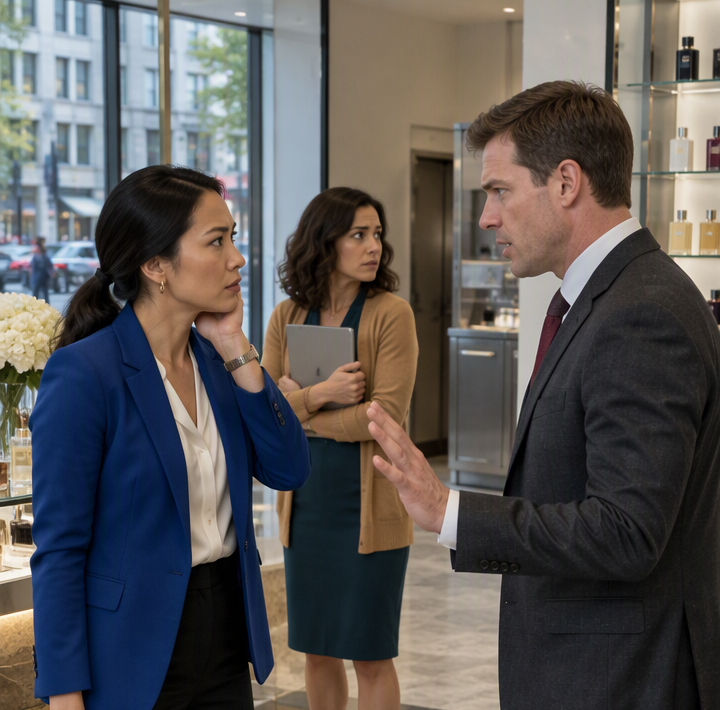
I was standing inside Aurelia House’s Manhattan flagship, surrounded by white marble, velvet chairs, and bottles of perfume that cost more than some people’s monthly rent. A customer near the fragrance display was crying quietly. One of the young sales associates had her hand over her mouth.
Grant stood three feet away, his palm still lifted from my face.
“She lost control,” he announced. “I was protecting the staff.”
My cheek throbbed. The room smelled of bergamot, rose, and fear.
I touched my skin, then looked past him at Lena Ortiz, the assistant manager who had worked beside me since our second store opened.
“Lena,” I said. “Did I threaten him?”
Her eyes moved toward the office hallway.
Grant noticed.
“Don’t drag her into your breakdown.”
That word—*breakdown*—was chosen carefully. It wasn’t an accusation. It was a diagnosis.
I had built Aurelia House from a folding table in a borrowed apartment and a skin-care formula mixed in a chipped saucepan. Twelve years later, we had boutiques across six countries, laboratories in New Jersey and Switzerland, and a valuation analysts whispered about on television.
But one word from Grant could turn me from founder into liability.
“I want the security footage,” I said.
Grant smiled. “The system has been offline all morning.”
I looked toward the security desk. The receptionist stared at the floor.
“Convenient.”
“You’re embarrassing yourself.”
“No,” I said. “You are.”
I opened the board portal on my phone. The emergency meeting notice was still there, scheduled for noon.
Agenda: Removal of Mara Voss as chief executive officer.
The stated reasons were “founder instability,” “operational risk,” and “reputational exposure.”
The notice had been sent at 8:07 that morning.
More than two hours before Grant slapped me.
I looked at him.
“You planned this.”
His expression hardened.
“You should go home,” he said.
“Why? So you can finish stealing my company without witnesses?”
A murmur passed through the store.
Grant stepped toward me, lowering his voice. “You don’t own what you think you own.”
That sentence frightened me more than the slap.
Because he didn’t sound like a man making a threat.
He sounded like a man delivering a fact.
I turned toward Lena.
“What’s in that office?”
She had gone pale. The tablet in her hands trembled.
For a moment, I thought she would answer.
Instead, she walked through the employee entrance and disappeared.
If Lena already knew what was inside, why did she leave before I could ask her?
I waited until Grant was distracted by the customers and slipped into the back corridor.
The office door was locked, but the keypad accepted my old code. Inside, the air smelled of dust and overheated electronics. Grant’s desk was covered in documents, but he had been careless. A black folder lay open beside his laptop.
The first page was a board resolution.
The second was a transfer agreement.
The third was a list of bank accounts.
I read the names.
Then I stopped breathing.
The controlling shares of Aurelia House had been transferred six months earlier.
Not to Grant.
Not to the board.
To an entity called The Voss Employee Trust.
I turned the page.
The trust had been created by me.
Or, more accurately, by someone using my electronic signature.
A red line had been drawn through my name on the final page. Beside it, in Grant’s handwriting, was a note:
She cannot be allowed to discover the second authorization.
A noise came from the adjoining storage room.
I grabbed the folder and pushed open the door.
Lena stood inside beside a metal cabinet. She had changed out of her black store uniform and was wearing a coat. A small travel bag rested at her feet.
“You’re leaving,” I said.
She swallowed. “You weren’t supposed to find that.”
“Did you create the trust?”
“No.”
“Did you sign the transfer?”
Her eyes filled with tears.
“Not exactly.”
I stepped closer. “What does that mean?”
She reached into her bag and pulled out a narrow wooden box.
I recognized it immediately.
It was the box I had kept in my apartment during Aurelia House’s first year. Inside had been the original formula, written in my mother’s handwriting, along with a silver locket and a photograph of a young woman standing beside me.
My sister, Eva.
Eva had died when I was nineteen.
That was what I had told everyone.
That was what I had believed.
Lena opened the box.
The photograph lay on top.
But there was something behind it I had never seen before: a folded birth certificate, yellowed at the edges.
I took it with numb fingers.
The name on the certificate was not Mara Voss.
It was Marina Vale.
I read the mother’s name.
Elena Vale.
My mother.
The father’s name was blank.
The child’s date of birth was twelve years before mine.
I stared at the paper until the letters blurred.
“That’s not possible,” I whispered.
Lena shook her head. “It is.”
“Who is Marina Vale?”
She looked at me with an expression I had seen only once before—on the face of a doctor delivering bad news.
“You are.”
The room tilted.
I laughed, but it came out thin and broken. “My name is Mara Voss.”
“That’s the name you were given after the fire.”
“What fire?”
Lena glanced at the closed door.
“Your mother changed your identity after Eva died.”
I gripped the edge of the cabinet.
“No. Eva was my older sister. She died in a car accident.”
“That is the story everyone was told.”
“Everyone?”
“Grant. The board. The attorneys. Me.”
“Why would my mother change my name?”
Lena’s answer was barely audible.
“Because you weren’t the sister who survived.”
A cold sensation moved through my body.
I looked again at the photograph.
Two girls stood in front of a brick house. One was eight or nine years old, wearing a yellow dress. The other was younger, maybe five, with dark curls and a missing front tooth.
I had always thought the older girl was me.
I had always assumed the younger girl was Eva.
But the older girl was wearing the silver locket.
The same locket that had been in my wooden box.
The same locket I had worn every day since I was nineteen.
My fingers began to shake.
“Which one am I?”
Lena pointed to the younger girl.
“You’re Eva.”
The world did not explode. There was no dramatic sound, no sudden collapse.
There was only the soft electrical hum of the office lights and the distant murmur of customers browsing expensive perfume.
I stared at the photograph.
The older girl—Marina—had my mother’s eyes.
The younger girl had mine.
“No,” I said.
Lena stepped closer. “Your mother believed Marina had died in the fire. She took you and disappeared. When you were old enough, she gave you Marina’s name, Marina’s documents, Marina’s education records.”
“Why?”
“Because Marina had created the original formula.”
I looked down at the document in my hand.
“The formula?”
“Your sister was a chemist. She developed the Aurelia compound with your mother. She also created the first patent application. But she was seventeen, and your mother was terrified that Marina’s biological father would find her.”
“My father?”
Lena nodded. “He was dangerous. He wanted control of the formula. He threatened to take Marina away.”
“Why didn’t my mother tell me?”
“Because she thought keeping you alive mattered more than telling you who you were.”
The room seemed to shrink around me.
I had spent twelve years believing Aurelia House began with me. I had told the story in interviews: the borrowed apartment, the folding table, the first cream stirred by hand.
It had always felt like memory.
But perhaps it was only inheritance.
Perhaps I had been living inside someone else’s life.
“Where is my mother?” I asked.
Lena’s gaze fell.
“She died three months ago.”
The pain came late, as if my body had been too overwhelmed to understand it.
My mother had died in a hospice facility in Connecticut. I had attended the funeral. I had stood beside her closed coffin while people told me she had been proud of the company.
She had never once told me I was Eva.
She had never once told me Marina existed.
“Why are you telling me this now?”
“Because she left instructions.”
Lena opened the wooden box and removed a second envelope.
It bore my mother’s handwriting.
For Eva, when Grant makes his move.
I stared at the words.
“Who is Grant?”
Lena’s face changed.
“Your father.”
For a few seconds I couldn’t understand the sentence.
Then I understood it too well.
Grant Hale had not been a regional manager who clawed his way into the company.
He had not discovered Aurelia House through ambition.
He had been there from the beginning.
He had funded the first laboratory through shell companies. He had sat on the board as an “independent investor.” He had controlled suppliers, attorneys, and patents.
And he was my father.
The man who had slapped me in front of a room full of witnesses.
The man who had spent years calling me unstable.
The man who had just tried to remove me from my own company.
I opened the letter.
My mother’s writing slanted across the page.
*Eva, if you are reading this, then Grant has learned the truth. He will try to take Aurelia because he believes it belongs to Marina. He knows nothing about you.*
*You were the one who completed the formula.*
*Marina began it. You finished it.*
*The company was built on both of your work, but only one of you survived.*
My eyes burned.
The formula had always responded to me. I had thought it was instinct. Talent. A strange inheritance of smell and texture.
But my mother had written that when I was five, I had watched Marina work and memorized every measurement. Years later, after the fire, I had reconstructed the compound from memory.
I hadn’t stolen my sister’s life.
I had carried it forward.
The letter continued.
*Grant believes the company is his because he paid for the first equipment. He does not know that I placed the controlling shares into an employee trust under your legal identity. You are the sole beneficiary. The trust cannot be dissolved by a board vote.*
I looked at the transfer agreement in my hand.
Grant had forged the first authorization—but not the second.
The employee trust was real.
It had been created by my mother and finalized six months earlier, shortly before her death. The board had discovered its existence and was trying to force me out before I could activate it.
Lena wiped her eyes.
“Your mother appointed me trustee.”
I looked at her. “You?”
“She wanted someone inside the company who Grant would underestimate.”
“You’ve been working for him.”
“I had to. He monitored every person near you.”
“Why did you leave the store?”
“Because I had to retrieve the original trust seal before he found it.”
She opened the wooden box further.
Beneath the letter was a small brass seal engraved with the Aurelia House emblem.
I felt my knees weaken.
“Then why didn’t you tell me before today?”
“Because your mother’s instructions were clear. You had to believe your life was ordinary until Grant revealed himself. If I told you too soon, he would have known.”
“He slapped me.”
“I know.”
“And you let it happen?”
“No.” Her voice cracked. “I didn’t know he would do that. I thought he would use the report and the board vote. I didn’t know he planned to create a criminal accusation.”
I turned toward the door.
“Where is he now?”
“At the board meeting.”
“Then let’s go.”
The boardroom occupied the top floor of Aurelia House’s headquarters. Its walls were glass, its table black walnut, and its windows overlooked Manhattan like the city belonged to whoever sat inside.
When I entered, Grant was speaking.
“Given Mara’s deteriorating mental state, we have no choice but to protect the company from further damage.”
Five directors sat around the table. Two lawyers stood near the screen. Behind them, a presentation displayed photographs of my face, each one cropped to make me appear exhausted or furious.
The board had been preparing my funeral while I was still alive.
Grant turned.
His eyes flicked to the folder in my hand.
Then to Lena.
For the first time that day, he looked afraid.
I walked to the head of the table.
“My name is not Mara Voss,” I said.
One of the directors frowned. “This is inappropriate.”
“My legal name is Eva Vale.”
Grant went still.
The screen behind him displayed the words FOUNDER INSTABILITY: EMERGENCY REMOVAL RECOMMENDATION.
I placed the birth certificate on the table.
Then the photograph.
Then my mother’s letter.
Lena connected her tablet to the screen.
A video appeared.
It showed my mother sitting in a hospital room, thin and pale, speaking directly into the camera.
“Grant,” she said, “if you’re watching this, you have tried to take Aurelia from my daughter.”
Grant’s face drained of color.
My mother continued.
“You have always believed Eva was weak because she was the child you abandoned. You believed Marina created everything and that the company should return to you when she died. You were wrong about both daughters.”
The room was silent.
“She was not Marina,” my mother said. “She was Eva. Marina died protecting her.”
I stopped breathing.
“What?” I whispered.
The video continued.
“Marina did not die in an accident. Grant found us. He set fire to the laboratory to destroy the formula and took Marina with him. She was seventeen. Eva survived because Marina hid her beneath the worktable.”
A director covered her mouth.
Grant shook his head. “This is fabricated.”
Lena played another file.
A scanned police report appeared on the screen. It contained a confession signed twenty-two years earlier by a man named Arthur Hale, Grant’s younger brother.
Arthur had admitted that Grant ordered him to destroy the laboratory. He had admitted that Marina had been alive after the fire.
And he had admitted that Grant had taken her.
My entire body turned cold.
“Where is she?” I asked.
Grant said nothing.
Lena reached for the final document.
A photograph appeared.
It showed a woman in a wheelchair, older now, with silver threaded through her dark hair.
She had my mother’s eyes.
She wore a yellow dress.
The photograph was dated three months earlier.
At the bottom was a name:
Marina Vale.
I stared at the screen.
My sister was alive.
The room dissolved into overlapping voices, but I heard only one sound: my own heartbeat.
Grant moved toward the door.
Two security officers entered before he reached it.
He looked at me then—not as a regional manager looking at a difficult founder, not as a board member facing a legal threat.
As a father looking at the daughter he had spent twenty-two years trying to erase.
“You don’t understand,” he said.
“I understand enough.”
“Marina was going to destroy everything.”
“You kidnapped her.”
“She was dangerous.”
“She was seventeen.”
“She had the formula.”
“And you wanted it.”
Grant’s expression twisted. “I built Aurelia.”
“No,” I said. “You built the cage around it.”
He lunged suddenly—not at me, but at the folder.
Lena stepped between us.
The security officers seized him, and one of the lawyers shouted that they were calling the police.
Grant struggled as they dragged him away.
“You have no idea what she’ll do!” he screamed.
I thought he meant Marina.
But Lena had gone white again.
I turned to her.
“What does he mean?”
She looked toward the screen.
The photograph of Marina remained frozen behind us.
“He wasn’t talking about Marina,” she said.
“Then who?”
Lena took out her phone and opened a message.
It had arrived ten minutes earlier from an unknown number.
Tell Eva the truth before she meets her sister.
Beneath the words was a photograph.
A woman sat in a wheelchair beside a window. Her face was older than the girl in the photograph, but unmistakable.
Marina.
On her lap rested a newborn baby.
I stared at the child.
The baby had my eyes.
Lena whispered, “Marina didn’t survive all these years alone.”
I could barely speak. “Who is the father?”
She looked at me.
“Grant.”
My stomach turned.
“No.”
“The baby was born seven months after the fire. Grant kept Marina hidden because she threatened to expose him. Your mother found her last year and brought her to a private clinic.”
“Why didn’t my mother tell me?”
“She wanted to protect you from the truth until Marina was strong enough to speak.”
I looked again at the photograph.
The baby’s tiny hand curled around Marina’s finger.
“Where are they now?”
Lena’s eyes filled with tears.
“Across the street.”
I ran.
I ran past the elevators, down the marble stairs, through the lobby, and out into Manhattan traffic. Horns blared. People shouted. Rain began to fall, darkening the pavement.
Across the street stood a small private medical building I had passed hundreds of times without noticing.
Lena caught up with me at the entrance.
The elevator carried us to the fourth floor.
A nurse opened the door to a quiet room.
Marina sat beside the window.
She was thinner than I expected, with a long scar crossing her jaw and another disappearing beneath her collar. But her eyes were mine.
Or perhaps mine were hers.
For a moment, neither of us moved.
Then she looked at the locket around my neck.
Her breath caught.
“You still have it,” she whispered.
I touched the silver pendant.
“You gave it to me?”
“I put it around your neck under the table.”
The memory came suddenly—not as a story, but as a sensation.
Smoke.
Heat.
A hand pressed against my mouth.
A girl’s voice saying, Don’t make a sound, Evie.
I began to cry.
“So you remember,” Marina said.
“I remember you.”
She reached for me.
I crossed the room and fell into her arms.
For the first time in twelve years, I was not the founder of Aurelia House. I was not a CEO, a daughter, a legal identity, or a woman whose face had been struck in public.
I was simply a little girl finding her sister again.
Behind us, Lena stood silently.
On the bed beside Marina lay the baby.
I moved closer.
The child opened her eyes.
They were the same impossible gray as mine.
“What’s her name?” I asked.
Marina smiled weakly.
“Hope.”
I looked at my sister, then at the child, then back toward the rain-streaked window.
Grant had tried to steal a company.
He had tried to erase two daughters.
He had mistaken silence for weakness and survival for surrender.
But the truth had been waiting inside Aurelia House all along—not in the marble, the patents, or the bank accounts.
It had been waiting in a forged signature, a hidden trust, a burned laboratory, and a sister who refused to die.
Weeks later, the board resigned. Grant was arrested for fraud, assault, kidnapping, and arson. The employee trust became the controlling authority of Aurelia House, exactly as my mother had intended.
I kept the company.
But I changed the name on the headquarters.
I replaced Mara Voss with Eva Vale.
And beneath it, in smaller letters, I added another name:
Marina Vale, Original Creator.
On the day the sign was unveiled, every employee gathered outside beneath a clear blue sky.
Marina watched from a wheelchair near the entrance, Hope sleeping against her chest.
I stood beside her and held her hand.
The city moved around us, loud and glittering and indifferent.
But when the applause began, Marina leaned toward me.
“Do you know what I remember most?” she asked.
“What?”
“The night of the fire.”
I waited.
“You were crying under the table,” she said. “I told you not to make a sound.”
A faint smile touched her lips.
“And you stopped.”
“Why?”
“Because I promised I would come back.”
Her fingers tightened around mine.
“You kept your promise,” I said.
“No,” Marina whispered, looking at the company sign. “You did.”
I looked at Aurelia House—the company I had spent twelve years believing I had built alone.
Then I looked at my sister and the baby who carried both our bloodlines.
The slap had lasted less than a second.
The lie had lasted twenty-two years.
But the truth had been waiting for us the entire time.
