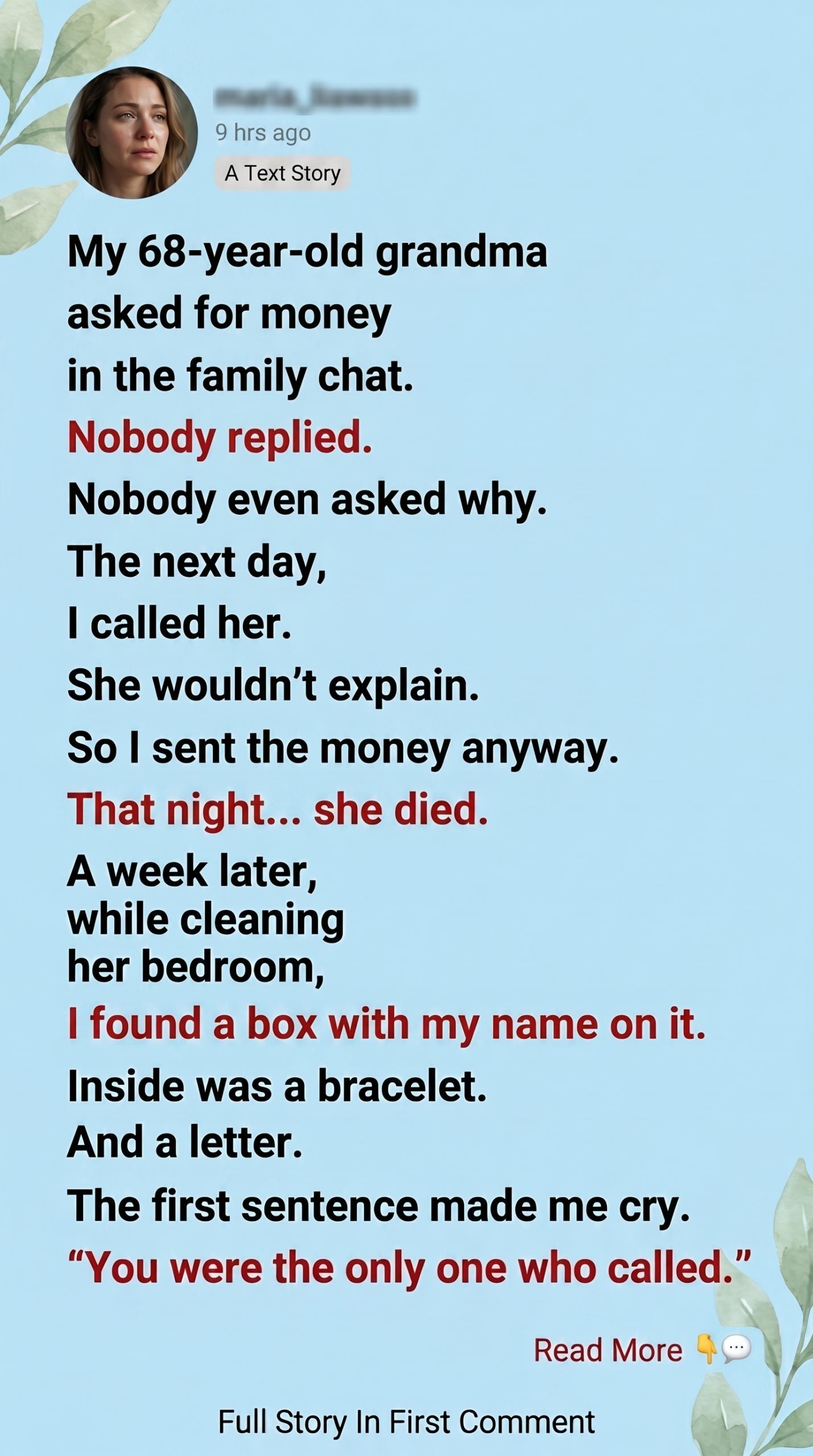
My 68-year-old grandma wrote in the family chat asking for money.
Nobody replied.
Not my uncles.
Not my cousins.
Not my brother.
The message sat there all day.
Read.
Ignored.
The next morning she sent another message.
“Please. I really need help.”
Still nothing.
Family members continued chatting about sports.
Sharing memes.
Making dinner plans.
Pretending they hadn’t seen her messages.
Something about it bothered me.
So I called her.
“Grandma, what’s wrong?”
There was a long silence.
Then she said softly:
“Nothing, sweetheart.”
“I just need a little money.”
“For what?”
Another pause.
“Something important.”
She wouldn’t explain.
I transferred the money immediately.
She started crying.
“Thank you.”
Then she said something strange.
“You’ve always been different.”
I laughed.
“Different how?”
“Your heart listens before your head does.”
At the time, I didn’t understand.
That night, Grandma died in her sleep.
The phone call came before sunrise.
I couldn’t believe it.
I’d spoken to her only hours earlier.
She sounded tired.
But not dying.
The funeral was three days later.
The entire family came.
Everyone cried.
Everyone spoke about how much they loved her.
I stayed quiet.
Because I kept remembering those unanswered messages.
A week later we gathered at Grandma’s house.
The plan was to sort through her belongings.
Instead, everyone argued.
Over jewelry.
Over furniture.
Over money.
Especially money.
I couldn’t take it anymore.
I went upstairs to Grandma’s bedroom.
The room smelled exactly like her.
Lavender.
Old books.
And tea.
I sat on the edge of her bed.
Trying not to cry.
Then I noticed something.
A small wooden box.
Hidden beneath the nightstand.
My name was written on it.
My hands started shaking.
I opened it.
Inside was a silver bracelet.
Simple.
Beautiful.
And a sealed envelope.
I opened the letter.
The first line hit me like a punch.
“If you’re reading this, I’m gone.”
Tears filled my eyes.
The letter continued.
“Last week I asked the family for money.”
“I didn’t actually need it.”
I frowned.
Confused.
Then I kept reading.
“For years, I’ve listened to everyone tell me how much they love me.”
“But people reveal who they are when they think there’s nothing to gain.”
My chest tightened.
“I wasn’t testing who would give me money.”
“I was testing who would stop long enough to ask why.”
I couldn’t breathe.
The next paragraph shattered me.
“You were the only one who called.”
“You were the only one who listened.”
“You were the only one who treated me like a person instead of a problem.”
Tears rolled down my face.
Then came the truth.
The money I sent her had paid for the bracelet.
Not because she couldn’t afford it.
Because she wanted her final gift to come from an act of kindness.
The letter ended:
“Everyone else will receive part of my estate.”
“But this belongs only to you.”
“Not because you loved me more.”
“But because you showed me your love when it mattered most.”
Downstairs I could hear relatives arguing about inheritance.
Voices growing louder.
Angrier.
I looked at the bracelet.
Then at the final sentence of Grandma’s letter.
“Money measures wealth.”
“Kindness measures character.”
At that moment, I realized Grandma hadn’t left me the most expensive thing she owned.
She had left me the thing everyone else wanted but couldn’t inherit.
Her trust.