The Qwaiter had just uncorked a second bottle when my brother slid a dry hot dog toward my son and said, “That’s all we ordered for him.”
My eight-year-old, Noah, stared at the paper plate as if it had appeared by mistake.
Around the private dining room, every adult suddenly became fascinated by steak knives, wine glasses, and the white tablecloth. The room smelled of butter, rosemary, and expensive red wine. Outside the tall windows, the ocean was turning black beneath a bruised purple sky.
Eric leaned back in his chair, pleased with himself.
“Don’t make this dramatic, Claire. Kids eat hot dogs.”
My mother sipped her wine. “You should’ve planned ahead.”
Noah wore his blue button-down shirt for his grandfather’s retirement dinner. He had spent the afternoon drawing a crooked fishing hat on a card and writing, in careful pencil, Happy Retirement, Grandpa.
Now he kept one hand in his lap and whispered, “I’m not that hungry.”
He was hungry.
He had been talking about the restaurant all week. He had asked whether the dining room had windows overlooking the water. He had practiced holding a fork properly. He had even decided he would ask Grandpa Martin what he planned to do now that he was retired.
I looked across the table at Eric’s children, Madison and Cole, cutting into expensive steaks covered in glossy brown sauce. Twenty-two relatives had been invited to the private room of the old coastal country club, and Eric had chosen the premium menu.
“Relax,” he had announced earlier, raising his glass as if he were the host of a royal banquet. “The family account is covering everything.”
That phrase had once meant something different.
Three years ago, when Mom needed surgery, everyone panicked. Her insurance had rejected the procedure, and the hospital wanted a deposit before scheduling it. My father had recently retired. Eric claimed his construction business was “between contracts.” My sister, Linda, said she was drowning in credit-card debt.
So I opened an emergency account.
I deposited every overtime check I could spare. I skipped dental appointments, postponed repairs on my car, and worked late after Noah went to sleep. I sold my grandmother’s silver bracelet. I stopped ordering takeout and learned to stretch one chicken across four dinners.
I never complained.
I told myself that was what families did.
Eric contributed nothing.
My parents contributed nothing.
But whenever the family needed a private room, imported wine, or a celebration dinner, they called the money ours.
Whenever my son needed basic consideration, they called him my responsibility.
Eric nudged the paper plate closer to Noah.
“There,” he said. “He can eat that.”
Noah looked at me, trying not to cry.
I placed my hand on his shoulder. “You don’t have to eat anything here.”
Eric gave a short laugh. “Then leave. Nobody’s stopping you.”
The waiter returned with another bottle, the one Eric had proudly selected because it cost more than my first car. My father suddenly found something fascinating on the menu. My mother adjusted her bracelet. Not one person defended Noah.
I stood.
The room quieted immediately.
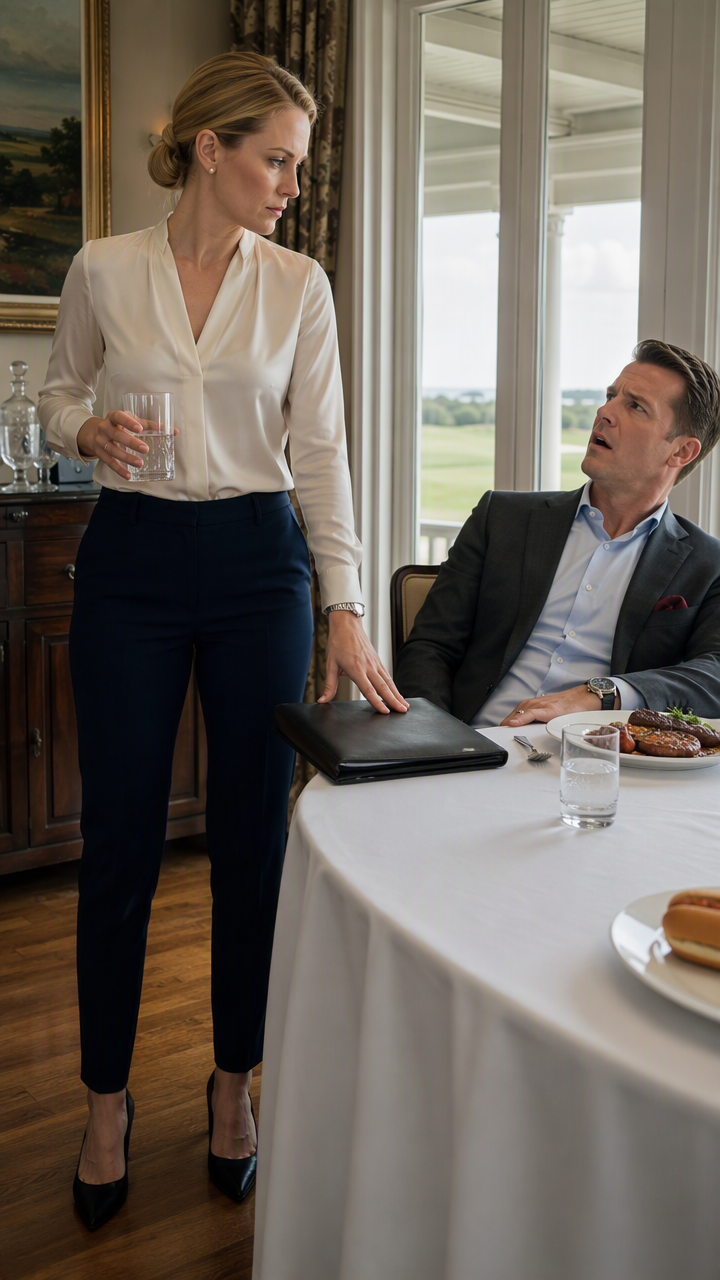
I lifted the blank payment folder from beside my chair and looked at Eric.
He smiled. “Finally. A scene.”
“No,” I said. “A correction.”
His smile faded when I told the room that the family account wasn’t family money.
It was mine.
I had authorized every charge until that night.
Then I turned the folder toward the waiter.
“Please remove my authorization from the bill.”
Eric’s chair scraped backward.
“You can’t do that.”
I kept my hand over the folder. “I already did.”
The waiter’s voice came from behind me. “Then whose account should I use for this dinner?”
Eric looked at the steaks, the wine, and finally the paper plate beside his nephew.
For the first time all evening, he had no answer.
My father cleared his throat. “Claire, this is inappropriate.”
“No,” I said. “What’s inappropriate is serving a child a cold hot dog while everyone else eats a three-hundred-dollar steak.”
“It was a misunderstanding,” my mother said.
I looked at Noah.
His eyes were fixed on the floor.
“Was it?” I asked.
Eric’s wife, Dana, shifted in her chair. “Claire, no one meant anything by it.”
Eric turned toward her sharply. “Don’t start.”
That was the first crack.
Not in the argument.
In the performance.
For years, everyone at that table had played their parts. My mother was the peacemaker. My father was the disappointed patriarch. Eric was the charming provider. I was the difficult one—too sensitive, too serious, too unwilling to “let things go.”
May you like
But now Dana’s face had gone pale.
I had seen that look before.
It was the look of someone who knew the truth and was terrified of being the first to say it.
The waiter stood patiently nearby, holding the bottle of wine.
“Sir?” he asked Eric.
Eric turned red. “Put it on the room.”
“I’m sorry,” the waiter said. “The room is attached to a payment authorization. That authorization has been canceled.”
My mother stared at me. “You would embarrass your father over a dinner?”
“I’m not embarrassing Dad. I’m refusing to finance Eric’s dinner.”
My father pushed his chair back. “You agreed to this.”
“I agreed to Grandpa’s retirement dinner,” I said. “I did not agree to pay for a feast Eric ordered without asking me.”
Eric’s eyes narrowed.
“You knew the family account was for family events.”
“It was for emergencies.”
“You’ve paid for every family event for three years.”
“And every time, I was told it was temporary.”
He laughed bitterly. “You’re acting like we robbed you.”
I reached into my handbag and removed a thin folder.
I placed it on the table.
Inside were printed bank statements, text messages, invoices, and a spreadsheet I had kept updated with the kind of meticulousness that only desperation could produce.
Emergency Fund Contributions: $31,800.
Medical Expenses for Mother: $18,450.
Family dinners, parties, flowers, gifts, wine, room rentals, and travel: $11,276.
Repaid by Eric: $0.
My mother glanced at the pages and looked away.
My father didn’t touch them.
Eric did.
His hand shook as he flipped through the statements.
“You kept records?”
“Yes.”
“Why?”
“Because every time I asked when you planned to repay me, you said you didn’t remember borrowing anything.”
He threw the pages down. “This is unbelievable.”
“No,” I said. “Unbelievable was believing you.”
At the end of the table, Noah tugged my sleeve.
“Mom,” he whispered, “can we go?”
I looked down at him.
His eyes were shiny, but he was trying hard not to cry. He had learned that crying at family gatherings made people call him dramatic.
I squeezed his hand.
“Yes,” I said. “We’re going.”
We started toward the door.
Behind me, Eric said, “If you walk out, don’t expect anyone to forgive you.”
I stopped.
The words were so familiar that, for a moment, they reached inside me and touched something old.
I remembered being sixteen, standing outside my parents’ bedroom while Eric screamed that I had ruined his chances of getting a car because I had “told Dad the truth” about his grades.
I remembered being twenty-four, lending Eric rent money after he lost his job. I remembered the promise he made while crying on my kitchen floor.
Just until Friday, Claire. I swear.
Friday had become twelve years.
I remembered my mother telling me not to be selfish when I asked Eric to return the money before I paid my electricity bill.
I remembered my father saying, “Your brother is under pressure. You’re the strong one.”
The strong one.
That was what they called the person they expected to carry everyone else.
I turned around.
“No one needs to forgive me,” I said. “I’m not the one who did something wrong.”
Eric stood so quickly his chair struck the wall.
“You think you’re better than us?”
“No.”
“You always have.”
“No,” I repeated. “I think I’m tired.”
That silenced him more effectively than anger would have.
For three years, I had been tired.
Tired of calculating whether I could afford groceries after paying for someone else’s birthday dinner. Tired of explaining to Noah why we couldn’t replace his winter coat while Uncle Eric posted pictures from ski resorts. Tired of pretending that my family loved us equally when they only valued us according to what I could provide.
The waiter finally placed the wine bottle back into its ice bucket.
“Perhaps we should discuss payment privately,” he said.
Eric pointed at me. “She canceled the account. She should pay the bill.”
The waiter’s expression remained polite, but his eyes sharpened. “The reservation was made under Mr. Eric Hale’s name.”
Every head turned toward my brother.
He blinked.
“You told everyone it was covered,” I said.
“You were going to cover it.”
“That isn’t the same thing.”
“You always cover it.”
“Not tonight.”
The room erupted.
My aunt demanded to know what was going on. My cousin accused me of ruining Grandpa’s retirement. My mother began crying quietly, though I noticed she kept one eye on Eric.
Then my father struck the table with his palm.
“Enough!”
The glasses trembled.
Everyone fell silent.
My father looked at me with an expression I had spent my entire childhood trying to earn—disappointment.
“You will pay this bill,” he said.
It was not a request.
For a moment, I was eight years old again, standing in the hallway with a broken lamp in my hands while Eric watched from behind the doorway.
I had not broken the lamp.
But Eric had said I did.
Dad had believed him because believing Eric was easier.
I held my father’s gaze.
“No.”
His face hardened. “Excuse me?”
“I said no.”
“You owe this family.”
“No,” I said. “I owe Noah.”
That was when Grandpa Martin spoke.
Until then, he had sat at the head of the table in silence, his retirement card propped against his water glass. He was seventy-two, broad-shouldered despite his age, with white hair and the steady hands of a man who had spent forty years repairing boats.
He had not touched his steak.
He looked at the paper plate in front of Noah.
Then he looked at Eric.
“What did you order for the boy?”
Eric’s mouth opened.
“Dad, it was just—”
“What did you order?”
“A hot dog.”
“For a child?”
“He likes hot dogs.”
“Noah likes grilled salmon,” Grandpa said.
The words landed with strange force.
I looked at him.
He remembered.
When Noah was six, Grandpa had taken him fishing off the northern pier. Noah had caught nothing, but Grandpa had cooked salmon afterward and told him the secret was lemon, pepper, and patience.
Noah had talked about that meal for months.
Eric scoffed. “We weren’t going to order everyone special food.”
“No,” Grandpa said. “You ordered special food for your children.”
Eric’s face darkened. “Don’t make this about my kids.”
“It is about your kids. It is about Claire’s child. It is about the fact that you used her money to feed everyone except him.”
The room became so quiet I could hear the ocean beyond the windows.
Grandpa looked at my father.
“And it is about you.”
My father stiffened.
“You knew Claire was paying for all of this?”
Dad said nothing.
Grandpa’s gaze moved to my mother.
“And you?”
My mother’s lips trembled. “We thought she wanted to help.”
“No,” Grandpa said. “You knew she couldn’t say no.”
Eric shoved his napkin onto the table. “This is insane. Claire is making everyone feel guilty because she wants attention.”
I almost laughed.
Attention.
I had spent years making myself invisible.
I had attended celebrations where no one thanked me because thanking me would have required admitting I was responsible for them happening. I had quietly paid medical bills, restaurant deposits, hotel rooms, birthday gifts, and even Eric’s overdue property taxes after he promised to sell a boat.
I had done it because I thought love meant absorbing the damage.
Grandpa turned to me.
“Claire,” he said, “there’s something you need to know.”
My stomach tightened.
He reached into the inside pocket of his jacket and removed a white envelope.
My name was written across it in his blocky handwriting.
I stared at it.
“What is that?”
“Something I should have given you a long time ago.”
My father rose halfway from his chair.
“Martin, not here.”
Grandpa didn’t even look at him.
“Especially here.”
Eric’s expression changed.
Not confusion.
Fear.
I took the envelope.
It was heavier than it should have been. Inside was a key, a folded letter, and a small black flash drive.
My pulse began to hammer.
Grandpa nodded toward the drive.
“Your father asked me to keep something safe after your grandmother died.”
My father’s face had gone gray.
“What are you talking about?” I asked.
Grandpa looked at him.
“Tell her.”
My father sank back into his chair.
I unfolded the letter.
The handwriting was unmistakable.
My grandmother’s.
Claire,
If you are reading this, Martin has finally decided that silence is no longer protection. I am sorry it took so long.
I stopped breathing.
The room seemed to tilt.
My grandmother had died eleven years earlier. She had been the only person in our family who had ever looked at me as if I were not difficult or useful, but simply loved.
I read on.
The money you have been saving for the family emergency account was never meant to belong to the family. It was meant to belong to you and Noah.
My fingers went numb.
I looked at Grandpa.
“What does that mean?”
My father whispered, “This is not the place.”
Grandpa slammed his fist against the table.
“Then you should have told her before she sold half her life to support you.”
No one moved.
I read the next paragraph.
When I became ill, your father asked me to place my investments in his hands. He said he would divide everything fairly among the grandchildren. I agreed because I believed him. Later, I learned he had transferred the money into an account controlled by Eric.
My eyes jumped over the words, unable to process them.
The account was established for Noah.
The hot dog sat untouched on the paper plate.
The dining room blurred.
“No,” I whispered.
My father closed his eyes.
Eric stood. “This is a lie.”
Grandpa took the black drive from my hand.
“Your grandmother recorded a video before she died. She knew they would deny it.”
Eric’s chair scraped backward.
“Dad, don’t.”
“Sit down.”
“I said don’t!”
Eric lunged toward the drive.
Grandpa was faster.
He caught Eric’s wrist with surprising strength.
The room exploded into shouting.
Dana grabbed Eric’s arm. My mother began sobbing. My father kept repeating that this was a misunderstanding, that there were explanations, that no one had stolen anything.
But Eric had already given himself away.
People do not attack lies they believe are harmless.
They attack truths that can destroy them.
Grandpa released his wrist.
“Sit down,” he said again.
Eric sat.
I held the flash drive so tightly the edges cut into my palm.
“What money?” I asked.
My grandmother’s letter continued.
The account contains the proceeds from the sale of my house, along with investments I held privately. Your father told the family he had used the money to pay for my medical care. That is false. Martin paid those bills.
I looked at Grandpa.
He nodded.
“The account was worth two hundred and eighty thousand dollars when your grandmother died,” he said.
My chair felt suddenly unstable beneath me.
Two hundred and eighty thousand dollars.
The number was too large to understand. It was a house deposit. Noah’s education. Medical security. A life-changing amount.
My father had told me there was nothing left after Grandma’s care.
He had told me I needed to help keep the family afloat.
He had watched me empty my savings while my inheritance sat in an account under Eric’s name.
I turned to my brother.
“How much is left?”
Eric stared at me.
“Claire—”
“How much?”
His silence answered before anyone else could.
Grandpa said, “There is approximately sixty-four thousand dollars remaining.”
My mother covered her mouth.
Sixty-four thousand.
The rest had vanished into dinners, cars, vacations, home renovations, and the lifestyle Eric had insisted the family deserved.
I looked at the luxury watch on his wrist.
At the expensive jacket.
At his children’s half-eaten steaks.
Then I looked at Noah.
He was watching me, frightened.
I forced my voice to steady.
“Why did you let me pay for everything?”
Eric’s face twisted.
“Because you had access to the family account.”
“It wasn’t yours.”
“You didn’t know that.”
“You knew it was for Noah.”
“It was family money.”
“No. It was my grandmother’s gift to my son.”
“She changed her mind.”
Grandpa’s mouth tightened.
“She did not.”
Eric turned toward him. “You were supposed to be dead before this came out.”
The words fell into the room like a knife.
No one breathed.
Grandpa’s face became utterly still.
“What did you say?” I asked.
Eric’s eyes widened.
For one terrible second, he seemed to realize what he had done.
Then he began to backpedal.
“I didn’t mean—”
“What did you mean?”
My father stood. “Eric, stop talking.”
“No,” I said. “Let him talk.”
Eric looked at all of us, trapped now by the thing that had escaped his mouth.
Grandpa’s voice was low. “You thought I was going to die before I could tell her.”
Eric said nothing.
“You knew about the recording,” Grandpa continued.
Eric’s jaw tightened.
“You knew I had discovered the account.”
My father grabbed the back of a chair. “Martin, please.”
“And you knew I had changed my will.”
Eric’s face lost all color.
That was the twist—not the stolen inheritance, not the family account, not even the years of manipulation.
It was the reason for the dinner.
This retirement celebration had never been meant to honor Grandpa.
It had been designed to isolate him, flatter him, and convince him to sign documents transferring the remaining money.
I looked at the envelope.
The key.
The drive.
The letter.
Grandpa had known they were planning something.
“Why was this dinner tonight?” I asked.
Grandpa looked at Eric.
“Because tomorrow morning, he intended to take me to a lawyer and have me sign over the remaining account.”
Eric shook his head violently. “That’s not true.”
Grandpa reached into his jacket again and removed a folded document.
“The appointment confirmation.”
He placed it on the table.
Eric’s name appeared beneath a law firm’s letterhead.
Asset Transfer and Estate Revision Consultation.
My father sat down heavily.
My mother began crying harder.
I stared at the paper while every strange detail of the evening rearranged itself in my mind.
The lavish menu.
The insistence that I pay.
The private room.
The wine.
The rush to make Grandpa sentimental and compliant.
And Noah’s hot dog.
It had not been an accident.
Eric had ordered it because he wanted to remind me of my place. He had wanted me quiet, embarrassed, and grateful for whatever scraps were offered.
Instead, he had pushed me past the point where fear could control me.
Grandpa reached across the table and covered my hand.
“I am sorry,” he said.
The apology broke something inside me.
Not because I blamed him.
Because he was the first person in that room to apologize without asking me to understand someone else.
“I thought I was helping,” he continued. “I thought keeping the peace protected you. Your grandmother warned me that silence would turn them against you.”
I looked down at her letter.
The final paragraph read:
You have always mistaken endurance for love. Please do not teach Noah to make the same mistake.
My vision blurred.
For years, I had believed I was saving my family.
I had really been teaching them that hurting me was profitable.
I took Noah’s hand.
“Are you ready to go?” I asked.
He nodded.
Before we reached the door, Grandpa called my name.
“There’s one more thing.”
I turned.
He looked at the untouched birthday card beside his plate.
“Would you and Noah come stay with me for a while?”
Noah glanced at me.
Grandpa smiled at him.
“I have an empty room with a view of the water. And tomorrow, if you’d like, we can go fishing.”
Noah’s face brightened for the first time that evening.
“Can we catch salmon?”
“We can try.”
“And can Mom come?”
Grandpa’s eyes filled.
“Your mother is the first person I’m inviting.”
We left the dining room together.
Behind us, Eric shouted that he would sue. My mother begged me to listen. My father called my name in the same furious tone he had used when I was a child.
I did not turn around.
At the front desk, the restaurant manager approached me quietly.
“Ms. Hale?”
“Yes?”
He handed me a small envelope.
“This was left for you earlier today.”
I recognized the handwriting before I opened it.
Grandma’s.
My hands trembled as I unfolded the final note.
Claire,
If the room is full when you finally stand up for yourself, do not mistake their noise for proof that you are wrong. People shout loudest when the door they used to enter your life is closing.
I pressed the letter against my chest.
Outside, rain had begun to fall over the dark ocean.
Noah slipped his hand into mine.
“Mom?”
“Yes?”
“Can we get real food now?”
I laughed, though tears were still running down my face.
“Yes,” I said. “We can get anything you want.”
He thought about it.
“Salmon.”
“Salmon it is.”
We walked toward the parking lot beneath Grandpa’s umbrella. Behind us, through the glowing windows of the country club, the family remained trapped at the table—surrounded by empty glasses, untouched desserts, and a bill no one wanted to claim.
But the greatest shock was not that Eric had stolen Noah’s inheritance.
It was that he had spent years using my money to make me believe I was powerless.
The account was not empty.
The family was not helpless.
And I was not the strong one because I could carry them.
I was the strong one because I finally put them down.QQQQ