The first lie cost them nothing. The last truth cost them everything.
“The mortgage bounced, and you need to fix it.”
My son delivered the sentence from my front door with all the emotion of someone reporting a broken dishwasher.
His wife, Lauren, stood beside him in the cream cashmere coat I had wrapped for her last Christmas. The price tag had been hidden. My affection had not.
She looked at me as though I had betrayed her.
Behind them, their black Range Rover idled beneath the sprawling live oaks lining my Savannah driveway.
Neither of them asked how I was.
Neither remembered it was my birthday.
Neither apologized for the text Lauren had sent three weeks earlier.
*”For the children’s emotional health, we’d appreciate more distance. Please stop dropping by without asking first.”*
Without asking.
After twelve years of paying their bills.
I stepped aside.
“Come in.”
They entered the house they once called home before they discovered I was more useful as a bank than as a mother.
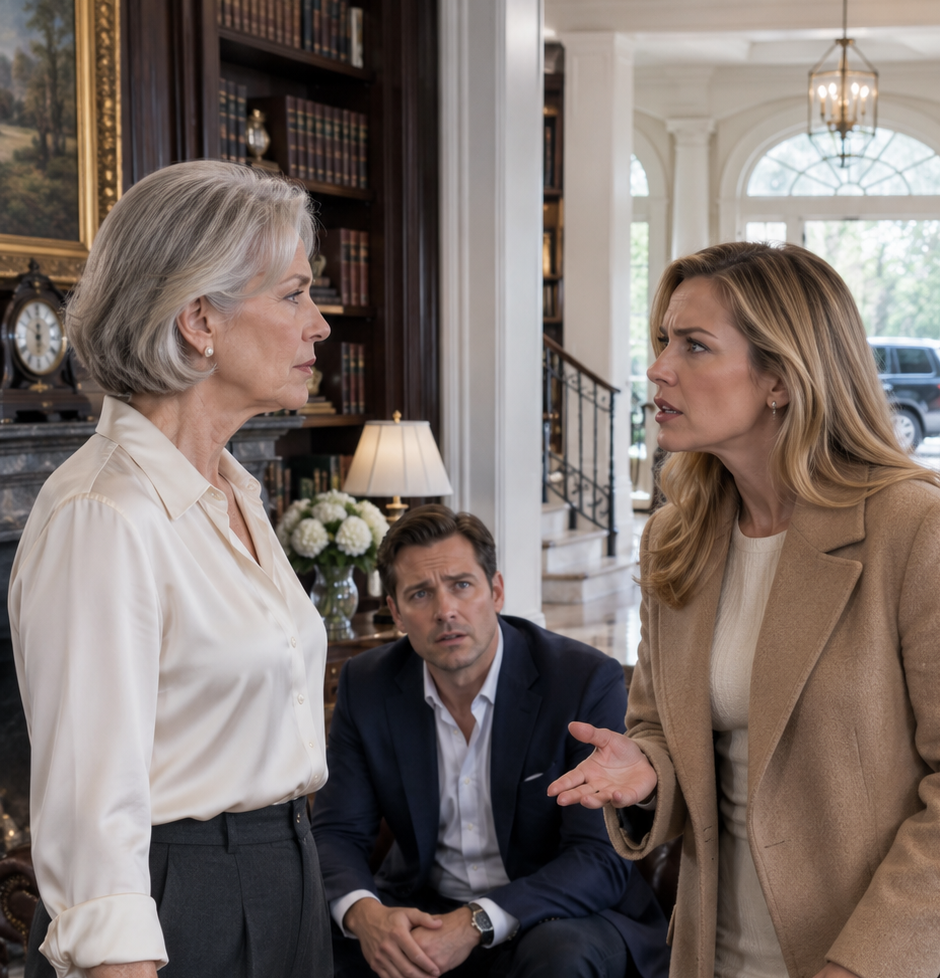
We crossed the marble foyer into the library Thomas had built with his own hands. Walnut shelves stretched from floor to ceiling. The smell of leather, cedar, and old books still lingered years after his death.
Thomas believed wealth should whisper.
Michael believed wealth should rescue him.
There was the difference.
Lauren remained standing.
Michael collapsed onto the leather sofa.
“The bank rejected the mortgage transfer,” Lauren said.
“I know.”
“You… know?”
“Yes.”
Michael frowned.
“What happened?”
“Nothing.”
Lauren’s voice sharpened.
“Then why didn’t the payment go through?”
“Because I canceled it.”
Silence.
Even the antique grandfather clock seemed to hesitate.
“You canceled our mortgage?” Michael whispered.
“Yes.”
“Without telling us?”
“You asked me not to contact you.”
“That isn’t what we meant.”
“It became exactly what you meant.”
Lauren inhaled carefully, rearranging her face into the expression she always wore before asking for money.
“Elaine… we requested emotional boundaries. We never asked you to destabilize our household.”
I smiled sadly.
“Your household.”
“Yes.”
“Your mortgage.”
“Yes.”
“Your responsibility.”
The color drained from Michael’s face.
Lauren folded her arms.
“You know we have children.”
“I do.”
“You know they deserve stability.”
“They do.”
“Then why would you do something this cruel?”
I looked directly into her eyes.
“Because boundaries work both ways.”
Neither answered.
Because deep down…
They already knew I was right.
—
That morning wasn’t the beginning.
It was simply the day they realized something had quietly ended months earlier.
For nearly twelve years I had financed their lives.
Not dramatically.
Not recklessly.
Not all at once.
Instead…
One emergency.
Then another.
Then another.
A furnace.
Private school tuition.
Medical deductibles.
Soccer camps.
Dance lessons.
A transmission.
Vacation deposits they couldn’t refund.
Property taxes.
Kitchen renovations that somehow became “necessary.”
Lauren always knew the sentence that unlocked my checkbook.
“You want the grandchildren to have opportunities… don’t you?”
Of course I did.
Every grandmother does.
Michael rarely demanded.
He apologized.
He sighed.
He sounded exhausted.
“Mom… we’re embarrassed to ask.”
“Mom… next month will be better.”
“Mom… just this once.”
Just this once became hundreds of times.
Thomas noticed before I did.
One rainy Saturday he closed his accounting ledger and looked across the breakfast table.
“He’s learning the wrong lesson.”
“He’s our son.”
“Exactly.”
“He has children.”
“So did we.”
I hated hearing it.
Because I knew he wasn’t criticizing Michael.
He was warning me.
After Thomas died…
I ignored every warning.
Grief is strange.
It convinces you that giving away pieces of yourself is love.
Michael’s calls gave me purpose.
Lauren’s emergencies made me feel needed.
The grandchildren filled the silence after Thomas was gone.
So every month I drove four hours from Savannah to Atlanta carrying casseroles, groceries, birthday presents, and envelopes that somehow always disappeared before I went home.
Their Buckhead house grew bigger.
Their vacations grew longer.
Their wine collection became impressive.
Their dependence became invisible.
Mine did too.
—
Three weeks before they arrived at my house, Lauren sent the message that shattered something inside me.
*”The children need healthier boundaries. Please don’t come unless invited.”*
I read it.
Then again.
Then a third time.
After that…
I opened my banking app.
One by one…
I canceled everything.
Mortgage.
School tuition.
Utilities.
Club memberships.
Insurance premiums.
Even the monthly grocery delivery.
Forty-seven missed calls arrived over the next two days.
I answered none.
Now…
They were here.
Desperate.
—
Michael rubbed both hands together.
“Mom… please. We just need you to restart the payments.”
“I won’t.”
“You’re punishing the children.”
“No.”
“I don’t understand.”
“I know.”
Lauren stepped closer.
“The bank expects payment tomorrow.”
“I imagine it does.”
“You’re being unreasonable.”
“Perhaps.”
“Thomas would never approve.”
At that…
I laughed.
A short laugh.
A tired laugh.
“Amazing,” I said softly.
“You ignored every piece of financial advice my husband ever gave… and today you’re quoting him.”
Lauren flushed.
Michael stared at the carpet.
I stood.
Walked toward Thomas’s antique desk.
Opened the top drawer.
Removed a thick cream-colored folder.
Placed it on the coffee table.
Neither touched it.
“What is that?” Michael asked.
“Your future.”
—
Inside were pages.
Checks.
Wire transfers.
Receipts.
Mortgage statements.
Insurance payments.
College tuition.
Medical bills.
Every dollar.
Every date.
Every signature.
Every transfer from the previous twelve years.
Michael slowly turned pages.
His breathing changed.
Lauren frowned.
“What is this supposed to prove?”
“It proves I spent $397,842.63 supporting your family.”
Michael stopped turning pages.
His hands shook.
“I… I didn’t know it was that much.”
“No.”
“You never kept score.”
“I wasn’t.”
Lauren spoke carefully.
“So… what are you saying?”
“I’ve resigned.”
“From what?”
“Being your emergency fund.”
—
For several long moments nobody spoke.
Then Michael whispered something I never expected.
“I’ll pay you back.”
Lauren turned sharply.
“What?”
He ignored her.
“I don’t know how long it’ll take.”
“You don’t have to.”
“I owe you.”
Lauren interrupted.
“No, Michael.”
He looked at her.
“We can’t.”
She lowered her voice.
“You know why.”
I noticed it immediately.
That sentence.
You know why.
Something hidden existed between them.
Something larger than debt.
—
“Explain,” I said quietly.
Neither answered.
Lauren reached for the folder.
I slid it away.
“No.”
Michael stood.
His eyes watered.
“We need some time.”
“You’ve had twelve years.”
“We’ll fix this.”
“How?”
Silence.
Then…
Lauren said something strange.
“We’re waiting.”
“For what?”
She looked at Michael.
He looked away.
“For an inheritance.”
I blinked.
“What inheritance?”
“My father’s.”
I frowned.
“Your father died fifteen years ago.”
Lauren swallowed.
“My grandfather.”
“How much?”
“We don’t know.”
“When?”
“The estate’s tied up.”
“For how long?”
“Almost nine years.”
Something didn’t make sense.
No estate remained frozen for nine years without reason.
Unless…
—
That night I couldn’t sleep.
Thomas used to say,
“If facts don’t fit…
someone’s lying.”
The next morning curiosity overcame pride.
I called an old friend.
Margaret.
Retired probate attorney.
She still knew everyone in Georgia’s legal community.
“Can you look into a family estate?”
“For you?
Of course.”
She called back four hours later.
“Elaine… something’s wrong.”
“What?”
“There isn’t an estate.”
“What?”
“There never was.”
I sat down slowly.
“No inheritance exists.”
My stomach tightened.
“Then why would they say—”
“There’s more.”
“What?”
“Lauren’s grandfather died broke.”
—
The lie wasn’t about waiting.
It was about hiding.
But hiding what?
—
Margaret continued investigating.
Three days later she drove to Savannah herself.
She carried another folder.
Thicker than mine.
“You need to see this.”
Inside were public records.
Business filings.
Loans.
Second mortgages.
Luxury vehicle leases.
Credit lines.
Tax liens.
My pulse quickened.
Then…
One document stopped me cold.
A company.
Whitmore Family Holdings.
Directors:
Michael Whitmore.
Lauren Whitmore.
Third director…
Thomas Whitmore.
My husband.
Dead five years.
His name should not have been there.
—
I stared.
“That isn’t possible.”
Margaret nodded slowly.
“It gets worse.”
She handed me incorporation papers.
Thomas’s signature appeared.
Except…
It wasn’t his.
It was close.
Very close.
But not perfect.
I knew my husband’s handwriting better than anyone alive.
Someone had forged it.
—
I drove to Atlanta that afternoon.
Not to confront them.
To watch.
Their house looked normal.
Children played in the yard.
Delivery trucks came and went.
Nothing unusual.
Until…
A black Mercedes arrived.
An older man exited.
Expensive suit.
Silver hair.
Lauren embraced him.
He wasn’t family.
He wasn’t a lawyer.
He wasn’t a banker.
I photographed everything.
Margaret identified him two hours later.
“Forensic accountant.”
“For who?”
She hesitated.
“The FBI.”
—
Everything inside me froze.
—
The next morning…
Two black SUVs parked outside Michael’s house.
Federal agents entered.
Neighbors watched.
Children cried.
Lauren screamed.
Michael sat on the front steps holding his head.
Television cameras appeared before lunch.
—
I wasn’t called.
Not immediately.
Three days later…
Two agents knocked on my front door.
“Mrs. Whitmore?”
“Yes.”
“We need to ask about several financial transfers.”
I invited them inside.
They opened photographs.
Bank records.
Corporate filings.
Then one agent asked,
“Did you authorize these?”
He slid across copies of checks.
My signature appeared.
I had never seen them.
The amounts…
$50,000.
$80,000.
$120,000.
Hundreds of thousands.
Total…
$2.8 million.
My hands began shaking.
“I never signed these.”
“We believe you.”
“What happened?”
The older agent leaned forward.
“Your son and daughter-in-law built an entire network of shell companies using your financial history.”
I stared.
“They borrowed against your reputation.”
“They forged Thomas’s signature.”
“They used previous legitimate transfers to disguise fraudulent ones.”
My voice barely existed.
“Why?”
“To convince lenders wealthy family support still existed.”
—
Everything I had paid willingly…
Had become the foundation for millions in fraud.
—
I cried harder that afternoon than I had at Thomas’s funeral.
Not because of money.
Because I finally understood.
They hadn’t needed me anymore.
They had only needed my name.
—
Weeks passed.
Then months.
The investigation expanded across three states.
Banks.
Real estate.
Luxury vehicle financing.
Investment fraud.
Identity forgery.
Tax fraud.
Wire fraud.
Everything collapsed.
Michael accepted a plea agreement.
Lauren refused.
She insisted she knew nothing.
Then…
Someone produced emails.
Thousands.
Every forged signature had originated from her laptop.
—
The trial lasted six weeks.
I attended only one day.
Michael testified.
He looked twenty years older.
He admitted everything.
Then he said something that silenced the courtroom.
“My mother never knew.”
The prosecutor asked,
“Why continue taking her money if you were already committing fraud?”
Michael cried.
“Because…
real money runs out.
Her love never did.”
No one spoke afterward.
Not even the judge.
—
Lauren was convicted.
Michael received prison time but substantially less for cooperating.
The children went to live with Lauren’s sister temporarily.
I thought that would be the end.
It wasn’t.
—
Nearly a year later…
Margaret called again.
“You should come.”
“To where?”
“The courthouse.”
“Why?”
“A probate hearing.”
“I don’t understand.”
“You will.”
—
A gray-haired judge opened an old file.
“Estate of Thomas Whitmore.”
My breath caught.
“There wasn’t an estate.”
“There wasn’t.”
“Then why am I here?”
The judge smiled gently.
“Because your husband planned farther ahead than anyone realized.”
He opened a sealed envelope.
Thomas’s handwriting.
Real.
Undeniably real.
The letter began:
*”Elaine…”*
I immediately started crying.
*”If you’re reading this, it means someone has tried to use my name after I’m gone.”*
Every person in the courtroom looked up.
*”I suspected it might happen someday.”*
I stared in disbelief.
*”That’s why I created a dormant trust that activates only if my signature is ever fraudulently used after my death.”*
The judge nodded.
“It activated automatically during the federal investigation.”
I couldn’t breathe.
Thomas had anticipated something impossible.
The letter continued.
*”If our son reaches that point, don’t rescue him again.”*
Tears blurred the page.
*”Consequences are painful.*
*But sometimes…*
*they’re the only remaining form of love.”*
The judge closed the file.
“The trust has appreciated considerably.”
“How much?”
He smiled.
“After taxes…
$18.4 million.”
I stared speechless.
“It belongs entirely to you.”
I looked down at Thomas’s final words.
*”Use it for people who appreciate kindness.*
*Not people who confuse it with entitlement.”*
—
I sold my house six months later.
Not because I needed to.
Because I wanted fewer rooms filled with ghosts.
I started a scholarship foundation for widows rebuilding their lives after financial abuse.
Hundreds applied.
Dozens graduated.
Several opened businesses.
One became a judge.
Another became a teacher.
The money kept multiplying through careful investments.
Exactly as Thomas always said it would.
—
Five years later I received one letter.
No return address.
Inside was a single handwritten sentence.
*”Mom… I finally understand what Dad meant.”*
There was no signature.
There didn’t need to be.
I folded the note carefully and placed it inside Thomas’s last letter.
Not because everything had been forgiven.
Some things cannot be.
But because understanding arrives only after consequences have finished teaching what love alone never could.
And that was the greatest inheritance Thomas had ever left either of us.