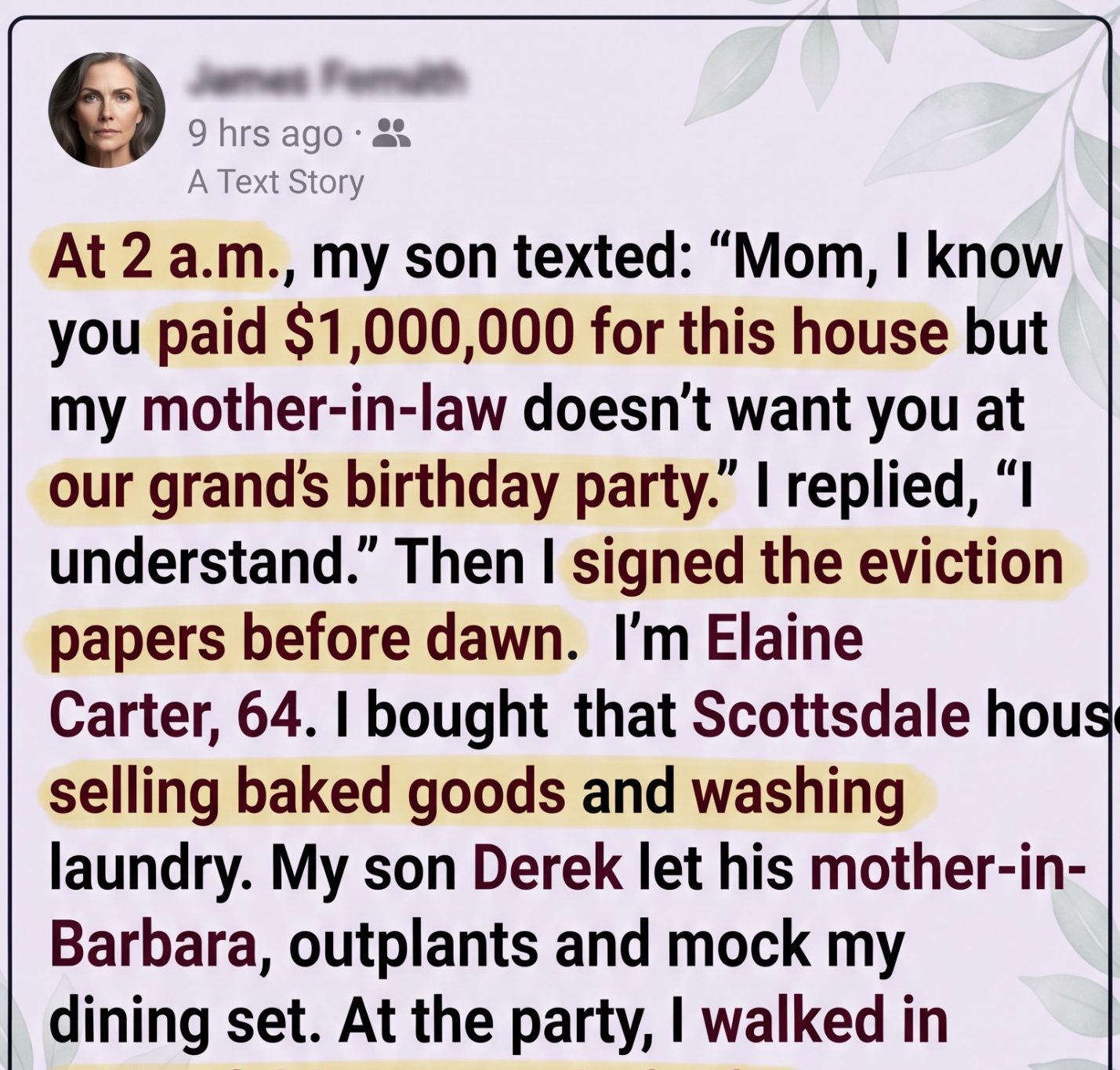
At 2 a.m., my son texted:
“Mom, I know you paid $1,000,000 for this house but my mother-in-law doesn’t want you at our grandson’s birthday party.”
I replied:
“I understand.”
Then I signed the eviction papers before dawn.
I’m Elaine Carter, 64.
I bought that Scottsdale house by selling baked goods and washing laundry.
My son Derek let his mother-in-law, Barbara, outplants and mock my dining set.
At the party, I walked in with a folder instead of gifts.
I laid the deed on the cake table.
“Thirty days to vacate.”
Barbara screamed that I was ridiculous.
Then my lawyer showed photos of a rainy night at a notary’s office.
She had forged my son’s name.
I looked her in the eye.
“That’s not Derek’s signature.”
I pointed at the document.
“It’s yours.”
The room went silent.
Derek stared at the papers.
“Mom… what is this?”
I looked at him.
“You told me you wanted me out of the house.”
“I never said that.”
I pulled out my phone.
His text was still on the screen.
He had written exactly what he thought I wanted to hear:
“Mom, please don’t make this harder. Barbara says you need to understand that this is our home now.”
I turned toward Barbara.
“She didn’t just ask me to leave.”
“She tried to take the house.”
Barbara’s face changed.
My lawyer placed another document on the table.
It was the original deed.
My name was the only name on it.
Barbara had created a fake transfer document claiming that I had gifted the property to Derek and his wife.
Then she’d taken it to a notary.
The notary had noticed something strange.
The signature didn’t match mine.
So she contacted my attorney.
That’s how I found out.
Derek stared at his mother-in-law.
“You forged my signature too?”
Barbara started crying.
“I was trying to protect the family.”
“No,” I said quietly.
“You were trying to take something that wasn’t yours.”
My grandson came running into the room.
“Grandma!”
He wrapped his arms around me.
I hugged him tightly.
Barbara looked away.
Derek stood there with tears in his eyes.
“Mom, I’m sorry.”
I looked at him.
“You didn’t protect me.”
“I know.”
“You didn’t even ask me what happened.”
He lowered his head.
“I believed Barbara.”
“That was your choice.”
My lawyer gathered the documents.
“The thirty-day notice stands.”
Derek looked at me.
“Where are we supposed to go?”
I paused.
Then I said something he clearly didn’t expect.
“You’re my son.”
His eyes filled with tears.
“But being my son doesn’t give you the right to let someone steal from me.”
I handed him an envelope.
Inside was a check.
Enough to cover a security deposit and several months of rent.
He stared at it.
“Mom, I can’t take this.”
“You’re not taking the house.”
“You’re taking responsibility for your choices.”
He hugged me.
For the first time that night, I hugged him back.
Then I looked at Barbara.
She didn’t say anything.
She didn’t need to.
The truth was finally sitting on the table between us.
The house wasn’t hers.
The deed wasn’t hers.
And neither was the family she had tried to control.
I had spent decades building that home.
Not because it was worth a million dollars.
Because every room held something I had worked for.
Every wall represented a sacrifice.
And I wasn’t going to let someone erase all of that because they thought an older woman would be too afraid to fight back.
Before I left, my grandson ran after me.
“Grandma, are you coming back?”
I smiled.
“Of course.”
He hugged me.
Then whispered:
“I’m glad it’s your house.”
I kissed his forehead.
“So am I.”
And as I walked out the door, I realized something:
Sometimes protecting your family doesn’t mean giving them everything they want.
Sometimes it means teaching them that love and boundaries can exist in the same room.
