My family had a tradition.
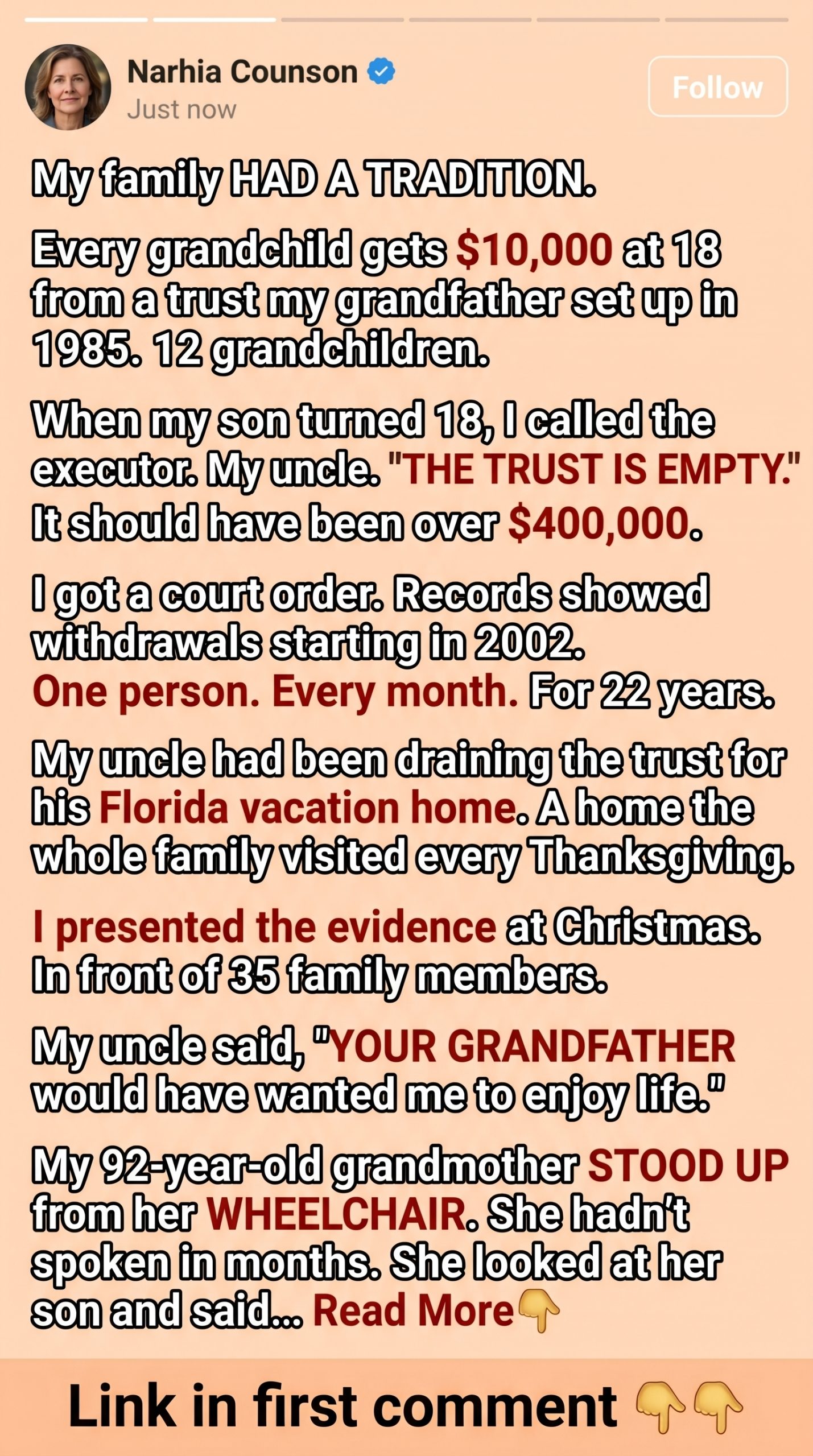
Every grandchild received $10,000 from my grandfather when they turned eighteen.
There were twelve grandchildren.
Twelve gifts.
Simple.
Fair.
Predictable.
Or so we thought.
When my son turned eighteen, I called the family attorney to ask about the trust.
There was a long silence on the phone.
Then he said something that made my stomach drop.
“The trust is empty.”
I laughed.
“What do you mean empty?”
“I mean there’s no money left.”
My grandfather had left over $400,000 in the trust.
It wasn’t supposed to disappear.
The attorney emailed me the records.
I stared at the withdrawals.
Month after month.
Year after year.
The same name.
My uncle.
Small amounts at first.
Then larger ones.
Then checks written almost every month for twenty-two years.
By the time I finished scrolling, my hands were shaking.
The money meant for every grandchild was gone.
All of it.
My son sat across from me.
“Is there some mistake?”
I wanted to tell him yes.
But there wasn’t.
For twenty-two years, my uncle had quietly drained the trust.
The family confronted him.
His excuse was simple.
“I borrowed it.”
Borrowed.
Hundreds of thousands of dollars.
Without permission.
Without repayment.
Without telling anyone.
The attorney advised us to go to court.
The judge reviewed the records.
The ruling came quickly.
My uncle was ordered to repay what remained possible and surrender several assets.
During the investigation, we learned where much of the money had gone.
A luxury vacation home in Florida.
Expensive trips.
Boats.
Renovations.
A lifestyle funded by money that was never his.
The family was furious.
But the hardest conversation was with my son.
The money his great-grandfather intended for him was gone.
“I don’t care about the money,” he told me.
“I care that Grandpa’s wishes didn’t matter to him.”
That hurt more than anything.
Months later, my grandmother’s ninety-second birthday arrived.
The entire family gathered.
My uncle came too.
Most people ignored him.
Some wouldn’t even look at him.
Near the end of the evening, he stood up and tried to defend himself.
“You all act like I’m some criminal.”
Nobody responded.
Then he pointed at my grandmother.
“Dad would have wanted me to have it anyway.”
The room went silent.
My grandmother had barely spoken in months.
She sat quietly in her wheelchair, listening.
Then, slowly, she pushed herself upright.
Everyone stared.
She looked directly at her son.
For the first time in years, her voice filled the room.
“Don’t you dare tell me what your father wanted.”
My uncle froze.
She continued.
“Your father worked sixty years for that money.”
The room was completely silent.
“He created that trust for his grandchildren because he loved them.”
She pointed her finger at him.
“You didn’t steal from a bank.”
“You didn’t steal from strangers.”
“You stole from your own family.”
My uncle opened his mouth.
She cut him off.
“And the saddest part is that you think the money is what we’re angry about.”
Tears filled her eyes.
“We’re angry because we trusted you.”
No one moved.
No one spoke.
My uncle looked around the room.
For the first time, there was nowhere to hide.
No excuses.
No arguments.
Just the truth.
He quietly sat down.
The birthday party ended soon after.
As we left, my son walked beside his great-grandmother.
She squeezed his hand.
“I’m sorry about the trust.”
He smiled.
“It’s okay, Grandma.”
She looked at him carefully.
“No,” she said.
“It’s not.”
Then she added something I’ll never forget:
“Money can be replaced. Character can’t.”
And in that moment, every person in the room knew exactly who had inherited my grandfather’s true legacy.
Not the money.
The values behind it.