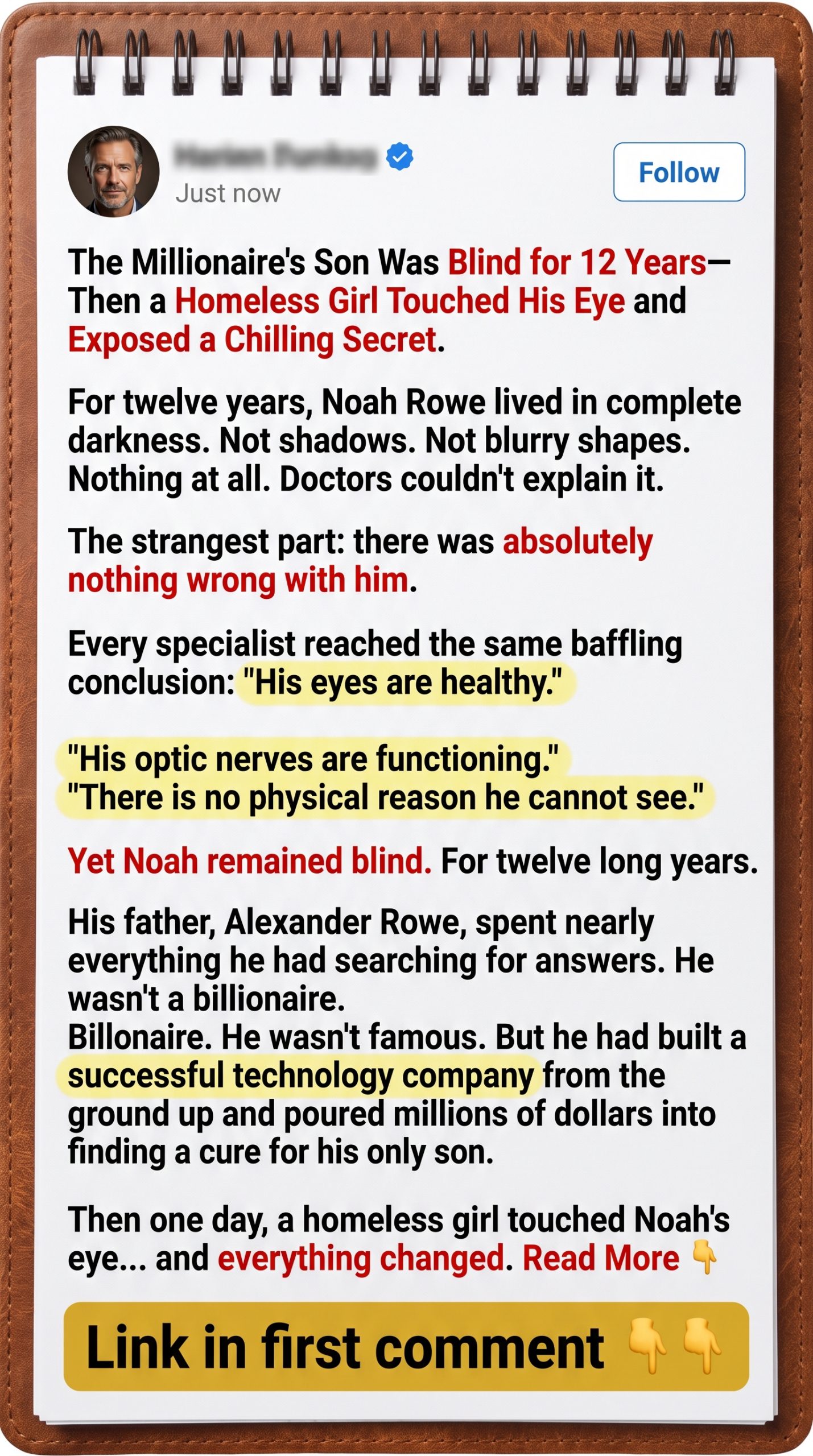
For twelve years, Noah Rowe lived in complete darkness.
Not shadows.
Not blurry shapes.
Nothing.
Doctors couldn’t explain it.
His eyes were healthy.
His optic nerves worked perfectly.
Every specialist reached the same conclusion:
“There is no physical reason this boy cannot see.”
Yet Noah remained blind.
His father, Alexander Rowe, refused to give up.
He spent millions.
The best hospitals.
The best neurologists.
The best experimental treatments.
Nothing worked.
As Noah grew older, Alexander became obsessed with finding answers.
Not because Noah complained.
The boy rarely did.
But because every parent wants to fix what hurts their child.
Then, one rainy afternoon, everything changed.
Alexander’s driver took a wrong turn through an older part of the city.
Traffic stopped near a shelter.
While waiting, Noah asked to get some fresh air.
The driver hesitated but agreed.
As Noah stood outside, someone approached.
A young girl.
Dirty clothes.
Worn shoes.
No older than sixteen.
She looked homeless.
“Are you really blind?” she asked.
Noah smiled.
“That’s what everyone tells me.”
The girl studied him carefully.
Then she did something strange.
She gently placed her hand over one of his eyes.
Instantly she pulled away.
Her face turned white.
“What happened?” Noah asked.
The girl whispered:
“Someone doesn’t want you to see.”
The driver laughed.
But the girl’s expression never changed.
She looked terrified.
That night Noah couldn’t stop thinking about her words.
Neither could Alexander.
Eventually, curiosity got the better of him.
He hired an investigator to find the girl.
Three weeks later they located her.
Her name was Emma.
She lived at a shelter nearby.
Alexander invited her to his home.
She almost refused.
But eventually she agreed.
When Emma entered the mansion, she ignored the expensive furniture.
Ignored the artwork.
Ignored everything except Noah.
Again she placed her hand lightly near his face.
Then she asked a question nobody expected.
“Was he ever in an accident when he was little?”
Alexander froze.
“Yes.”
Emma looked at him.
“Tell me.”
Twelve years earlier, when Noah was six, there had been a car accident.
A terrible one.
Noah survived.
His mother didn’t.
The doctors said his blindness started shortly afterward.
Emma nodded slowly.
Then she said something that stunned everyone.
“I don’t think his eyes stopped working.”
“What do you mean?” Alexander asked.
“I think his mind stopped letting him see.”
The room fell silent.
Alexander immediately arranged consultations with trauma specialists.
Not eye doctors.
Psychologists.
Neurologists who specialized in childhood trauma.
Months of testing followed.
Eventually one specialist delivered a shocking diagnosis.
Noah suffered from an extremely rare condition.
His brain had essentially shut down visual processing after the trauma of witnessing the accident that killed his mother.
His blindness was real.
But it wasn’t caused by damaged eyes.
It was caused by a wound hidden deep inside his mind.
For the first time in twelve years, they had an answer.
The treatment was difficult.
Painful.
Months of therapy.
Years of buried memories.
Grief.
Fear.
Guilt.
Everything Noah had unknowingly locked away.
Then one afternoon, nearly a year later, it happened.
Noah was sitting in a therapy room.
A window faced the garden outside.
Suddenly he blinked.
Then blinked again.
A faint shape.
A blur.
The first thing he’d seen in over a decade.
He started crying.
His therapist started crying.
The nurses started crying.
Slowly, over the following months, more vision returned.
Not perfectly.
Not immediately.
But steadily.
The first face Noah clearly recognized was his father’s.
Alexander fell to his knees.
After twelve years, his son looked directly into his eyes.
“Dad,” Noah whispered.
Alexander couldn’t speak.
He simply hugged him.
Years later, reporters asked Noah what finally saved him.
The expensive doctors?
The specialists?
The therapy?
Noah always gave the same answer.
“A homeless girl named Emma.”
Because if she hadn’t asked one simple question…
No one would have stopped looking at his eyes long enough to discover what was really broken.
And Emma?
Alexander paid for her education.
She became a counselor.
Helping children heal from trauma.
The same way she unknowingly helped Noah.
Sometimes the person with the answer isn’t the richest.
Or the most powerful.
Or the most educated.
Sometimes it’s simply the person who sees what everyone else has missed.