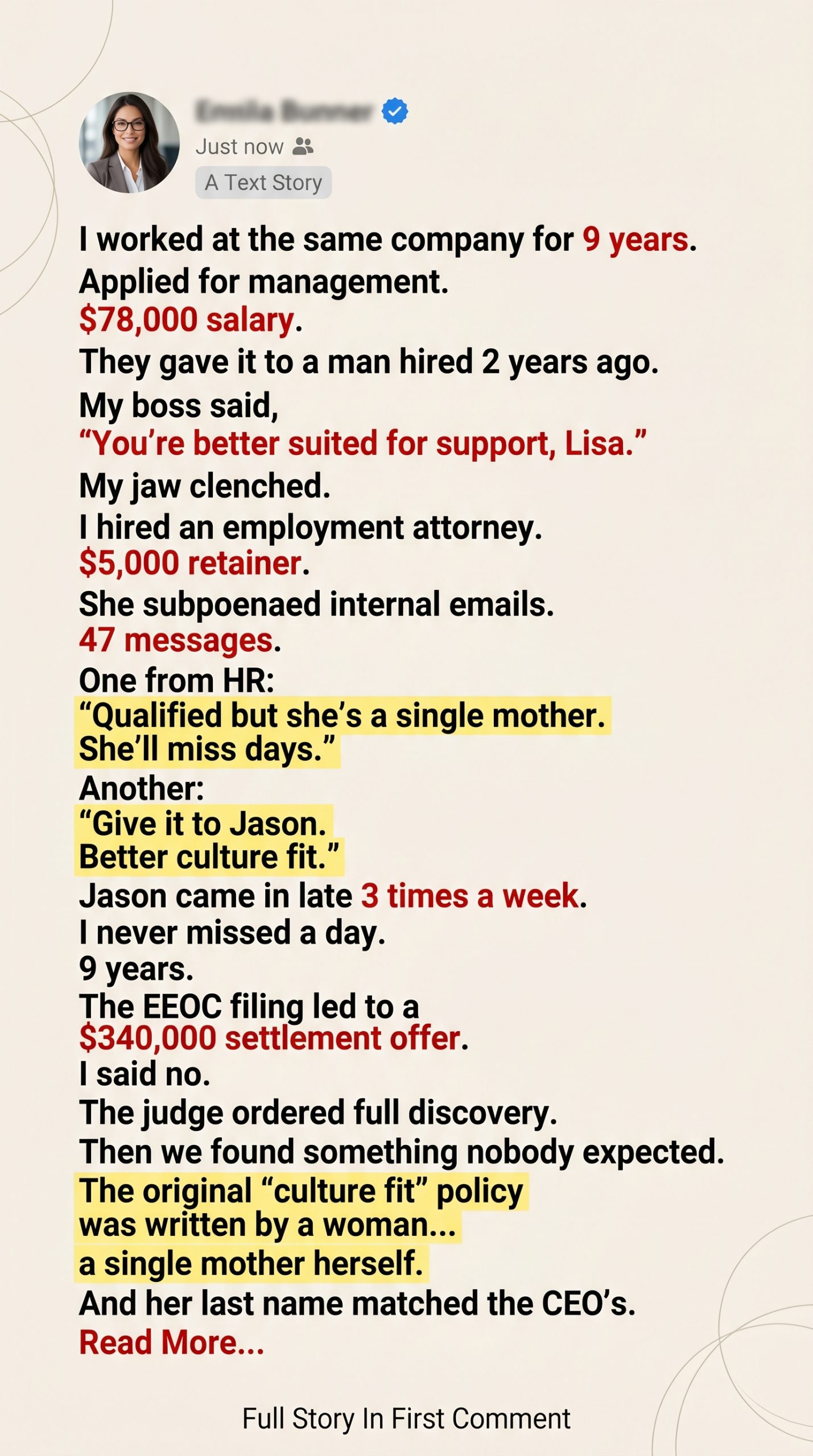
I worked at the same company for nine years.
Nine years of early mornings.
Nine years of skipped lunches.
Nine years of staying late whenever the team needed help.
When the management position opened, everyone assumed I would get it.
Including me.
The job paid $78,000 a year.
It would have changed everything for my son and me.
Instead, they gave it to Jason.
Jason had been with the company for barely two years.
At first, I thought there must be a reason.
Maybe he had qualifications I didn’t know about.
Maybe he’d achieved something extraordinary.
Then my boss called me into his office.
He smiled and said,
“You’re better suited for support, Lisa.”
Support.
Not leadership.
Not management.
Support.
I nodded politely and walked out.
Then I went into the bathroom and cried.
That night, my sister asked me a simple question.
“Do you really believe that’s the truth?”
The more I thought about it, the less sense it made.
My performance reviews were excellent.
My department had the highest retention rate.
I’d trained half the staff—including Jason.
So I hired an employment attorney.
The $5,000 retainer nearly emptied my savings account.
But something felt wrong.
Months later, subpoenas were issued.
Internal emails started arriving.
Dozens of them.
Then came the message that changed everything.
An HR manager had written:
“Qualified, but she’s a single mother. She’ll miss days.”
Another replied:
“Give it to Jason. Better culture fit.”
Culture fit.
Two words.
Those two words had cost me years of opportunities.
My attorney kept digging.
The deeper we looked, the uglier things became.
Jason wasn’t coming into the office five days a week.
Sometimes not even four.
Yet management repeatedly praised his “commitment.”
Meanwhile, every absence I’d ever taken—to care for my sick son, attend school meetings, or handle emergencies—was documented and discussed.
The company eventually offered a settlement.
$340,000.
My attorney looked pleased.
“You could take it.”
I thought about my son’s future.
The mortgage.
The bills.
The stress.
Then I asked one question.
“Does this stop the investigation?”
“Yes.”
I pushed the offer back across the table.
“No.”
The company was stunned.
Most people settle.
Most people walk away.
I couldn’t.
Because this wasn’t just about me anymore.
Discovery continued.
And that’s when we found the document.
The so-called “culture fit” policy.
Management insisted it was created by company leadership.
A long-standing guideline.
Proof they treated everyone equally.
But the metadata told a different story.
The policy had originally been written fifteen years earlier.
By a woman.
A single mother.
Someone who had fought for fair treatment.
Her name seemed familiar.
Very familiar.
My attorney looked up.
“Lisa… you need to see this.”
The current CEO’s original employee file was attached to the policy history.
Before marriage.
Before promotions.
Before becoming CEO.
She had a different last name.
The same last name as the woman who wrote the policy.
I stared at the screen.
Then it hit me.
The CEO wasn’t just connected to the policy.
The woman who wrote it was her mother.
A single mother.
The exact kind of woman the company was now discriminating against.
When the story reached court, everything unraveled.
The judge wasn’t impressed.
Neither were the shareholders.
Within months, several executives resigned.
The promotion process was completely redesigned.
New oversight rules were introduced.
And hundreds of employees had their records reviewed.
As for me?
I finally received the management position.
Not because anyone handed it to me.
Because I’d earned it years earlier.
The biggest surprise came later.
One afternoon, I received a letter.
It was from the retired woman who had written the original policy.
The CEO’s mother.
Inside was a handwritten note“I created that policy to protect women like us.
Thank you for refusing to let them use it against us.”
I still keep that letter in my desk.
Because sometimes standing up for yourself changes more than your own life.
Sometimes it changes the system that tried to hold you back.
