My mother remarried at seventy-two.
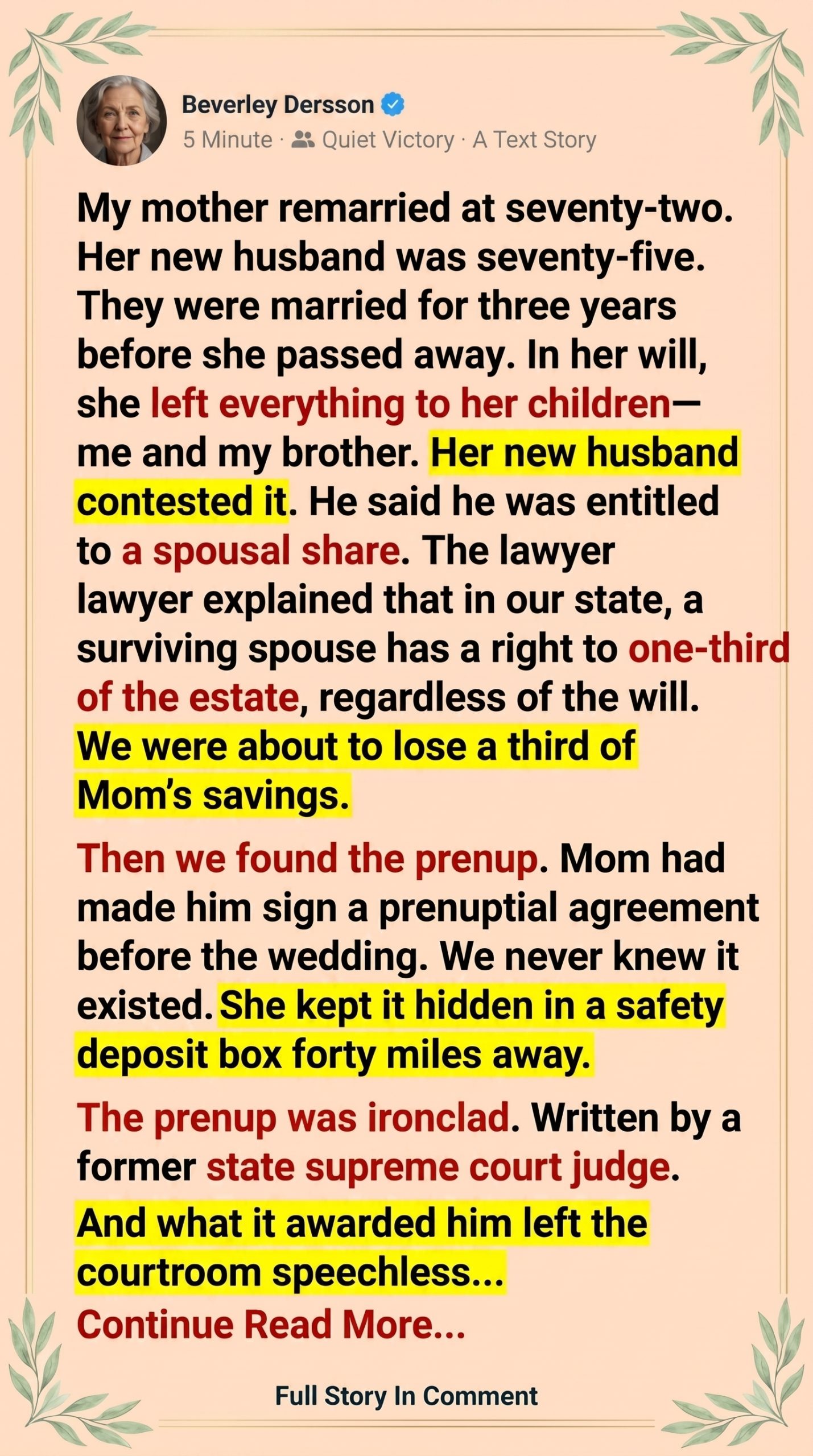
Her new husband, Gerald, was seventy-five.
At first, we were happy for her.
After Dad passed away, Mom spent years alone.
Then Gerald came along.
He was charming.
Polite.
Attentive.
Or so we thought.
Three years later, Mom passed away unexpectedly.
The grief was overwhelming.
But within days, another shock arrived.
Gerald contested the will.
Mom had left everything to me and my brother.
Every dollar.
Every investment.
Every piece of property.
Gerald’s attorney argued that, under state law, a surviving spouse was entitled to a substantial share of the estate regardless of what the will said.
The amount was staggering.
Nearly one-third of everything Mom had spent her life building.
My brother and I were devastated.
Mom had worked for forty years as a teacher.
She saved every penny.
And now it seemed much of it would be lost.
Then our lawyer called.
“There may be something you should see.”
He slid a faded document across the conference table.
A prenuptial agreement.
Neither my brother nor I knew it existed.
Mom had never mentioned it.
The document had been stored in a safety deposit box at a small bank nearly forty miles away.
And the terms were unlike anything I’d ever seen.
Mom had hired a former state supreme court judge to draft it.
Every line was precise.
Every possibility addressed.
The agreement clearly stated that Gerald waived any claim to her separate property, investments, retirement accounts, and estate.
If the marriage ended by divorce or death, he would receive only the specific assets listed in the agreement.
His attorney immediately challenged it.
Claiming Gerald didn’t understand what he signed.
Claiming it was unfair.
Claiming Mom pressured him.
But then another document surfaced.
A video recording.
Mom had anticipated a challenge.
On the video, she sat across from Gerald and a lawyer.
The attorney carefully explained every clause.
Gerald acknowledged that he understood.
Repeatedly.
Clearly.
Calmly.
The courtroom became very quiet.
The judge watched the entire recording.
Then looked at Gerald.
“Do you still claim you didn’t understand the agreement?”
Gerald said nothing.
The judge ruled the prenup valid.
Completely valid.
The estate remained exactly as Mom intended.
After the hearing, curiosity got the better of me.
I looked at the list of assets Gerald was entitled to under the agreement.
It wasn’t much.
A set of golf clubs.
A guest bedroom furniture set.
A small antique clock.
And the contents of the guest bedroom closet.
That’s it.
The closet seemed oddly specific.
A week later, my brother and I began sorting through Mom’s house.
Eventually we reached the guest room.
Inside the closet sat several old storage boxes.
One was labeled:
“For my children.”
My hands shook as I opened it.
Inside were dozens of letters.
One for every major milestone Mom thought she might miss.
Birthdays.
Anniversaries.
Retirements.
Future grandchildren.
Each envelope was dated years into the future.
My brother started crying.
So did I.
Then we found one final envelope.
Marked:
“Open together.”
Inside was a handwritten note.
It read: you’re reading this, then my plan worked.
I knew Gerald might contest the estate.
That’s why I insisted on the prenup.
But the real treasure isn’t the money.
It’s this.
I wanted to leave you something no lawsuit could ever take away.
At the bottom was a simple sentence:Love lasts longer than inheritance.
That night, my brother and I sat in the guest room reading letter after letter.
Laughing.
Crying.
Remembering.
The legal battle had consumed months of our lives.
But in the end, the most valuable thing Mom left behind wasn’t her savings.
It wasn’t her house.
It wasn’t her investments.
It was the reminder that even after she’s gone, a parent’s love can still find a way to reach their children.