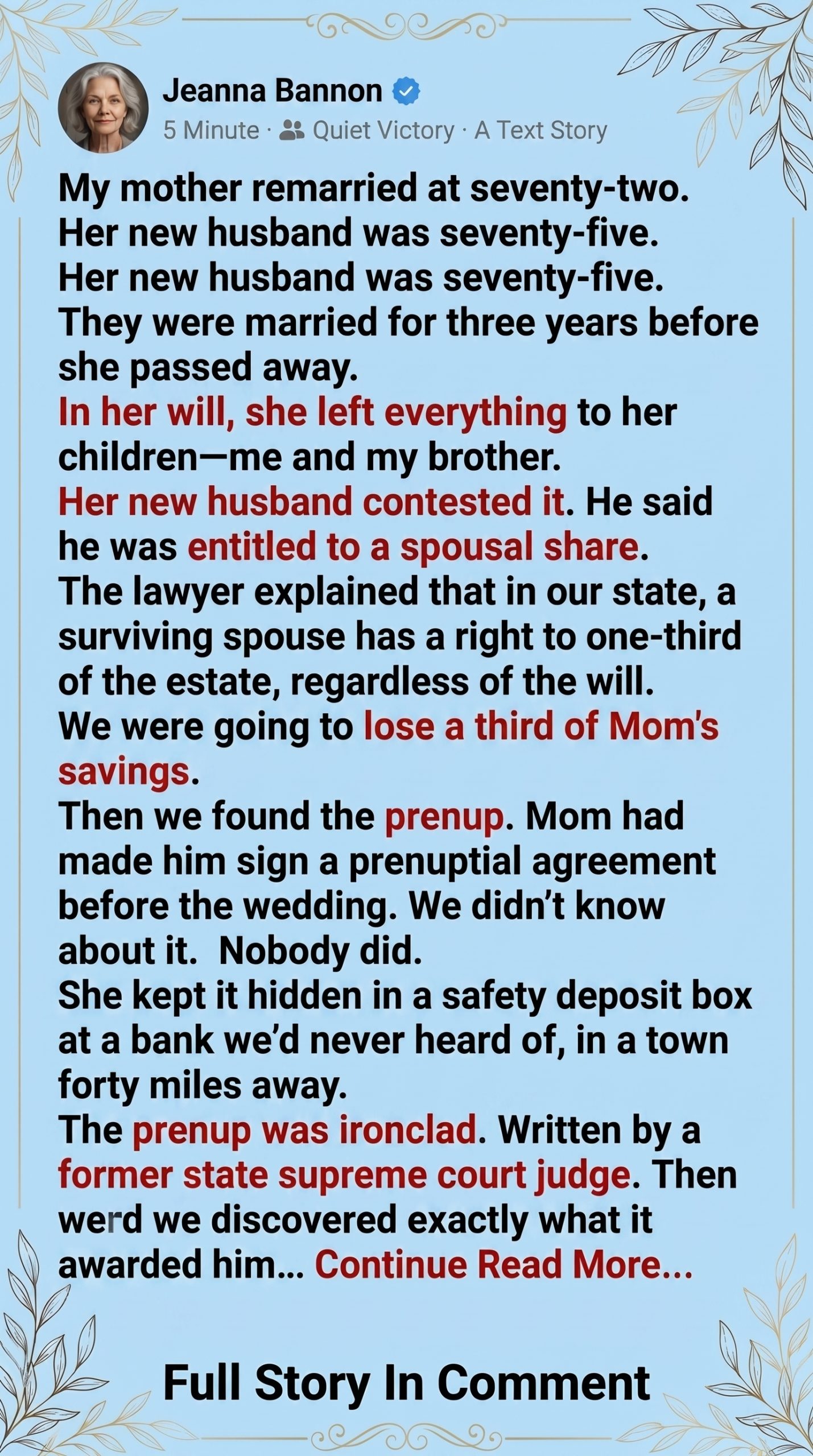
My mother remarried at seventy-two.
Her new husband, Walter, was seventy-five.
At first, we were relieved.
After Dad died, Mom spent nearly a decade alone.
Walter seemed kind.
Polite.
Helpful.
The sort of man who remembered birthdays and brought flowers.
Three years later, Mom passed away peacefully in her sleep.
The grief was unbearable.
But it got worse.
Less than two weeks after the funeral, Walter filed paperwork contesting her will.
Mom had left everything to me and my brother.
Her house.
Her investments.
Her savings.
Everything.
Walter’s attorney argued that, as a surviving spouse, he was entitled to a substantial share of the estate regardless of the will’s instructions.
The number was staggering.
Nearly one-third of everything.
My brother and I were devastated.
Mom had spent decades saving for retirement.
Now a huge portion of it might disappear.
Then our attorney made a surprising phone call.
“Your mother may have anticipated this.”
A week later, we were standing inside a tiny bank forty miles away.
The manager unlocked a safety deposit box.
Inside was a thick envelope.
Written across the front were four words:
OPEN ONLY IF NECESSARY
Inside was a prenuptial agreement.
An incredibly detailed one.
Mom had never mentioned it.
Not once.
The document had been prepared by a former state supreme court judge who specialized in estate planning.
Every page was airtight.
Every clause crystal clear.
Walter had signed every page.
Initialed every amendment.
Acknowledged every condition.
His attorney immediately claimed he hadn’t understood what he was signing.
Then another surprise appeared.
Attached to the prenup was a video recording.
Mom had insisted on filming the signing.
The recording showed Walter reviewing the agreement with his own lawyer.
He repeatedly confirmed that he understood every provision.
The challenge began falling apart.
Fast.
But the biggest surprise was still waiting.
The prenup didn’t leave Walter completely empty-handed.
Instead, it listed exactly what he would receive.
The courtroom listened as the attorney read it aloud.
A set of golf clubs.
The contents of the guest bedroom closet.
A grandfather clock.
And one locked cedar chest.
That’s it.
People actually laughed.
Walter looked furious.
The judge upheld the agreement.
Case closed.
Weeks later, my brother and I opened the cedar chest.
Inside were dozens of letters.
Handwritten by Mom.
Each labeled for a future event.
For your next birthday.
For when you’re feeling lost.
For your retirement.
For the day you become a grandparent.
For when you miss me.
My brother started crying before he finished the first paragraph.
So did I.
Then we found one final envelope.
It simply read:
Read this together.
Inside was a letter.
Mom wrote:
“If you’re reading this, then the prenup did exactly what I intended.
I didn’t create it because I hated Walter.
I created it because I loved you.
Money creates arguments.
Love should not.”
Then came the sentence that hit hardest:
“The real inheritance was never in my bank account.”
Tucked beneath the letter was a photo album.
Hundreds of photographs.
Family vacations.
Birthdays.
School plays.
Christmas mornings.
Tiny moments we had forgotten.
That album became the most valuable thing she left behind.
Months later, Walter called.
For the first time, he sounded defeated.
Not angry.
Just sad.
He admitted he had contested the will because he felt abandoned after Mom died.
He wasn’t really fighting for money.
He was fighting against being alone.
We talked for nearly two hours.
And eventually, something unexpected happened.
We made peace.
The lawsuit ended.
The bitterness ended.
And the family that almost fell apart slowly began to heal.
Because in the end, Mom had been right.
The real inheritance wasn’t the house.
Or the investments.
Or the savings account.
It was the reminder that family is worth more than anything money can buy.