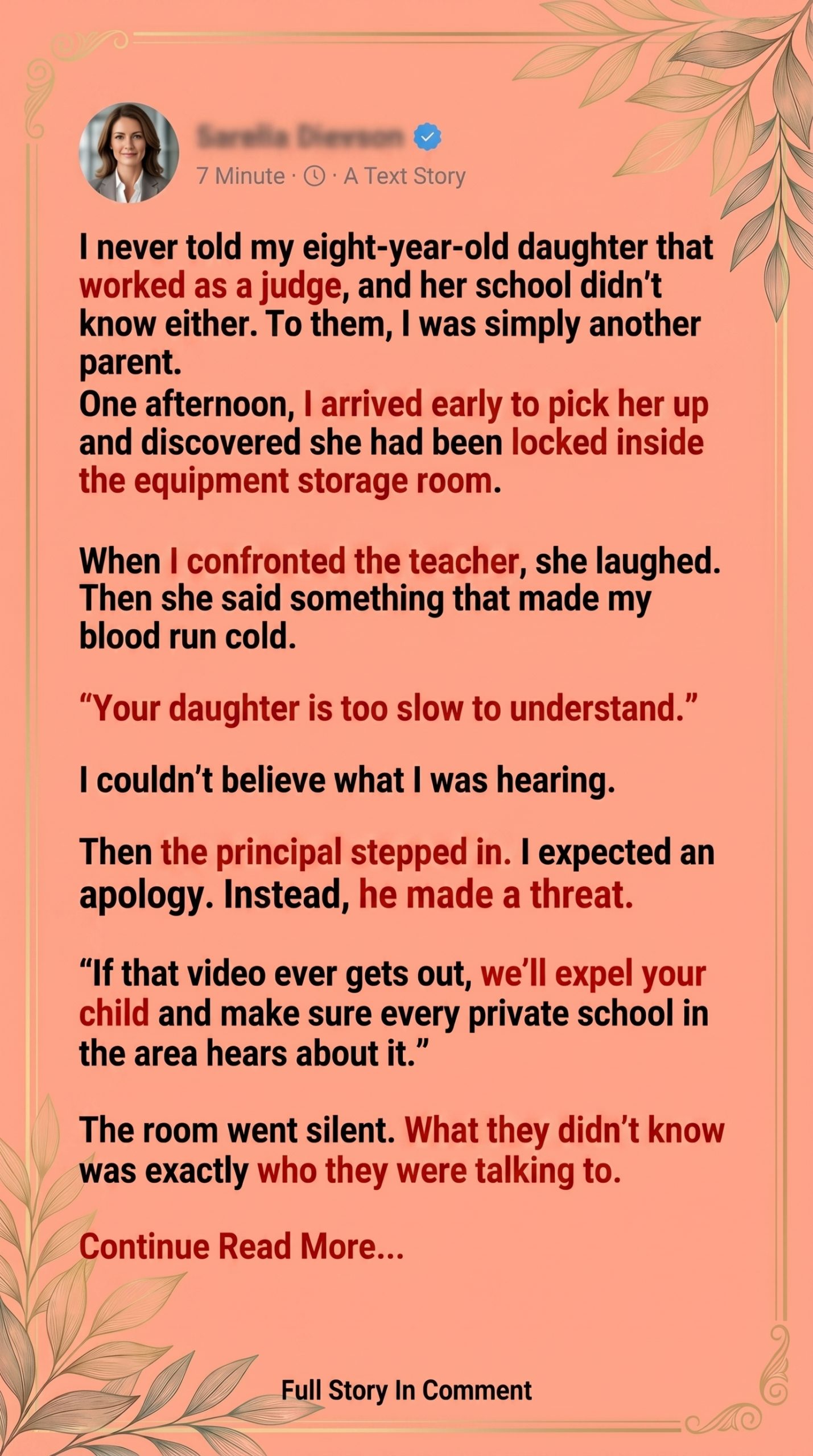
I never told my eight-year-old daughter that I was a judge.
To her, I was just Mom.
The woman who packed lunches, helped with homework, and forgot where she left her car keys.
I wanted her childhood to be normal.
So I kept my job separate from our home life.
One afternoon, I arrived early to pick her up from school.
The parking lot was nearly empty.
Classes had ended twenty minutes earlier.
Yet my daughter wasn’t waiting outside.
The receptionist looked confused.
“She should have been dismissed.”
A knot formed in my stomach.
Teachers started searching.
Finally, a janitor mentioned hearing noises from the equipment storage room behind the gym.
When we opened the door, I found my daughter sitting alone in the dark.
Crying.
She ran into my arms.
“What happened?”
She pointed toward her classroom.
“My teacher put me here.”
I felt my blood turn cold.
According to my daughter, she’d answered a question incorrectly.
The teacher became angry and ordered her into the storage room “to think about her behavior.”
At first, I couldn’t believe it.
There had to be an explanation.
Then I checked the small camera I kept in my car.
I had installed a dashcam years earlier.
Because I parked facing the rear service area, part of the hallway entrance appeared in the footage.
The video showed the teacher escorting my daughter toward the storage area.
Then leaving her there.
Alone.
For nearly an hour.
The next morning, I met with the teacher and principal.
I calmly placed a copy of the footage on the desk.
The teacher watched in silence.
Then she rolled her eyes.
“Your daughter is too slow to understand.”
I stared at her.
She continued.
“This is how I deal with students like her.”
Students like her.
My daughter was an honor student.
Curious.
Kind.
Sensitive.
But none of that mattered to the woman sitting across from me.
Before I could respond, the principal interrupted.
His face had gone pale.
“If that video gets out,” he said, “we’ll expel your child and make sure every private school in the area hears about it.”
For a moment, I thought I’d misheard him.
Then he repeated it.
A threat.
Directed at an eight-year-old.
The room fell silent.
I slowly closed my notebook.
Stood up.
And handed him my business card.
He glanced at it.
Then looked again.
His expression changed instantly.
The color drained from his face.
Because for the first time, he realized who I was.
Not just a parent.
A judge.
But it was already too late.
The meeting had been recorded.
Legally.
The threats.
The admissions.
Everything.
Within forty-eight hours, my attorney filed complaints with the school board, the state education department, and child welfare authorities.
The investigation moved quickly.
Very quickly.
The security footage from inside the school confirmed my daughter’s account.
And revealed something worse.
She wasn’t the only child.
Several students had been isolated as punishment.
Parents began coming forward.
Stories emerged.
A pattern formed.
The teacher was suspended.
Then terminated.
The principal resigned before the investigation concluded.
Months later, the school implemented major policy changes.
New oversight.
New reporting procedures.
Mandatory staff training.
But the most important moment happened much later.
One evening, my daughter asked:
“Mom, were you angry because you’re a judge?”
I smiled.
“No.”
“Then why?”
I pulled her into a hug.
“Because I’m your mother.”
She thought about that.
Then nodded.
And rested her head on my shoulder.
The truth is, being a judge helped uncover what happened.
But being a mother is why I fought.
Because titles matter in court.
But love is what gives you the courage to walk into the courtroom in the first place.