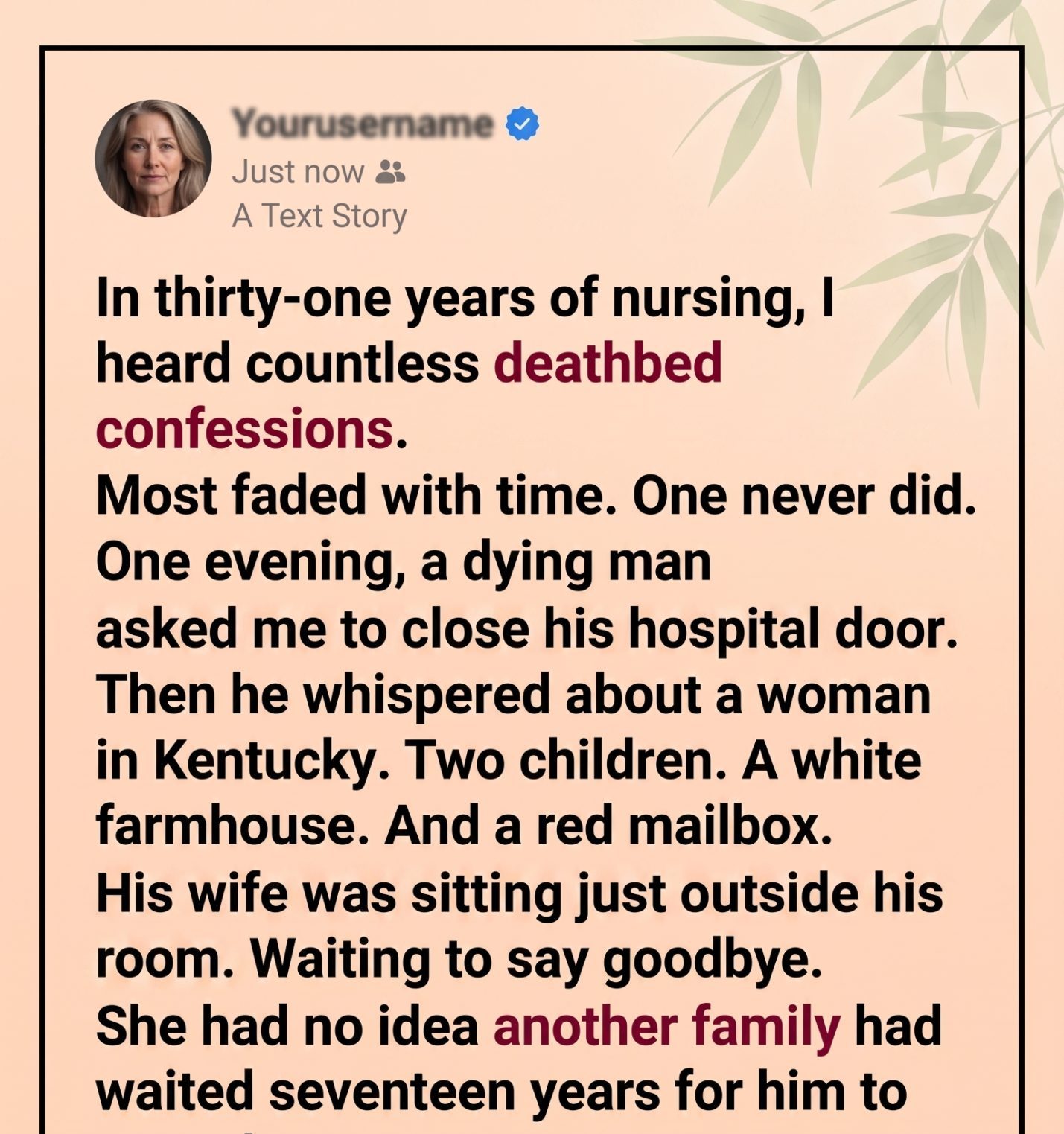
In thirty-one years of nursing, I heard countless deathbed confessions.
Some were heartbreaking.
Some were unbelievable.
Most faded with time.
But one has stayed with me every single day.
The patient was in Room 614.
His name was Arthur.
Eighty-one years old.
Terminal cancer.
Quiet.
Polite.
Always thanked every nurse who entered his room.
One evening, just after visiting hours ended, he looked at me and said softly,
“Could you close the door?”
I did.
He waited until the hallway was silent.
Then he pointed to the chair beside his bed.
“Sit for a minute.”
“I’ve carried something for seventeen years,” he whispered.
“I can’t die with it.”
He told me about a small town in Kentucky.
A white farmhouse.
A woman named Claire.
Two young children.
A red mailbox at the end of a gravel driveway.
“They’re my family.”
I frowned.
“But your wife has been here every day.”
He nodded.
“I know.”
“My wife, Margaret… she’s a wonderful woman.”
“She deserves better than what I gave her.”
He explained that before meeting Margaret, he’d fallen in love with Claire.
They had two children together.
When Arthur was offered a job in another state, he promised he’d return after getting settled.
He never did.
Weeks became months.
Months became years.
Ashamed of abandoning them, he convinced himself they would be better off without him.
Eventually, he married Margaret.
She never knew Claire existed.
Neither did anyone else.
“I’ve lived with that cowardice every day,” he said.
The next morning, Arthur slipped into a coma.
He died peacefully at 3 a.m.
Margaret was holding his hand.
She cried quietly as we prepared his belongings.
While emptying his bedside drawer, she found an old leather wallet.
Hidden behind a faded family photo was a tiny folded piece of paper.
She opened it.
Inside was a phone number.
No name.
Only one sentence.
“If it’s ever too late… tell them I never stopped loving them.”
Margaret looked at me.
“Do you know who this belongs to?”
I froze.
Arthur had trusted me with his secret.
But he had never asked me to tell her.
Nor had he asked me to stay silent.
I spent the entire day wrestling with my conscience.
Finally, after my shift ended, I drove to my nursing supervisor’s office.
She listened carefully.
Then she said,
“The secret died with him.”
I nodded.
But Margaret kept calling the number.
It always went to voicemail.
Three days later, she returned to the hospital.
She wasn’t angry.
She simply said,
“I know he told you something.”
There was so much sadness in her voice that I couldn’t ignore it.
I couldn’t betray Arthur.
But I couldn’t lie to his widow either.
So I handed her the folded paper.
Nothing more.
She thanked me.
And left.
Nearly two months passed.
Then one afternoon, Margaret walked back into the hospital carrying a small quilt.
“I found them,” she whispered.
Claire had passed away five years earlier.
But Arthur’s son and daughter were still living in the same Kentucky town.
She drove there herself.
At first, they refused to open the door.
They thought she was another scammer.
Then she showed them Arthur’s photograph.
His daughter burst into tears.
She had kept every birthday card Arthur secretly mailed through anonymous friends after he disappeared.
She’d never known who sent them.
Margaret stayed with them all weekend.
She apologized…
For something she had never done.
Arthur’s children cried with her.
Before she left, Arthur’s grandson handed her a knitted blanket.
“My grandma made this,” he said.
“She always believed he’d come home someday.”
Margaret smiled through tears.
“He finally did.”
Months later, she donated the blanket to our hospital hospice unit.
Today, it still rests across the bed of patients who have no family beside them.
Every time I see it…
I remember Arthur.
And I remember that the heaviest burden many people carry isn’t illness.
It’s the truth they’ve waited too long to tell.