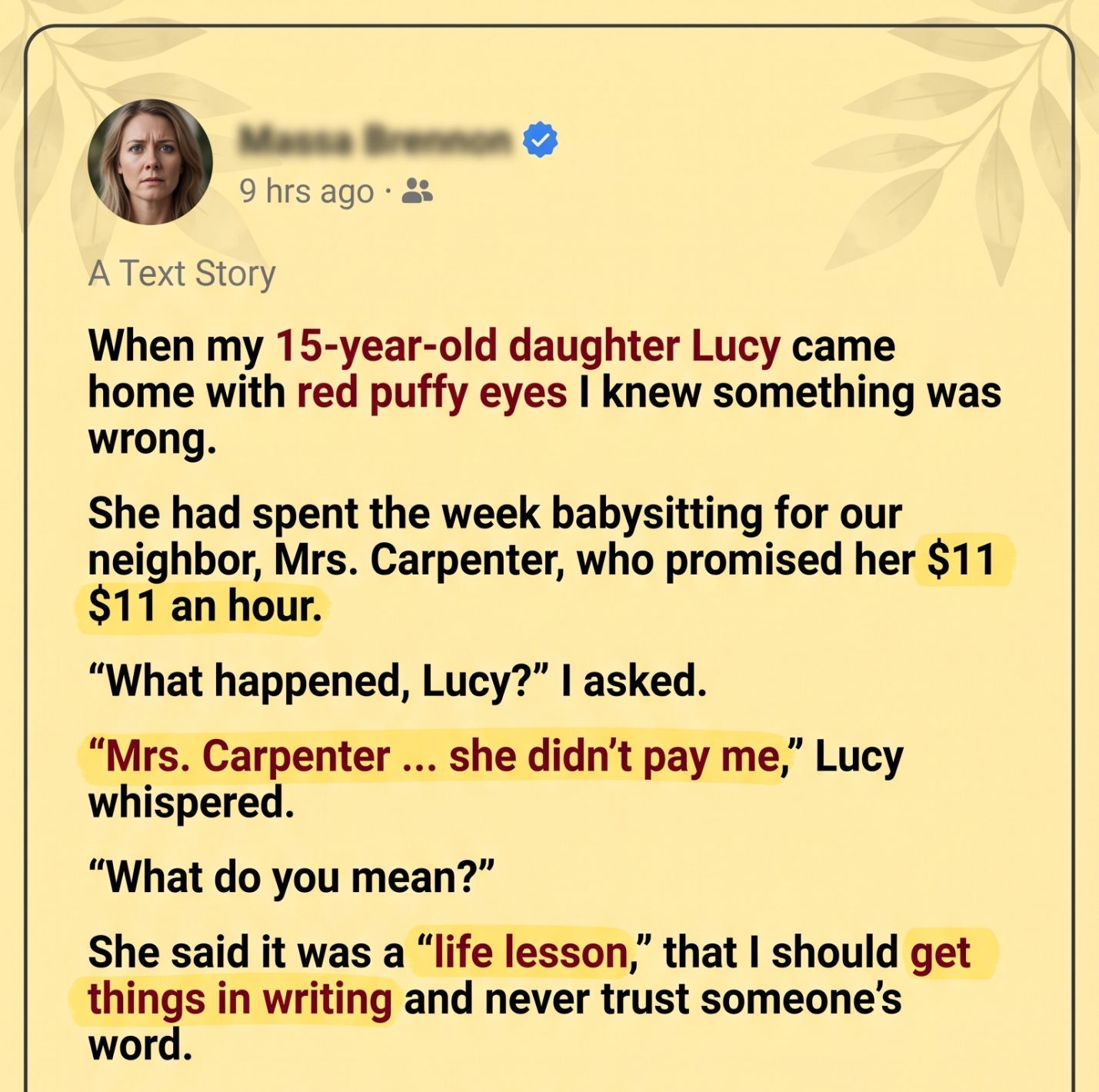
When my 15-year-old daughter Lucy came home with red puffy eyes, I knew something was wrong.
She had spent the week babysitting for our neighbor, Mrs. Carpenter, who promised her $11 an hour.
Lucy had been saving for months.
She wanted to buy a new laptop for school.
When she walked through the door that Friday evening, she dropped her backpack and went straight to her room.
I followed.
“What happened, Lucy?”
She wiped her eyes.
“Mrs. Carpenter… she didn’t pay me.”
I stared at her.
“What do you mean she didn’t pay you?”
Lucy pulled out a small notebook.
“I worked twenty hours.”
“She owes me $220.”
My heart sank.
“Did you ask her?”
Lucy nodded.
“She said it was a ‘life lesson.’”
I couldn’t believe it.
“What kind of life lesson?”
Lucy took a shaky breath.
“She said I should get things in writing and never trust someone’s word.”
Then she slammed her bedroom door.
I stood there, furious.
Not because of the money alone.
Because someone had deliberately taken advantage of my daughter.
The next morning, I walked over to Mrs. Carpenter’s house.
She opened the door with a smile.
“Good morning!”
I didn’t smile back.
“Lucy says you haven’t paid her.”
Her expression changed immediately.
“Oh, that.”
She waved her hand dismissively.
“I was trying to teach her responsibility.”
“Responsibility?”
“She needs to learn that the real world doesn’t always work the way children expect.”
I stared at her.
“You promised her $11 an hour.”
“She agreed to babysit.”
“She did her job.”
Mrs. Carpenter shrugged.
“And now she’s learned an important lesson.”
I pulled out my phone.
“I recorded our conversation.”
Her face went pale.
“I also have Lucy’s messages confirming the hours she worked.”
Then I said something she clearly wasn’t expecting.
“And I have the names of two other teenagers you’ve hired this year.”
She stopped smiling.
Apparently, Lucy wasn’t the first.
Two other neighborhood teenagers had babysat for her and never received the full amount they were promised.
Mrs. Carpenter suddenly became very interested in paying.
“I can give you the money today.”
“No,” I said.
“You can pay Lucy directly.”
She handed my daughter the $220 that afternoon.
But I wasn’t finished.
I contacted the other families.
They compared messages, dates and promised rates.
Within days, several parents were involved.
Mrs. Carpenter eventually apologized.
Not because she suddenly understood what she’d done.
But because she realized everyone knew.
That evening, Lucy sat beside me at the kitchen table.
“I thought maybe I was being stupid,” she said.
“You weren’t.”
“But she made me feel like it was my fault.”
I took her hand.
“Someone refusing to pay you doesn’t make your work worthless.”
Lucy smiled weakly.
Then she opened her notebook.
At the top of a fresh page, she wrote:
“Always get it in writing.”
I laughed.
“Looks like you did learn a life lesson.”
She looked at me.
“Yeah.”
Then she added:
“But I learned it from Mom.”
And that $220?
Lucy didn’t spend it.
She put every dollar into her savings account.
Because the most valuable thing she earned that week wasn’t the money.
It was learning that she deserved to be treated fairly—and