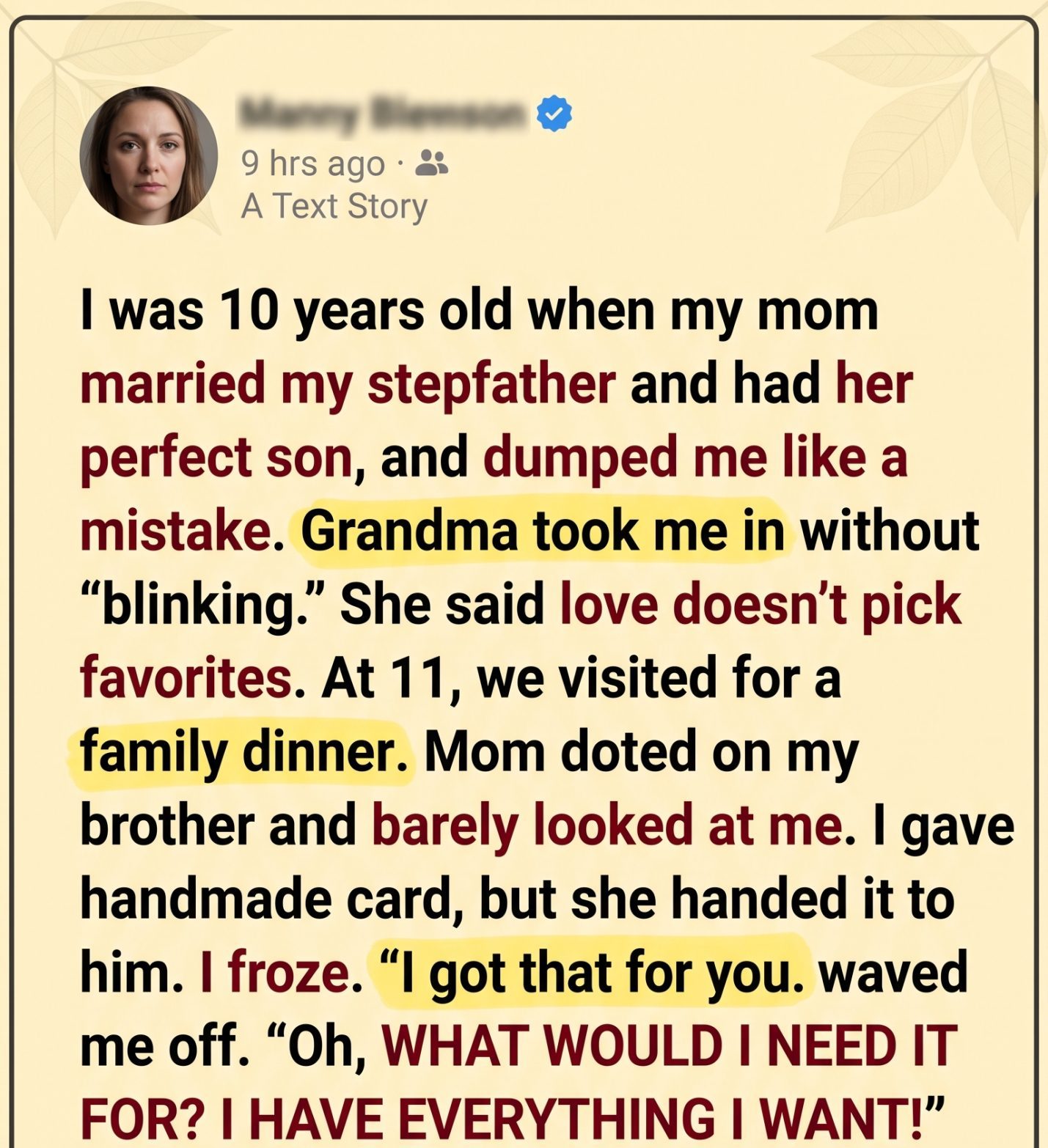
I was 10 years old when my mom married my stepfather.
He already had a son.
A perfect son, according to everyone.
He was athletic, confident, and apparently incapable of doing anything wrong.
Within months, my mother had completely changed.
She stopped calling me “sweetheart.”
She stopped asking about school.
And whenever my stepbrother made a mistake, somehow I was blamed.
One afternoon, I spilled juice on the kitchen floor.
My mother sighed dramatically.
“Why can’t you be more careful like him?”
I looked at my stepbrother.
He was sitting on the couch playing video games.
He didn’t even look up.
Then came the day Grandma intervened.
She took me aside and said,
“Sweetheart, love doesn’t pick favorites.”
I didn’t understand what she meant.
Until Thanksgiving.
My mother announced that she was taking my stepbrother on a special vacation.
When I asked if I could go, she laughed.
“Maybe when you learn how to behave.”
Grandma immediately took my hand.
“You’re coming with me.”
I moved into Grandma’s house a few months later.
My mother barely objected.
That hurt more than anything.
Grandma became my real mother in everything but name.
She helped with homework.
She attended every school event.
She taught me how to cook.
When I got my first job, she was the first person I told.
When I graduated, she cried harder than I did.
But I never stopped wondering about my mother.
At 32, Grandma passed away.
I was devastated.
Three days after the funeral, someone knocked on my apartment door.
I opened it.
My mother was standing there.
I almost didn’t recognize her.
She looked older.
Tired.
And frightened.
“Can I come in?”
I stepped aside.
She sat at my kitchen table and stared at her hands.
Then she said,
“I need to tell you something.”
I waited.
She pulled an old envelope from her purse.
“I found this after your grandmother died.”
She placed it in front of me.
My name was written across the front.
I opened it.
Inside was the handmade card I’d given my mother when I was eleven.
The one she’d rejected.
But there was something else.
A letter from Grandma.
I began reading.
It explained that my mother had struggled after my biological father left.
She had been overwhelmed and afraid she couldn’t raise me alone.
When she married my stepfather, she became desperate to make the new family work.
And instead of protecting me, she convinced herself that pushing me aside would make everyone happier.
I stopped reading.
I looked at my mother.
“Why are you telling me this now?”
She started crying.
“Because I was wrong.”
I didn’t know what to say.
Then she whispered,
“I watched your grandmother love you for years, and I knew she was giving you the childhood I should have given you.”
She reached into her purse again.
This time, she pulled out an old photograph.
It showed me at eleven, holding the handmade card.
Grandma was standing beside me.
On the back was a sentence written in Grandma’s handwriting:
“One day she will understand that she was never the problem.”
My mother covered her face.
“I thought you hated me.”
I looked at her for a long time.
“I did.”
She nodded.
“I know.”
“But I don’t anymore.”
She looked up.
“Why?”
“Because Grandma taught me something.”
“What?”
“That forgiveness doesn’t mean pretending nothing happened.”
I folded the letter carefully.
“It means I don’t have to carry it anymore.”
My mother cried.
I didn’t hug her.
Not that day.
But I didn’t ask her to leave either.
Over the following months, we slowly rebuilt a relationship.
It wasn’t like the movies.
There was no magical moment when everything became perfect.
She had missed too many birthdays.
Too many school plays.
Too many ordinary afternoons.
But she started showing up.
And for the first time, I let her.
One year later, she brought me a small wrapped box.
Inside was a handmade card.
She had made it herself.
On the front were the words:
“I’m sorry I didn’t know how to love you when you needed me most.”
I cried when I read it.
Then I finally hugged her.
Not because the past had disappeared.
But because I was finally free from it.
Grandma had been right all those years.
Love shouldn’t pick favorites.
And when it does, the child who gets left behind needs to know one thing:
