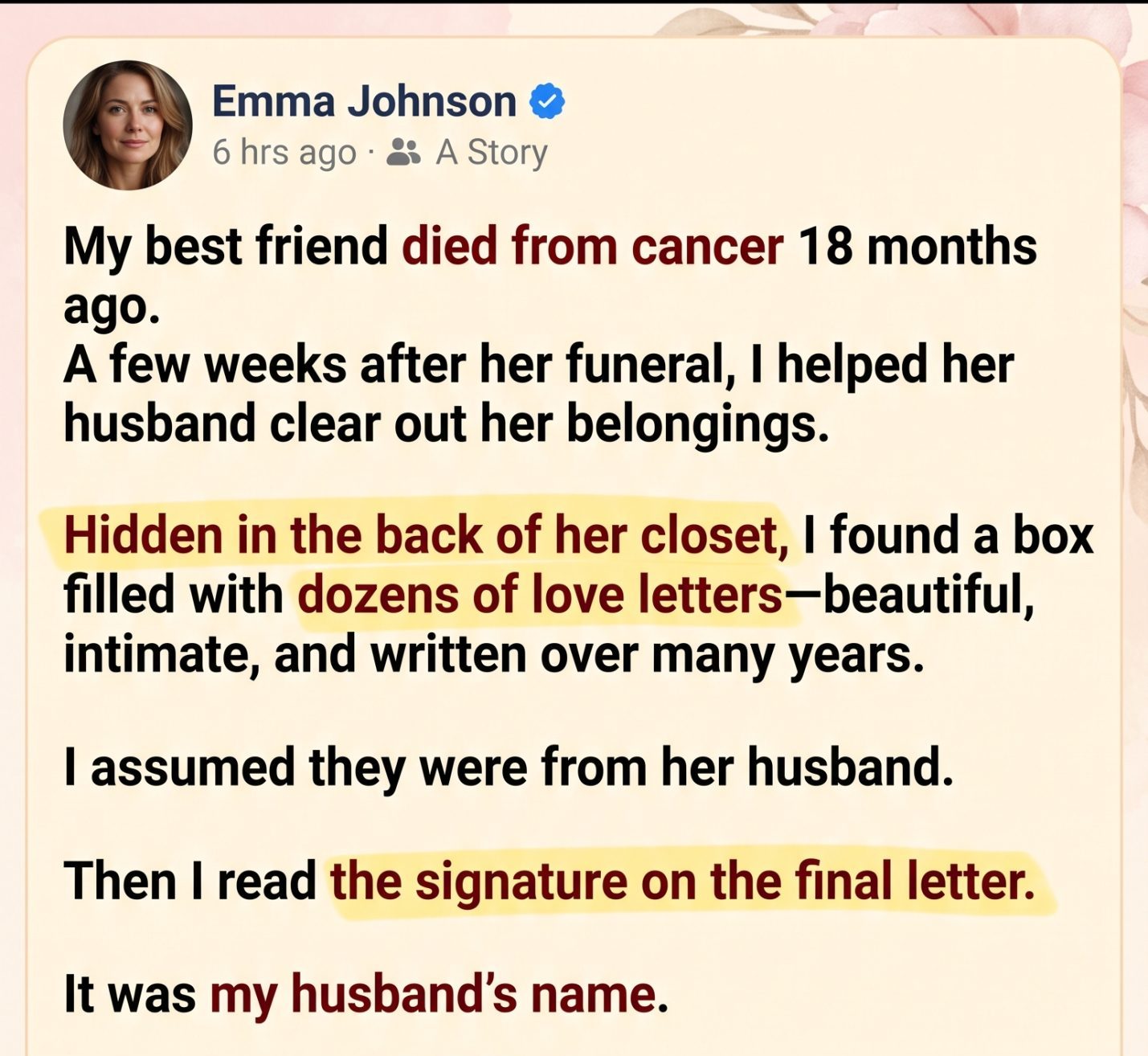
My best friend died from cancer eighteen months ago.
Her name was Sarah.
She was the kind of person who could walk into a room full of strangers and somehow leave with ten new friends. She laughed too loudly, loved too deeply, and remembered tiny details about people that even they had forgotten.
For nearly twenty years, she had been my person.
When she got married, I was there beside her.
When she had her first child, I was the first person she called.
When she got sick, I was there for every hospital visit, every frightening phone call, every night when she was too scared to sleep.
And when she died, something inside me went with her.
Her husband, Daniel, was devastated.
I had never seen a man break the way he did.
After the funeral, I tried to stay close to him and the children. Not because I wanted anything from him, but because Sarah had been my family.
About three weeks after the funeral, Daniel called me.
“Could you help me clean out her things?”
I almost said no.
But then he added quietly, “I can’t do it alone.”
So I went.
We spent most of the afternoon going through her clothes, photographs, books, and little things she’d collected over the years.
Eventually, Daniel went downstairs to deal with some boxes while I continued cleaning her bedroom.
Her closet was packed.
At the very back, behind several winter coats, I noticed an old cardboard box.
It wasn’t labeled.
I pulled it out and opened it.
Inside were dozens of envelopes.
Some were yellowed with age.
Some were newer.
They were tied together with a faded blue ribbon.
I assumed immediately that they were from Daniel.
Maybe old love letters.
Maybe birthday notes.
Maybe something from the early days of their marriage.
I almost put them back.
But then I noticed something strange.
The letters weren’t addressed to Sarah.
They were written by someone else.
I picked up the first envelope.
There was no name on the front.
Only a date.
I opened it.
The handwriting was unmistakably male.
And the first sentence made my stomach drop.
“Today you laughed at something I said, and I’ve been thinking about it all day.”
I kept reading.
The letter described Sarah at work.
The way she pushed her hair behind her ear when she was concentrating.
The way she smiled when she was trying not to laugh.
The way she always bought an extra coffee because she knew someone might need it.
It was intimate.
Tender.
Almost painfully intimate.
I assumed it was from Daniel.
Then I reached the final page.
There was a signature.
I froze.
It wasn’t Daniel’s name.
It was my husband’s.
My husband, Michael.
I stopped breathing.
Michael had died seven years earlier.
I read the signature again.
And again.
Then I grabbed another letter.
Same handwriting.
Same signature.
Michael.
There were twelve years of letters.
Twelve years.
I sat on Sarah’s bedroom floor, surrounded by her clothes, and began reading.
The first letter was dated twelve years earlier.
Michael had written about meeting Sarah at one of our dinners.
He said he had noticed her immediately.
Not because she was beautiful, although he admitted she was.
But because she knew exactly how to make me laugh when I was stressed.
He wrote:
“I think I understand why she loves you. She makes you lighter.”
Another letter talked about a Christmas party.
Another about a vacation.
Another about the day Michael and I bought our first house.
But as the years went on, the letters changed.
They became confessions.
He wrote about loving Sarah.
Not casually.
Not temporarily.
He loved her deeply.
And he hated himself for it.
I couldn’t stop reading.
One letter said:
“Sometimes I wonder what my life would look like if I had met her first. Then I hate myself for wondering.”
Another said:
“She deserves someone who can tell her exactly how he feels. But I will never be that man.”
And then I found a letter dated the day Michael was diagnosed with cancer.
“Today I learned I may not have as much time as I thought. My first thought was of my wife. My second was of Sarah. I hate that.”
I started crying.
Not because I was angry.
Not even because I felt betrayed.
I was crying because I suddenly understood how lonely he must have been.
He had carried this secret for years.
And Sarah had apparently known.
At least, I assumed she had.
I heard footsteps behind me.
I quickly wiped my face.
Daniel was standing in the doorway.
He looked at the box.
Then he looked at me.
He didn’t look surprised.
He simply sighed.
“You found them.”
I stared at him.
“You knew?”
He nodded.
“For how long?”
“Almost from the beginning.”
My hands started shaking.
“You knew my husband loved my best friend?”
Daniel looked down.
“Yes.”
“Did Sarah know?”
He hesitated.
“Yes.”
That answer hurt more than anything.
“She knew?”
“She knew he loved her,” Daniel said. “But she never encouraged it.”
I stood up.
“Then why did she keep these?”
Daniel walked into the room and sat on the edge of the bed.
“Because your husband asked her to.”
I didn’t understand.
“Asked her to what?”
“Keep them.”
Daniel explained that Michael had given Sarah the letters shortly before he died.
He had written them because he needed somewhere to put his feelings.
But he never intended to send them.
Sarah had promised to keep them private.
Daniel knew because Sarah eventually told him.
“She wanted me to burn them,” he said. “I couldn’t.”
“Why?”
“Because they were the last part of Michael she had.”
I looked at the box again.
There were still dozens of letters inside.
“What happened between them?”
“Nothing.”
I shook my head.
“There has to be more.”
“There isn’t.”
Daniel looked directly at me.
“Your husband loved her. She knew. And she loved you enough never to cross that line.”
I sat beside him.
“Then why didn’t Michael ever tell me?”
Daniel’s eyes filled with tears.
“Because he knew it would destroy you.”
For a long moment, neither of us spoke.
Then Daniel reached into his pocket.
He pulled out a small envelope.
“I’ve been holding onto this for eighteen months.”
My name was written on it.
In Sarah’s handwriting.
I opened it.
Inside was a single sheet of paper.
“If you’re reading this, then you found the letters.”
My hands trembled.
“I’m sorry you had to learn this way.”
“I didn’t know how to tell you while I was alive.”
“Your husband loved me. I knew. I also knew he loved you.”
“Those two things can exist at the same time, even though I know that doesn’t make them easier to understand.”
I swallowed hard.
“Michael never asked me to choose him. He never asked me to betray you. He never even asked me to love him back.”
“He only asked me to let him write.”
“And I let him.”
Then came the sentence that broke me.
“Because I understood what it meant to love someone you could never have.”
I stopped reading.
Daniel looked away.
I continued.
“Please don’t let these letters change the way you remember him.”
“He wasn’t perfect.”
“Neither was I.”
“But he loved you. Every day. Even on the days when his heart was confused.”
“And I loved you too.”
“That is why I kept his secret.”
The final paragraph was only three lines.
“You were the greatest friend I ever had.”
“I would choose you again.”
“Every single time.”
I couldn’t see the page anymore because my tears had blurred everything.
Daniel put a hand on my shoulder.
“I’m sorry.”
I shook my head.
“No.”
He looked at me.
“I’m not angry.”
And surprisingly, I wasn’t.
I was heartbroken.
But not angry.
That night, I took the box home.
For weeks, I couldn’t open it.
Then one evening, I finally did.
I read every letter.
There were 147.
Some were only a few lines.
Some were several pages long.
Some were full of guilt.
Some were funny.
Some were about ordinary things.
Sarah’s birthday.
A rainy afternoon.
A dinner we’d all shared.
A stupid joke Michael had heard.
And slowly, I realized something.
The letters weren’t really a love story.
They were the story of a man who had feelings he couldn’t act on and chose, every day, not to hurt the people he loved.
Michael never sent a single letter.
Sarah never betrayed me.
And Daniel had protected both families by keeping the secret.
The final letter was dated three days before Michael died.
It said:
“If I had one wish, it wouldn’t be to have Sarah.”
“It would be to have more time with my wife.”
“I wasted too much time being ashamed of what I felt instead of being grateful for what I had.”
“If she ever finds these letters, tell her this:”
“I loved someone I couldn’t have.”
“But I spent my life with the woman I chose.”
“And I would choose her again.”
I closed my eyes.
For the first time in years, I cried for Michael without feeling angry.
And for the first time since Sarah died, I cried for her without feeling completely empty.
A year later, I still have the letters.
I haven’t destroyed them.
I couldn’t.
They’re in a wooden box on the top shelf of my closet.
Sometimes I read one.
Not because I want to know what Michael felt for Sarah.
I already know.
I read them because they remind me that people are complicated.
That love isn’t always simple.
That having a feeling doesn’t mean you have to act on it.
And that sometimes the greatest act of love is knowing where the line is—and choosing not to cross it.
Sarah was my best friend.
Michael was my husband.
They both carried secrets.
But neither of them stopped loving me.
And maybe that’s the part of the story I needed to understand most.
Some truths hurt when you first discover them.
But sometimes, after the pain settles, they teach you something beautiful.
Sometimes love isn’t about getting what you want.
Sometimes love is about protecting what you already have.
