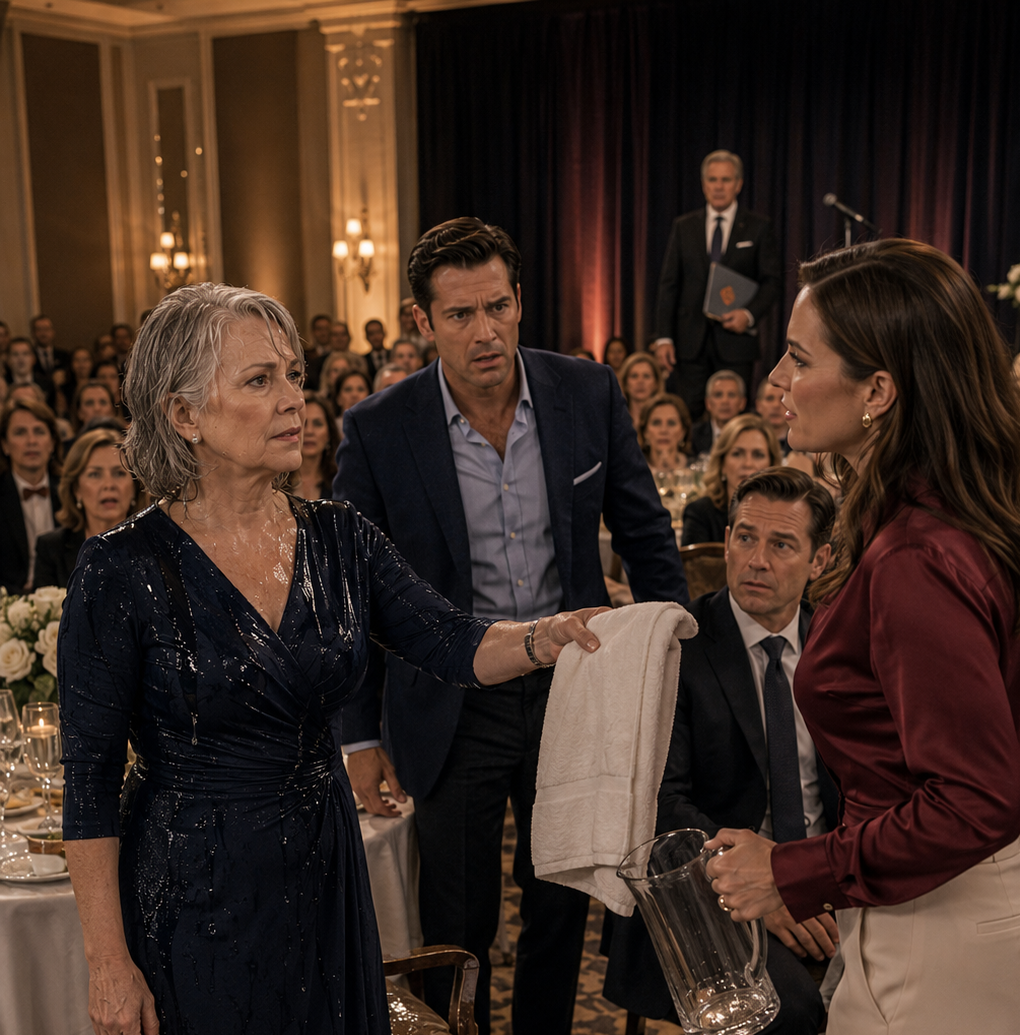
My daughter dumped an entire pitcher of ice water over my head in front of nearly two hundred people at my retirement dinner.
“There,” Kendra said, laughing as ice slid down my navy dress and scattered across the ballroom carpet.
“Maybe that’ll cool down your ego.”
She expected me to cry.
Yell.
Walk out of the Grand Meridian Hotel humiliated.
Instead, I stood slowly, took the linen towel hanging over the back of my chair—
and placed it in her hand.
“You’ll need this more than I will in about five minutes.”
For the first time that evening, my thirty-seven-year-old daughter looked uncertain.
Then she laughed again.
Rolled her eyes.
As though humiliating her sixty-seven-year-old mother in front of former coworkers was nothing more than a joke.
My son Travis shot to his feet.
“What the hell are you doing?”
Kendra shrugged.
“Relax. It was water.”
“It was humiliation,” Travis snapped.
Kendra ignored him and looked around the ballroom as if she expected everyone to agree with her.
Nobody did.
Suddenly, plates and coffee cups became very interesting.
I wiped the water from my face.
And refused to give her the scene she clearly wanted.
That dinner was supposed to mark the end of my thirty-eight years at Hawthorne Industrial Systems in Tulsa, Oklahoma.
I had spent most of my career solving problems other people wanted no part of.
Failed suppliers.
Delayed factories.
Broken contracts.
Projects losing millions of dollars.
I never asked the company to throw me a ballroom celebration.
In fact, I had requested a small lunch.
But my former CEO, Howard Sutter, refused.
Kendra apparently saw the evening differently.
“You couldn’t just retire like a normal person,” she said loudly.
“You had to have the speeches and the photographs and everybody telling you how brilliant you are.”
That was when I understood.
The pitcher of water had very little to do with a joke.
“You know what people at my company say?” she demanded.
“They say I got where I am because I’m Loretta Vaughn’s daughter.”
Her words landed harder than the ice water had.
Kendra had recently become vice president of regional partnerships at Elevanta Solutions.
I had believed that promotion was one of the proudest accomplishments of her life.
I never wanted credit for her career.
When she was young, I turned down opportunities because she needed me at home.
Frank and I refinanced our house so she could finish college without private student loans.
After her first marriage collapsed, I quietly helped with her rent.
Years later, I rearranged my work schedule to help with her son Owen.
When she wanted to enter corporate consulting, I introduced her to people I trusted.
Because I thought that was what mothers did.
I never kept a ledger.
Love wasn’t supposed to need receipts.
But standing there with the empty pitcher in her hand, Kendra had clearly rewritten those years in her mind.
My help had become interference.
My reputation had become an embarrassment.
And somehow—
my retirement celebration had become an attack on her.
“Maybe once in your life you could let somebody else have the spotlight.”
I looked at the woman I had spent thirty-seven years protecting.
And something inside me settled.
Not broke.
Settled.
“This evening wasn’t my idea.”
“Of course not,” she answered sarcastically.
Her husband Grant stayed seated beside her, looking increasingly uncomfortable.
Travis leaned toward me.
“Mom, do you want to leave?”
For most of my life, leaving would have been exactly what I did.
I would have protected Kendra from embarrassment even after she had publicly embarrassed me.
But that evening—
I looked toward the stage.
Howard Sutter stood beside the curtain, waiting for the next part of the retirement program.
He was holding a dark gray folder.
Across the front was a bright orange logo I recognized immediately.
Elevanta Solutions.
My daughter’s company.
Kendra hadn’t noticed the folder when she arrived.
I had.
Because two weeks earlier, Howard called me with a strange request.
“Loretta, I need your permission before I do something.”
“What do you want permission to do?”
May you like

His answer stayed with me every day afterward.
“Tell the truth in public.”
At first, I refused.
Whatever professional matter Howard wanted to discuss, I didn’t want my retirement dinner turned into a courtroom.
And I certainly didn’t want my daughter humiliated.
Even after years of quietly rescuing Kendra—
my first instinct was still to protect her.
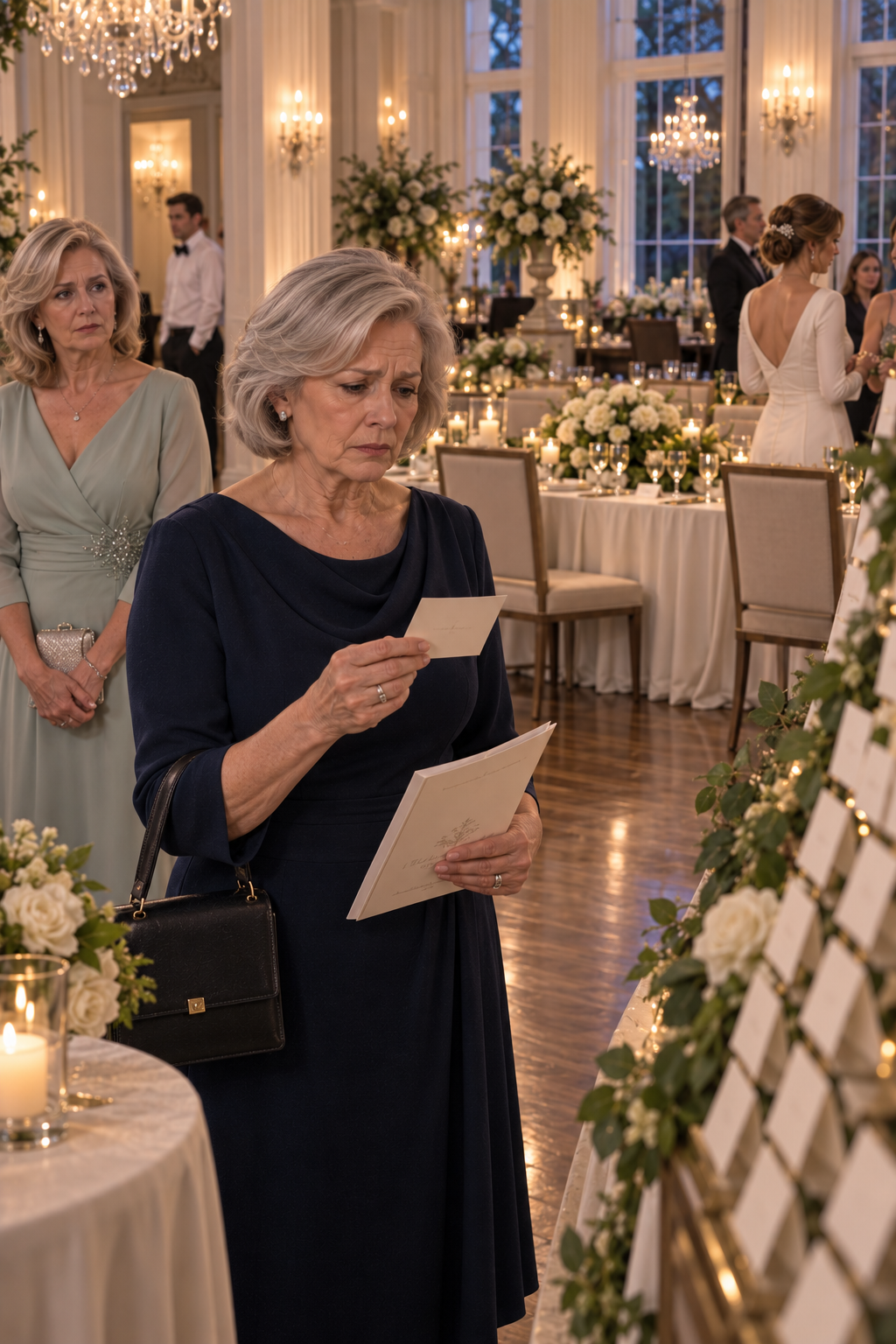
Then, four days before the dinner, I received an email from Celeste Avery, Elevanta’s chief compliance officer.
She wanted to speak with me about materials one of their executives had submitted during an internal promotion review.
That executive—
was my daughter.
The phone call lasted fifty-two minutes.
When it ended, I went into my home office.
Unlocked a filing cabinet.
And removed a flash drive containing years of project notes, dated drafts, spreadsheets, correspondence, and development records.
Buried among them was something called the Horizon Routing Model.
I created Horizon while solving supply-chain problems at Hawthorne.
Later, after the company formally released the applicable rights to me, I continued developing an expanded version independently.
Kendra knew about it.
She had spent countless evenings sitting at my kitchen counter while I worked.
She asked questions.
Studied pieces of it.
Once told me she admired the way my mind worked.
Until four days before my retirement dinner, I believed those conversations had simply been between a daughter and her mother.
Celeste’s questions made me wonder whether they had been something else entirely.
I still didn’t know exactly how far it had gone.
“Mom,” Travis said again, pulling me back into the ballroom.
“Do you want to leave?”
Kendra watched me like she expected me to retreat.
Dry my clothes.
Absorb another wound.
Disappear quietly.
I looked at my son.
“No.”
Kendra scoffed.
“There she goes again.”
I turned toward her.
And spoke more firmly than I had in years.
“No, sweetheart.”
I paused.
“There I stay.”
At that exact moment—
the music stopped.
Howard stepped onto the stage carrying the gray Elevanta folder.
But instead of beginning another sentimental retirement speech, he walked directly to the microphone.
His expression told me the five minutes I had warned Kendra about—
were almost over.
“Ladies and gentlemen,” Howard said, “before we continue with Loretta’s retirement program, there is a professional matter we need to address.”
Kendra’s champagne glass stopped halfway to her mouth.
Then Howard looked directly at my daughter.
“Kendra Felton…”
The ballroom went silent.
“I believe this concerns you.”
Kendra lowered her champagne glass.
Slowly.
“What does?”
Howard did not answer immediately.
He opened the gray folder.
The orange Elevanta logo flashed beneath the ballroom lights.
Grant looked at his wife.
Then at the folder.
Then back at her.
“Kendra?”
She ignored him.
Howard adjusted the microphone.
“Two weeks ago, Hawthorne Industrial Systems received a formal inquiry from Elevanta Solutions regarding the origin and ownership history of a supply-chain optimization framework submitted during an internal executive review.”
Several people in the ballroom shifted.
Most of my former coworkers immediately understood the language.
Corporate people recognize trouble when it arrives wearing polite nouns.
Inquiry.
Origin.
Ownership.
Review.
Kendra laughed.
Too quickly.
“This is ridiculous.”
Howard looked at her.
“Then it should be easy to clarify.”
Her face tightened.
He continued.
“The framework was submitted under the title Dynamic Horizon Partner Routing Architecture.”
My stomach went cold.
Not because the name was unfamiliar.
Because it was familiar enough.
Horizon.
My Horizon.
Repackaged.
Expanded.
Renamed just enough to sound new.
Kendra stood.
“You have no right to discuss Elevanta’s internal work here.”
Howard’s expression did not change.
“Normally, I would agree.”
Then he looked toward me.
“But the materials presented to Elevanta included documents originating from Loretta Vaughn.”
The ballroom fell silent again.
I heard Travis whisper:
“Oh, God.”
Kendra looked at me.
Her face changed.
Not guilt yet.
Calculation.
“You gave them my files?”
“No.”
I said it calmly.
“I gave them mine.”
Her mouth tightened.
Howard continued.
“Elevanta’s compliance office requested Hawthorne verify whether certain historical drafts belonged to the company, to Loretta personally, or to the executive who submitted them.”
Kendra’s voice sharpened.
“This is a misunderstanding.”
Howard nodded.
“Good.”
She blinked.
He continued.
“Then you won’t object to the record.”
He removed several sheets.
On the screen behind him, a slide appeared.
I had not known he planned that.
Howard had warned me he wanted to tell the truth publicly.
Apparently, he had decided truth deserved visual aids.
The first image was a scanned page from one of my project notebooks.
Top right corner:
March 17, 2014.
My handwriting.
My equations.
My annotations.
A routing matrix I had built while Hawthorne was struggling with a supplier crisis involving three manufacturing plants.
Beside it appeared a second image.
An Elevanta presentation.
Submitted twelve years later.
Different colors.
Different font.
Cleaner graphics.
But the architecture was unmistakable.
Same branching logic.
Same exception hierarchy.
Same five-stage supplier-risk weighting.
Even one strange notation I had developed because I hated writing the full phrase “probability-weighted reroute window.”
I had abbreviated it PWRW.
So had Kendra.
Howard said:
“The Elevanta version identifies Ms. Felton as primary originator.”
Kendra’s face reddened.
“I developed it independently.”
I looked at her.
She finally looked back.
Howard changed the slide.
Another notebook page.
October 2, 2015.
Then an Elevanta document.
Same decision tree.
Another.
June 8, 2017.
Another Elevanta deck.
Same model.
Another.
An email I had sent myself years earlier with a versioned attachment.
HORIZON_v4_LV
Howard said:
“Timestamped project records establish Loretta’s work across multiple years.”
Kendra folded her arms.
“She showed me some of that.”
Nobody spoke.
She continued.
“She asked for my opinion.”
I almost smiled.
That was true.
Sometimes I had.
When Kendra was younger, curious, ambitious, clever—
I loved talking with her.
I would show her a diagram.
Ask:
“What do you see?”
She would notice something I had missed.
I was proud of that.
Proud enough that I never imagined I needed to protect my work from my own daughter.
Howard nodded.
“Being shown material is not the same as creating it.”
Kendra’s voice rose.
“I changed it.”
Howard said:
“Elevanta’s compliance team believes you changed approximately eighteen percent of the documented structure.”
That landed.
Grant turned toward her.
“Eighteen?”
She glared at him.
“You don’t understand any of this.”
“I understand percentages.”
Several people looked away.
Howard continued.
“The broader concern is not merely similarity.”
He opened another document.
“This is the authorship declaration attached to Ms. Felton’s promotion submission.”
A statement appeared on the screen.
I read it.
I certify that the strategic frameworks, models, methodologies, and proprietary concepts submitted herein are either my original work or are properly attributed and authorized.
Kendra’s signature sat beneath it.
Her face went pale.
Howard said:
“Would you like to explain why Loretta is not mentioned anywhere?”
She snapped:
“Because it wasn’t hers anymore.”
I felt something inside me go still.
Howard looked at her.
“What does that mean?”
Kendra hesitated.
Then said:
“Hawthorne released the rights.”
I stared at my daughter.
There it was.
She knew.
Not just the model.
The legal history.
The release.
She knew exactly why I had continued developing Horizon after retirement planning began.
Howard nodded slowly.
“Hawthorne released certain rights to Loretta.”
“Not to you.”
Kendra’s jaw tightened.
“She’s my mother.”
The sentence moved through the ballroom like a draft.
Howard stared at her.
“And?”
Kendra’s mouth opened.
Nothing came out.
My son Travis closed his eyes.
Grant stepped away from her.
Only half a step.
But I noticed.
Howard continued.
“Family relationship is not a transfer instrument.”
Several of my former legal colleagues nodded almost involuntarily.
Kendra turned toward me.
“So this is what tonight really was?”
“What?”
“You set me up.”
I almost laughed.
“You poured ice water over my head.”
Her face flushed.
“You knew this was coming.”
“Yes.”
“And you still let me walk in here?”
“Yes.”
“You let me humiliate myself?”
I looked at her.
“Kendra.”
My voice was quiet.
“I spent thirty-seven years trying to prevent exactly that.”
She froze.
I continued.
“I protected you when your first marriage collapsed.”
“I protected you when you needed money.”
“I protected you when Owen was small.”
“I protected you when you were afraid people would say you only got opportunities because of me.”
“I made introductions and then stepped back.”
“I refused public credit.”
“I never corrected people when they assumed you had done everything alone.”
My throat tightened.
“And four days ago, when I learned you may have submitted my work as yours, my first reaction was still to protect you.”
Kendra looked away.
“That isn’t true.”
“It is.”
“I told Howard not to bring this up tonight.”
Howard nodded from the stage.
“She did.”
That surprised Kendra.
He continued.
“Repeatedly.”
I looked at her.
“Then you dumped water over my head.”
She stared at me.
“That didn’t make me decide to tell the truth.”
“I had already decided.”
“It only made me understand why telling it had become necessary.”
Kendra’s lips trembled.
Then she did what people do when facts become unbearable.
She attacked motive.
“You’ve always needed to be the smartest person in the room.”
Travis said:
“Stop.”
She ignored him.
“You couldn’t stand that I finally had something of my own.”
“Kendra.”
Grant’s voice was low.
She turned.
“What?”
He looked at her.
“Did you use her work?”
She stared at him.
“That is not what this is about.”
“That is exactly what this is about.”
“No.”
He looked toward the screen.
“Those documents are dated.”
She laughed bitterly.
“So now you believe her?”
Grant went pale.
“What does that mean?”
Kendra realized too late.
I saw it.
Travis saw it.
Howard saw it.
Grant took another step away.
“What else have you told me isn’t true?”
Kendra whispered:
“Grant.”
He shook his head.
“No.”
“You’ve spent three years telling me your mother undermines you.”
“That she takes credit.”
“That she inserts herself into your work.”
“That she manipulates your career.”
He pointed toward the screen.
“Did she?”
Kendra said nothing.
That silence answered more than any explanation could.
Grant’s face changed.
Not anger.
Recognition.
The terrible kind.
The kind that begins rearranging years of memory.
He looked at me.
“Mrs. Vaughn…”
I almost corrected him.
Then didn’t.
He swallowed.
“She told me you tried to get her first promotion blocked.”
I stared.
“What?”
Kendra snapped:
“Grant.”
He kept looking at me.
“She said you called Elevanta and warned them she wasn’t ready for senior leadership.”
I shook my head.
“I never called Elevanta before Celeste Avery called me four days ago.”
Grant closed his eyes.
Travis cursed under his breath.
Kendra’s face had gone white.
I looked at my daughter.
“You told him that?”
She folded her arms.
“You didn’t have to call.”
“What does that mean?”
“Your name followed me everywhere.”
“That is not the same thing.”
“To you.”
Her voice cracked.
“To me, it was.”
For the first time, I heard something beneath the anger.
Not entitlement.
Not entirely.
Pain.
Old pain.
It did not excuse anything.
But it explained part of it.
Kendra continued.
“Do you know what it’s like to walk into a room and have people ask whether Loretta Vaughn is your mother before they ask what you do?”
I stared at her.
“Yes.”
She laughed.
“No, you don’t.”
“Yes.”
I stepped closer.
“Do you know how many years I was introduced as Frank Vaughn’s wife before anyone asked what I did?”
She went silent.
“Do you know how many meetings I entered where someone assumed I was taking notes?”
“Do you know how many men repeated my analysis five minutes later and were congratulated for it?”
Her face changed.
I continued.
“I know exactly what it feels like to be reduced to someone else’s identity.”
“That is why I tried so hard not to do that to you.”
Tears filled her eyes.
“But I did not create the problem by existing.”
That landed.
The room stayed quiet.
Kendra looked down.
For one second, I thought she might finally stop fighting.
Then Howard spoke.
“There is another issue.”
Her head snapped up.
Of course there was.
I had known about Horizon.
I did not know everything Celeste had found.
Howard closed the presentation and opened a new page.
“Elevanta’s compliance team also identified client-performance results attributed to the model.”
Kendra looked confused.
I was too.
Howard continued.
“Several case studies in the promotion packet claim the framework reduced distribution failure rates by forty-one percent for three regional clients.”
Kendra said:
“It did.”
Howard looked at her.
“Elevanta cannot verify two of those deployments.”
The air changed.
Grant stared at her.
“What?”
Kendra shook her head.
“That’s a documentation issue.”
Howard continued.
“One client denies implementing the model.”
“Another confirms only a limited pilot.”
Kendra’s mouth opened.
Howard looked almost sad now.
“And the largest claimed savings figure appears to have been copied from a Hawthorne internal case study Loretta led in 2018.”
I felt physically ill.
Not because of the theft anymore.
Because of the scale.
My daughter had not simply borrowed ideas.
She had built a professional story.
A polished one.
One strong enough to earn a vice presidency.
Grant whispered:
“Kendra.”
She turned.
His face had emptied.
“Was the promotion based on this?”
She said nothing.
Howard closed the folder.
Then looked toward me.
“Loretta, I think the rest belongs to Elevanta.”
As if summoned by the company name, the ballroom doors opened.
A woman entered.
Tall.
Dark green suit.
Silver hair.
Celeste Avery.
Kendra sat down.
Just folded.
Like her knees had stopped working.
Celeste walked toward us.
She did not look triumphant.
Compliance officers rarely do.
Good ones understand that almost every investigation ends with someone’s life becoming smaller.
“Ms. Felton.”
Kendra stared at her.
Celeste continued.
“I had hoped we would speak privately tomorrow morning.”
Kendra laughed once.
“Clearly not.”
Celeste glanced at the wet carpet.
The empty pitcher.
My soaked dress.
Then back at her.
“No.”
“Clearly not.”
She handed Kendra an envelope.
“What is this?”
“Notice of administrative leave effective immediately pending completion of the investigation.”
Kendra’s hand trembled.
Grant sat down heavily.
Travis looked at me.
I did not move.
Kendra opened the envelope.
Her eyes raced.
Then:
“You’re suspending me?”
“Yes.”
“Because my mother is jealous?”
Celeste’s expression did not change.
“No.”
“Because documentary evidence raises serious questions about authorship representations, data integrity, and potential misuse of third-party intellectual property.”
Kendra looked around.
Nearly two hundred people.
Former Hawthorne executives.
Engineers.
Managers.
People who knew my work.
People who knew hers.
The worst possible audience for the lie.
She whispered:
“You planned this.”
Celeste shook her head.
“I planned to meet with you tomorrow.”
Then she looked toward the soaked front of my dress.
“You changed the schedule.”
Nobody said anything.
Kendra stared at me.
For the first time all night, she no longer looked angry.
She looked frightened.
“Mom.”
One word.
The same word Travis had used.
But different.
I heard the child inside it.
The six-year-old who once crawled into my bed after nightmares.
The twelve-year-old who cried when she did not make the volleyball team.
The twenty-two-year-old who called me from a bathroom on her first day of corporate work because she thought everyone was smarter than she was.
My heart reacted before my judgment did.
That was the danger.
I loved her.
Even now.
Maybe especially now.
I stepped closer.
She looked up.
“Help me.”
The room disappeared.
I heard only those two words.
For decades, they had controlled me.
Help me with tuition.
Help me with rent.
Help me with Owen.
Help me make this introduction.
Help me prepare for this interview.
Help me understand this contract.
Help me.
And I always had.
I looked at her.
“I can’t.”
Her face crumpled.
“You can.”
“No.”
“You can tell them I had permission.”
I closed my eyes.
There it was.
Not:
I’m sorry.
Not:
I was wrong.
Not:
What did I do?
Tell them I had permission.
Save me again.
I opened my eyes.
“You didn’t.”
Tears spilled down her cheeks.
“You could say I did.”
“Kendra.”
I shook my head.
“That would make me part of the lie.”
She stood suddenly.
“So you’re choosing your reputation over your daughter?”
Travis stepped forward.
“No.”
He looked at his sister.
“She’s choosing the truth over your job.”
Kendra turned on him.
“Stay out of this.”
“I’ve stayed out of enough.”
His voice shook.
“I watched Mom help you for years.”
“She introduced you to half the people who built your network.”
“She watched Owen whenever you needed.”
“She paid your rent after the divorce.”
“She never took credit.”
“And you’ve spent years telling everyone she’s the problem.”
Kendra stared.
Travis continued.
“You know what she did when my business failed?”
I looked at him.
He had never mentioned that publicly.
Kendra frowned.
“What?”
“She let me fail.”
That surprised her.
Travis almost smiled.
“I asked for money.”
“Mom said no.”
Kendra looked at me.
I remembered.
Travis had been thirty-nine.
A landscaping venture.
Too much debt.
Bad planning.
He wanted eighty thousand dollars.
I refused.
He did not speak to me for three weeks.
Then rebuilt.
Travis said:
“I hated her for about a month.”
“Then I figured it out.”
“She knew saving me would only let me keep doing the same thing.”
He looked at Kendra.
“You never had to learn that.”
The words hurt because they were true.
Not entirely.
But enough.
I had treated my children differently.
Travis resisted help.
Kendra asked for it.
So I gave.
Again.
Again.
Again.
Until help became expectation.
Expectation became entitlement.
And entitlement eventually decided my work belonged to her too.
I whispered:
“He’s right.”
Kendra looked at me.
“What?”
“I helped you too much.”
Her face twisted.
“Oh, now this is your fault?”
“No.”
“I am responsible for making rescue too available.”
“You are responsible for what you did with that.”
The distinction mattered.
Her mouth trembled.
Celeste stepped forward.
“Kendra, we need your company laptop and phone before you leave tonight.”
Grant looked at her.
“Kendra…”
She turned toward him.
He looked devastated.
“Did you lie to me about the promotion packet?”
She said nothing.
“Kendra.”
Her shoulders dropped.
“Yes.”
It was barely audible.
Grant closed his eyes.
“How much?”
She cried.
“I used pieces of Mom’s model.”
“How much?”
“I don’t know.”
“You do.”
She covered her face.
“I thought I could improve it.”
I felt no satisfaction.
Only grief.
Grant whispered:
“And the case studies?”
She lowered her hands.
“One was real.”
“Which one?”
“The pilot.”
His face collapsed.
“So the biggest claims were false.”
Kendra said nothing.
He walked away from her.
Not out of the ballroom.
Just ten feet.
Sometimes ten feet is the beginning of a marriage ending.
Celeste collected Kendra’s devices.
Then left with a member of Elevanta’s legal team who had apparently been waiting in the lobby.
Howard stood beside the stage.
Nobody knew what to do.
My retirement dinner had become an ethics investigation.
A family confrontation.
And, somehow, I was still dripping onto the carpet.
Then Howard picked up the microphone.
“Everyone.”
The room quieted.
He looked at me.
“Loretta asked for a small lunch.”
A few people laughed nervously.
I did too.
Howard continued.
“I ignored her.”
More laughter.
“Which, after thirty-eight years of watching her solve everyone else’s disasters, was probably foolish.”
I shook my head.
He smiled.
“Tonight obviously did not go the way any of us expected.”
“No kidding,” someone called.
That broke the tension.
Howard continued.
“But there is one thing I refuse to let happen.”
He looked around.
“We are not going to let the worst ten minutes of Loretta Vaughn’s retirement dinner become the only thing anyone remembers about her career.”
My throat tightened.
Applause began.
Small.
Then grew.
I hated attention.
Kendra had been right about one thing.
I had never been comfortable in the spotlight.
But this time, I did not shrink from it.
I stood.
Soaked dress.
Wet hair.
No dignity left to perform.
Only dignity left to own.
Howard invited me to the stage.
I went.
He handed me a towel first.
That made everyone laugh.
Then he gave me the dark gray folder.
Inside was not Kendra’s file.
It was a letter from Hawthorne’s board.
The company was establishing the Loretta Vaughn Operations Fellowship for mid-career women moving into industrial leadership.
I stared at the page.
“Howard.”
He smiled.
“You’re retired.”
“That doesn’t mean we’re done exploiting your name.”
I laughed so hard I cried.
Or maybe I was already crying.
The dinner resumed.
Not normally.
Nothing could make it normal.
But honestly.
People came to me.
Some hugged me.
Some said nothing.
Some pretended not to have witnessed anything, which I appreciated more than they knew.
Grant left with Kendra.
Travis stayed.
At eleven thirty, he drove me home.
For most of the ride, we were quiet.
Then he said:
“Mom?”
“Yes?”
“You okay?”
“No.”
He nodded.
“Good answer.”
I looked out the window.
Streetlights moved across the glass.
After a while, I said:
“I keep wanting to call her.”
“I know.”
“To make sure she’s safe.”
“I know.”
“To tell her what attorney to hire.”
Travis laughed sadly.
“I know.”
I closed my eyes.
“What is wrong with me?”
“Nothing.”
He glanced at me.
“But maybe don’t do it tonight.”
So I didn’t.
That was harder than refusing money.
Harder than standing in the ballroom.
Harder than letting Celeste take the laptop.
I went home.
Changed out of the navy dress.
Picked one piece of ice from inside my bra.
Then laughed alone in my bathroom for almost a full minute.
After that, I cried.
The Elevanta investigation lasted ten weeks.
The findings were worse than I hoped.
Better than I feared.
Kendra had not stolen source code.
There was no criminal case.
No dramatic police arrival.
The Horizon framework was conceptual and methodological, supported by written materials, models, spreadsheets, and project histories.
But Elevanta concluded that substantial portions of Kendra’s executive submission were derived from my work without attribution.
Several performance claims were materially misleading.
Two case studies overstated implementation and results.
One copied savings data from my Hawthorne project.
The company revoked her promotion.
Then terminated her employment for violations involving integrity of submitted materials.
Her name disappeared from the leadership page by noon.
She blamed me for three months.
Every conversation ended the same way.
“You could have fixed it.”
And every time, I answered:
“No.”
Then she stopped calling.
Grant filed for separation six months later.
I did not celebrate.
I liked Grant.
But their marriage had fractures I knew nothing about.
The investigation merely removed wallpaper from them.
Later, Travis told me Kendra had admitted lying to Grant about several things over the years.
My supposed interference.
Money I had given her.
Introductions I had made.
Even Owen’s childcare.
Grant had believed she paid me.
She never had.
That detail hurt strangely.
Not because I wanted money.
Because Kendra had needed my generosity and hidden it simultaneously.
She wanted the benefit without the evidence of dependence.
I finally understood her anger at my retirement dinner.
My career had become intolerable to her because she had built an identity around pretending she had never needed me.
My existence contradicted the story.
The Horizon model made that contradiction professional.
So she stole the thing she admired—
then hated me for still being its creator.
That realization helped me stop taking her cruelty personally.
Not excuse it.
Understand it.
Those are different.
Owen called me during the seventh month.
He was fifteen.
“Grandma?”
“Yes?”
“Mom says you got her fired.”
I closed my eyes.
“What do you think?”
“I don’t know.”
“That’s okay.”
“Did you?”
“No.”
“Then why does she say you did?”
“Because the truth hurts her right now.”
He went quiet.
Then:
“Did she steal your work?”
Children should not have to carry adult corporate investigations.
But lies become dangerous when adults make children choose between reality and loyalty.
I answered carefully.
“She submitted work that included things I created and did not give proper credit.”
“That’s stealing.”
“Partly.”
“Grandma.”
I almost smiled.
“Yes.”
“Why are you defending her?”
That stopped me.
I looked around my kitchen.
Old habit.
Even now.
Softening.
Editing.
Making Kendra’s actions easier for the listener.
“I’m not.”
“You are.”
He was right.
I took a breath.
“Your mother made serious professional choices that were dishonest.”
Silence.
Then:
“Okay.”
“I love her.”
“I know.”
“You can love her too.”
“I do.”
“And still know she did something wrong.”
Another pause.
“Okay.”
That conversation changed me.
I stopped protecting Kendra from accurate nouns.
Dishonest.
Cruel.
Entitled.
Afraid.
Talented.
My daughter.
All could be true at once.
Eight months after the dinner, I went to Scotland.
Yes.
Scotland.
Not because Frank and I had planned it.
We hadn’t.
That was another widow’s story.
Mine involved a train trip I had postponed for twenty-two years.
Seattle to Vancouver.
Vancouver across the Canadian Rockies.
Then Montreal.
I had always wanted to see the country by rail.
Frank hated trains.
So we kept putting it off.
After he died, I kept putting it off alone.
That year, I stopped.
Travis came for part of it.
Then went home.
I finished by myself.
Somewhere outside Jasper, I watched mountains rise beyond the glass and realized nobody needed me for three entire days.
No supplier.
No executive.
No child.
No grandson.
No crisis.
I had spent thirty-eight years being useful.
Retirement taught me how strange it felt to be valuable without being needed.
Kendra wrote me a letter eleven months after the dinner.
Not an email.
Paper.
Her handwriting.
I left it unopened for two days.
Then read it.
The first line was:
I still want to blame you.
I almost stopped.
Then continued.
But my therapist says wanting something to be true does not make it true.
I laughed despite myself.
The letter was seven pages.
She admitted everything.
Not elegantly.
Not all at once.
She wrote that she had copied pieces of Horizon years earlier for internal presentations.
Nobody questioned them.
People praised her.
So she used more.
Then she convinced herself the ideas were partly hers because she had discussed them with me.
Eventually, she stopped remembering where my work ended and hers began.
Or chose not to remember.
She admitted fabricating the larger performance claims because she believed everyone else at her level exaggerated too.
She admitted telling Grant I interfered with her career.
Why?
Because admitting I had opened doors for her made her feel fraudulent.
So she created a version where she succeeded despite me.
Then she wrote:
The worst part is that the more I erased what you did for me, the more I resented you for existing as evidence that I had erased it.
I read that sentence three times.
Then cried.
Toward the end:
I poured the water because I wanted everyone to see you look ridiculous.
I told myself it was a joke.
It wasn’t.
I wanted to make you smaller in the exact room where everyone was celebrating how large your career had been.
No excuse.
No “but.”
Then:
I am sorry.
I did not call her.
Not immediately.
A month later, I invited her to coffee.
Public place.
Neutral.
She arrived early.
No makeup.
Hair tied back.
She looked tired.
For a long time, neither of us spoke.
Then she said:
“You look good.”
“You look terrible.”
She laughed.
Then cried.
“That sounds like you.”
“I’ve been retired.”
“I have time for honesty.”
She wiped her face.
“Do you forgive me?”
“No.”
She nodded.
I appreciated that.
No argument.
No collapse.
Just acceptance.
I continued.
“But I believe your apology.”
Her eyes filled.
“That’s more than I expected.”
We talked for two hours.
She told me about Grant.
They were divorcing.
Not only because of the investigation.
Because neither trusted the other anymore.
She admitted she had built their marriage around performance.
Appearances.
Success.
Comparison.
Grant had his own failures.
She had hers.
Owen was in therapy.
That hurt most.
Kendra whispered:
“I think I taught him that mistakes are things you hide until someone else can be blamed.”
I reached across the table.
Not to rescue her.
Just touched her hand.
“Then teach him something different now.”
She nodded.
“What?”
“Show him what accountability looks like.”
That became the beginning.
Kendra found work again.
Not quickly.
Not at the same level.
A midsized logistics company hired her as a senior account manager.
No vice president title.
No glamorous conferences.
No company biography calling her an industry visionary.
She told them about Elevanta before they completed the background check.
That mattered.
Two years later, she became director.
Not because of me.
I knew nobody there.
She made sure to tell me that.
I laughed.
“Good.”
Then she added:
“But I also stopped pretending I didn’t learn things from you.”
That mattered more.
The Horizon Routing Model took on a second life too.
Hawthorne asked if I wanted to commercialize it.
I said no.
I was done building companies.
Instead, I licensed an educational version to three universities and donated the royalties to the Loretta Vaughn Operations Fellowship.
The first cohort had twelve women.
At the closing dinner, one young engineer approached me.
“Mrs. Vaughn?”
“Loretta.”
She smiled.
“Did you really create Horizon at your kitchen table?”
“Parts of it.”
She looked impressed.
“My professor says it changed how companies think about supplier risk.”
I almost corrected her.
Hawthorne had done the real work.
Teams.
Data.
Years.
No model belongs entirely to one mind once people begin testing it.
Then I stopped.
Attribution matters.
So I told her the truth.
“I developed the core architecture.”
“A lot of people made it better.”
She nodded.
“That seems important.”
“It is.”
I thought about Kendra.
Yes.
It was.
Five years after my retirement dinner, Kendra asked me to attend a presentation.
Her company had developed a new partnership-screening framework.
She was presenting it at an industry conference in Dallas.
I hesitated.
Then went.
I sat in the third row.
Kendra took the stage.
Confident.
Older.
Different.
Halfway through, she displayed a slide.
Influences and Prior Work
There were six names.
Academic researchers.
Industry models.
A public Hawthorne methodology.
And:
Loretta Vaughn — Horizon Routing Model
My throat tightened.
Kendra did not look at me when the slide appeared.
She kept speaking.
Professional.
Matter-of-fact.
Exactly as attribution should be.
Not a confession.
Not a tribute.
Credit.
Afterward, she found me outside the ballroom.
“Well?”
I smiled.
“You overused bullet points.”
She stared.
Then laughed.
“Mom.”
“The framework was good.”
Her eyes filled.
“Mine?”
“Yours.”
She cried.
So did I.
That was when I forgave her.
Not because of the slide.
Because by then she had spent years becoming someone who no longer needed to steal from another person to believe she had value.
Grant eventually remarried.
Kendra did not.
Not for a long time.
They became decent co-parents.
Owen grew up.
At twenty-six, he asked me about the pitcher.
We were sitting on my porch.
“You really handed Mom the towel?”
“Yes.”
He laughed.
“That’s cold.”
“I was wet.”
He laughed harder.
Then became serious.
“Why did you say she’d need it?”
I thought about the ballroom.
The gray folder.
Howard.
Celeste.
My daughter’s face.
“I knew something she didn’t.”
“What?”
“That consequences were already moving toward her.”
Owen nodded.
“Do you think she deserved everything that happened?”
I considered the question carefully.
“She deserved professional consequences for professional dishonesty.”
“She deserved relational consequences for lying.”
“She did not deserve endless humiliation.”
He looked at me.
“That’s a very grandma answer.”
“It’s an accurate one.”
I continued.
“Your mother did something cruel to me.”
“She also became better.”
“Both matter.”
At seventy-nine, Howard died.
Peacefully.
His daughter called me.
At the memorial, former Hawthorne employees filled a smaller ballroom.
No pitchers.
Thank God.
Afterward, Howard’s daughter gave me an envelope.
Inside was a note in his handwriting.
Loretta,
You spent your career fixing systems.
The hardest one you ever fixed was the one that taught your family your love was not an unlimited corporate resource.
You were terrible at retirement.
—Howard
I laughed until I cried.
He was right.
I served on advisory boards.
Mentored fellows.
Traveled.
Learned watercolor badly.
Became excellent at saying no.
Especially to committees.
At eighty-two, Kendra and Travis threw me a birthday dinner.
Small.
Twenty people.
At home.
I approved the guest list.
That part was nonnegotiable.
Before dessert, Travis appeared from the kitchen carrying a pitcher.
I stared.
“Don’t.”
Everyone laughed.
“It’s lemonade.”
“I don’t care.”
Kendra stood beside him holding a towel.
That made me laugh.
She came over.
Placed the towel gently on my shoulder.
Then whispered:
“I think this one belongs to you.”
I looked at my daughter.
Gray had begun appearing near her temples.
Her face no longer resembled the furious thirty-seven-year-old in the ballroom.
Or maybe it did.
People do not become different by erasing who they were.
They become different by carrying the truth about who they were without letting it decide who they remain.
I took the towel.
“Thank you.”
She kissed my cheek.
The same cheek she had once watched ice water run across while laughing.
No one made a speech about healing.
I was grateful.
Healing becomes suspicious when narrated too aggressively.
We ate cake.
Travis complained about retirement taxes.
Owen showed me photographs of his new apartment.
Kendra washed dishes without being asked.
Ordinary.
Beautifully ordinary.
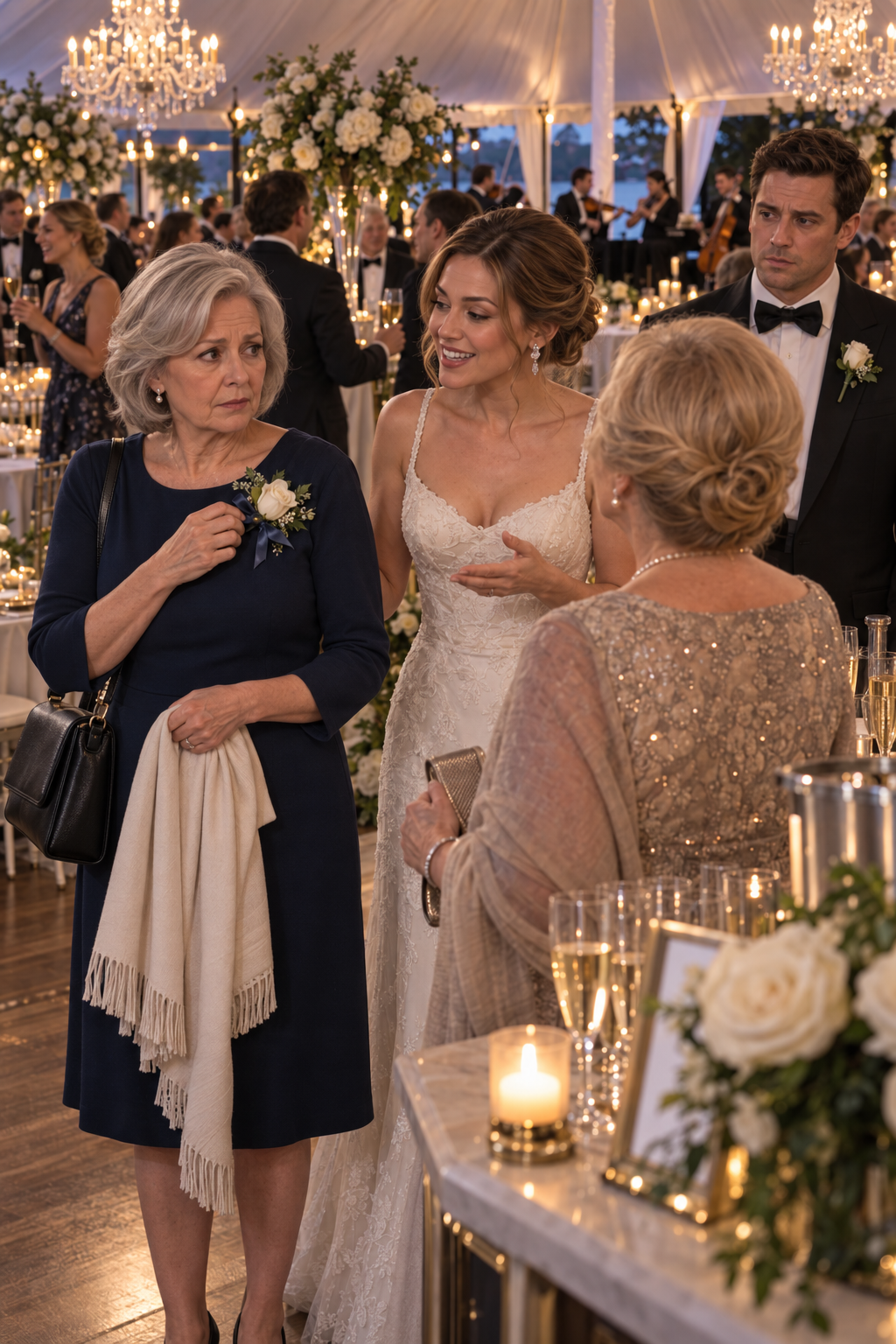
Years earlier, people at my retirement dinner assumed the most shocking thing that happened was a daughter dumping ice water over her mother’s head.
It wasn’t.
The shocking thing was what came before.
Years of help converted into resentment.
Generosity rewritten as interference.
A daughter so desperate to prove she had built herself that she stole from the woman who had helped build her.
And a mother so committed to protecting her child that she nearly became dishonest too.
That was my part.
I had confused protection with love.
They are not always the same.
Sometimes love protects.
Sometimes love tells the truth.
Sometimes love pays the rent.
Sometimes love refuses to lie to a compliance officer.
Sometimes love answers the phone.
Sometimes it lets the phone ring.
And sometimes—
when your daughter pours an entire pitcher of ice water over your head in front of nearly two hundred people—
love hands her a towel.
Then steps aside.
Not because you want her destroyed.
Because you finally understand that saving someone from every consequence can become another way of helping them remain exactly who they are.
Kendra thought my reputation had made her smaller.
For years, I tried to solve that by shrinking myself.
Taking less credit.
Speaking less about my career.
Pretending introductions had happened naturally.
Never mentioning money.
Never reminding her of help.
It did not work.
You cannot make another person feel substantial by erasing yourself.
Eventually they must decide what they are made of.
Kendra did.
So did I.
On the night I retired, she told me maybe once in my life I could let somebody else have the spotlight.
Years later, I realized the answer I should have given.
The spotlight was never mine to give.
It moves.
Careers end.
Titles disappear.
People retire.
Children grow older.
Companies forget names.
Ballrooms empty.
What remains is whether you can stand inside your own life without needing someone else to become smaller so you can feel large.
It took my daughter a long time to learn that.
It took me almost as long.
But we did.
And that mattered more than the pitcher.
More than Horizon.
More than the promotion she lost.
More than the retirement dinner everyone remembered.
Because the evening Kendra tried to humiliate me publicly became the first night in our lives when I stopped rescuing her privately.
Five minutes after I handed her that towel, she thought everything was falling apart.
She was wrong.
For the first time—
something honest was finally beginning.