The waiter placed a $4,860 bill in front of me—
at the worst table in the restaurant.
Not in front of my son-in-law, who had ordered seventy-dollar whiskey.
Not in front of his mother, who was sitting in my chair drinking champagne.
In front of me.
My daughter smiled across the private dining room.
“Mom always takes care of Christmas.”
Several people laughed.
I looked at the total.
Then at the fourteen relatives enjoying the Christmas Eve dinner I had organized, reserved, and paid the deposit for.
Finally, I looked at my daughter.
“Not this year.”
Her smile disappeared.
And across the room—
my son-in-law Derek suddenly stopped moving.
Because he knew something Claire didn’t.
Forty-eight hours earlier, my credit-card company had called me about a $7,900 charge I never authorized.
And the man responsible—
was sitting at that table.
But I’m getting ahead of myself.
When I walked into the steakhouse that Christmas Eve, the first thing I noticed wasn’t the tree.
It wasn’t the chandelier.
It wasn’t even the private dining room I had reserved three months earlier.
It was the woman sitting in my chair.
Not just any chair.
My seat at the center of the table.
The one Claire had specifically asked me to reserve when she called in September complaining that Christmas at her house had become “too stressful.”
And there, beneath the chandelier—
drinking champagne from the glass beside my place setting—
sat my son-in-law’s mother.
Patricia.
She wore a red velvet dress and looked perfectly comfortable.
Almost like she was hosting.
Claire saw me immediately.
For half a second, her smile disappeared.
Then she hurried across the room.
“Mom! You made it.”
I looked past her.
Fourteen people were seated around the long table.
Derek.
His parents.
His brother and sister-in-law.
Claire’s cousins.
Several family friends.
And in the middle of them all—
Patricia.
In my seat.
I looked back at my daughter.
“I thought I was sitting there.”
Claire’s eyes flicked toward the table.
“Oh.”
One syllable.
Then came the explanation.
“Patricia’s back has been bothering her, and that chair has more room. I knew you wouldn’t mind.”
That sentence stayed with me.
I knew you wouldn’t mind.
People say those words when they’ve already decided your feelings matter less than the inconvenience of asking permission.
I said nothing.
Claire touched my elbow.
“We made you another spot.”
Then she led me away from the private dining room.
Past the wine display.
Past servers carrying filet mignon and lobster tails.
Past the table I had reserved.
And stopped beside the swinging kitchen doors.
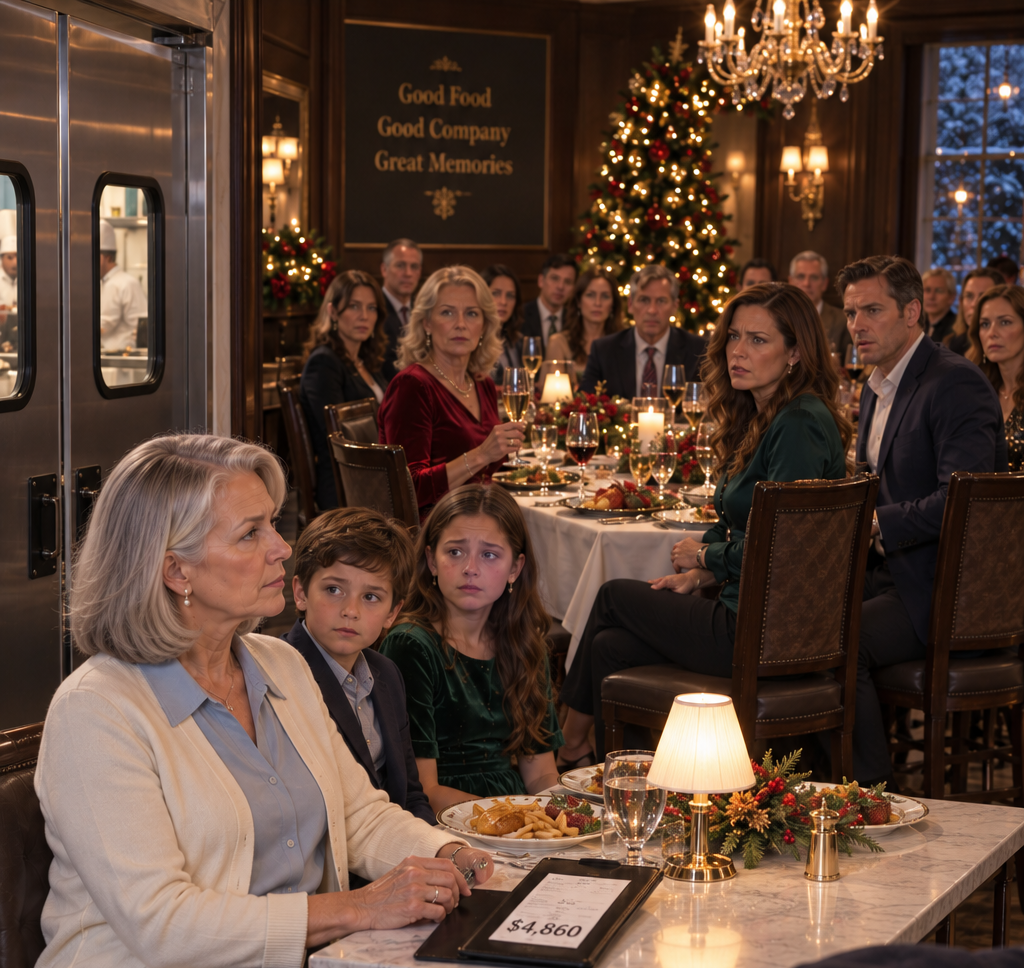
There was a tiny table.
Two children were already sitting there.
Derek’s niece and nephew.
Eight and ten years old.
Three place settings.
One empty chair.
Mine.
Every few seconds, the kitchen doors swung open behind us.
Heat rushed out.
Plates clattered.
Servers called orders.
Someone dropped silverware.
I looked at Claire.
She gave me the same smile she had used since childhood whenever she wanted something uncomfortable to sound perfectly reasonable.
“You’re so good with kids.”
And that was when I understood.
This wasn’t a misunderstanding.
I had paid the deposit.
I had made the reservation.
I had arranged the private room.
I had done it because Claire asked me to.
And somehow—
by Christmas Eve—
I had become the one person who didn’t belong at the table I had paid to reserve.
I could have made a scene.
I didn’t.
Instead, I pulled out the chair.
“Enjoy dinner, sweetheart.”
Claire visibly relaxed.
That may have been her biggest mistake.
Because she mistook my silence for surrender.
What she didn’t know—
was that forty-eight hours earlier, my credit-card company had called.
And I had learned something about her husband.
Something Claire didn’t know I knew.
Dinner lasted almost three hours.
From my little table beside the kitchen, I watched the celebration unfold.
First came Cabernet.
Then appetizers.
Oysters.
Crab cakes.
Steaks.
Lobster.
More wine.
Desserts.
Derek ordered a seventy-dollar whiskey and lifted it toward his father.
“Merry Christmas.”
Patricia ordered another bottle of wine.
Nobody asked whether I wanted a glass.
The children and I ate cheeseburgers.
And truthfully—
they were delightful company.
The little boy told me about a science project.
His sister showed me a bracelet she had made.
Then, halfway through dinner, he looked toward the private room.
“Why aren’t you sitting with the grown-ups?”
Before I could answer, his sister leaned closer and whispered—
“Because Grandma Patricia is important tonight.”
I stopped.
Children repeat what adults say when they think nobody important is listening.
I folded my napkin.
“I see.”
Near ten o’clock, coffee arrived at the main table.
Claire was laughing.
Derek leaned back comfortably with one arm stretched across the back of her chair.
Patricia was opening a small Christmas gift someone had brought her.
Then our waiter entered carrying a black leather check presenter.
I watched him approach Derek.
Derek didn’t even reach for it.
He simply made a tiny motion with his hand.
Toward me.
The waiter turned.
Walked past Derek.
Past Claire.
Past Patricia sitting in my chair.
All the way to the little table beside the kitchen.
Then he placed the bill directly in front of me.
$4,860.
For several seconds—
nobody spoke.
Then Claire laughed.
Not nervously.
Confidently.
“Mom always takes care of Christmas.”
Several people smiled.
As though it were charming.
A sweet little family tradition.
I looked at the bill again.
Four thousand eight hundred sixty dollars.
Then I looked at my daughter.
“Not this year.”
Claire’s smile remained for perhaps two seconds.
Then vanished.
“What?”
“I’m not paying it.”
Derek immediately sat forward.
“Linda, come on.”
Interesting.
He hadn’t spoken directly to me all evening.
Now he remembered my name.
Claire lowered her voice.
“Mom, you booked the room.”
“Yes.”
“You paid the deposit.”
“Yes.”
“So what’s the problem?”
I looked directly at Derek.
“The problem is I’ve already bought your husband something for Christmas.”
Derek froze.
Claire frowned.
“What are you talking about?”
I reached into my handbag.
Not dramatically.
I simply removed the envelope I had been carrying since I left home.
Then I placed it beside the $4,860 restaurant bill.
Inside—
was a printout from my credit-card company.
Derek’s face changed before Claire even touched it.
That told me everything.
Three weeks earlier, someone had used my saved credit-card information to make a $7,900 payment connected to Derek’s business.
I had never authorized it.
Apparently, Derek assumed I wouldn’t notice before Christmas.
Or perhaps he assumed that even if I did—
I would do what I had always done.
Protect the family.
Avoid embarrassment.
Keep the peace.
Claire read the page.
Once.
Then again.
She looked at her husband.
“Derek?”
He shook his head immediately.
“It’s not what it looks like.”
Patricia lowered her champagne glass.
The entire room became quiet.
I leaned back in the little chair they had chosen for me.
“No,” I said calmly.
“I imagine it isn’t.”
Claire looked at me.
“Why didn’t you tell me?”
“Because I wanted to see what happened tonight.”
Her expression hardened.
“You were testing us?”
“No.”
I glanced toward my empty seat at the main table.
“You answered the question before I ever had to ask it.”
Nobody smiled after that.
Derek started explaining.
He needed the money temporarily.
He intended to replace it.
My card information had been saved from a family vacation I paid for the previous summer.
Then he made the worst possible choice.
He shrugged.
“I figured Linda wouldn’t make a big deal over money.”
The silence afterward was different.
Because everyone heard him.
His wife.
His mother.
His father.
The relatives.
The family friends.
Even the waiter standing beside me with the payment terminal.
I nodded.
“You figured correctly.”
For one brief second—
Derek relaxed.
Then I slid the restaurant bill across the table toward him.
“I didn’t make a big deal over it.”
I paused.
“I made a fraud report.”
The color disappeared from his face.
Claire whispered—
“You what?”
“The charge is being investigated. My old card was canceled, and the bank issued me a new one yesterday.”
Then I looked at the waiter.
“So whatever card information this reservation has on file will not cover tonight’s remaining balance.”
Derek stood.
“You reported me for fraud?”
“I reported a charge I didn’t authorize.”
“I’m family!”
I looked at him.
“And yet the credit-card company never once asked whether the person who took my money shared my last name.”
Claire was still staring at the printout.
Then something caught her attention.
She looked at Derek.
“You told me your business account covered this payment.”
Derek said nothing.
That was the second secret.
And unlike the first—
I hadn’t brought it into the room.
He had.
Patricia slowly put down her champagne glass.
“Derek?”
He wouldn’t look at her.
“Mom, please.”
Claire stood.
“What business account?”
Derek’s jaw tightened.
“Can we not do this here?”
I almost laughed.
Three hours earlier, the room had apparently been public enough to give away my seat, send me beside the kitchen, and announce that I would pay for everyone.
Now—
privacy mattered.
A moment later, the restaurant manager entered.
Apparently, someone had told him there was a payment problem.
“Mrs. Harris?”
He looked at me.
Claire immediately seized on what she thought was her final argument.
“See? The reservation is Mom’s.”
“Yes,” I said.
“It is.”
The private room.
The reservation.
The deposit.
Everything was in my name.
What Claire and Derek hadn’t understood—
was what that actually meant.
I turned toward the manager.
“I’d like my reservation closed using only the deposit already authorized.”
He nodded professionally.
“Of course.”
Derek stared at him.
“What about the rest?”
“The remaining balance will need to be settled tonight.”
And suddenly—
for the first time all evening—
nobody was looking at Patricia.
Nobody was looking at Claire.
Nobody was looking at me.
Everyone was looking at Derek.
I stood.
Put on my coat.
Claire stared at me.
“Mom, you’re seriously leaving us with this?”
I paused.
“No, sweetheart.”
I looked over the table.
Empty wine bottles.
Steak plates.
Cocktail glasses.
Dessert dishes.
Thousands of dollars’ worth of choices I hadn’t made.
“You left it for me.”
Then I glanced toward the tiny table beside the kitchen.
“You just assumed I’d accept it.”
I opened my purse and gave each child twenty dollars.
“Merry Christmas.”
The little girl stood and hugged me.
And somehow—
that nearly broke my heart more than anything else that evening.
At the doorway, Claire called after me.
“Mom.”
I stopped.
Her voice was smaller now.
“What happens with Derek?”
I looked at my son-in-law.
He was no longer lounging comfortably in his chair.
He was standing beside a $4,860 restaurant bill—
while his wife held proof of a $7,900 charge he had apparently lied about.
For once—
I didn’t fix the problem.
“That,” I said, “is something the two of you should probably discuss.”
Then Derek asked the question he had clearly been afraid to ask.
“What did the bank say happens next?”
I met his eyes.
“They said they’ll contact whoever authorized the transaction.”
He swallowed.
“And if nobody did?”
“Then I suppose you’ll finally have to explain why you thought my money belonged to you.”
I walked out.
Behind me, I heard Claire’s voice.
“Give me your phone.”
“Claire—”
“Your phone. Now.”
I kept walking.
Outside, snow had begun to fall.
I stopped beneath the restaurant awning and buttoned my coat.
Through the window, I could still see the private dining room.
And then I noticed something.
Patricia had quietly moved out of my chair.
That detail stayed with me.
Not because I wanted the seat back.
I didn’t.
Some chairs aren’t worth fighting over.
Sometimes—
you have to lose your place at someone else’s table before you understand that respect was never supposed to depend on where they allowed you to sit.
My phone buzzed.
A message from Claire.
Mom, please don’t leave.
Then another.
I didn’t know about the card.
I believed her.
But there were things she had known.
She knew who paid the deposit.
She knew who organized Christmas.
She knew whose seat she gave away.
And she knew exactly where she had put me instead.
Those were choices too.
I typed one sentence.
We can talk tomorrow, but tonight you need to handle your own Christmas.
Then I turned my phone facedown.
Snow settled softly on the sidewalk.
Behind me was a private room full of people who had spent the evening assuming I would pay simply because I always had.
Ahead of me—
was a quiet Christmas Eve that belonged entirely to me.
And for the first time in years—
I wasn’t paying to be included.
I wasn’t paying to keep the peace.
I wasn’t paying to be loved.
Standing beneath the falling snow, I realized something surprising.
I didn’t feel lonely.
I felt free.
The next morning, Claire called at 7:12.
I was already awake.
I had barely slept.
Not because I regretted leaving.
Because for the first time in years, I had stopped solving the problem before it reached my daughter.
And apparently—
my nervous system had forgotten how to do nothing.
I let the phone ring twice.
Then answered.
“Morning.”
Claire was silent.
I could hear traffic somewhere behind her.
“Where are you?”
“Home.”
Another pause.
“Can I come over?”
“Yes.”
“Alone?”
“That would be best.”
She arrived forty minutes later.
No makeup.
Hair tied back.
Same black coat from the restaurant.
She looked ten years older than she had the night before.
I opened the door.
She stepped inside.
Then stopped.
“I’m sorry.”
I said nothing.
“For last night.”
Still nothing.
“For the table.”
“The bill.”
“The way I talked to you.”
Her eyes filled.
“And for knowing exactly where I put you and pretending it wasn’t cruel.”
That mattered.
More than the apology itself.
She had named it correctly.
I stepped aside.
“Coffee?”
She nodded.
We sat at my kitchen table.
Not the private dining room.
Not under a chandelier.
No audience.
Just mother and daughter.
Claire wrapped both hands around the mug.
Then said:
“I went through Derek’s phone.”
I looked at her.
“How bad?”
Her mouth twisted.
“Worse than the seven thousand nine hundred.”
Of course it was.
It rarely begins with the number you discover.
That is simply the first number that becomes visible.
Claire pulled several printed pages from her handbag.
Bank statements.
Credit-card screenshots.
Emails.
A business account summary.
I did not reach for them.
“Tell me.”
She inhaled.
“Derek’s business has been losing money for almost a year.”
“How much?”
“He says about a hundred and sixty thousand.”
“Do you believe him?”
“No.”
That answer came too quickly.
She continued.
“He has two business credit cards I didn’t know about.”
“One personal line of credit.”
“Three months of unpaid payroll taxes.”
“And a loan from Patricia.”
I blinked.
“His mother?”
“Forty-five thousand dollars.”
Apparently my stolen card had not been his first family rescue.
Just the first one involving me without permission.
Claire stared at her coffee.
“He told me everything was fine.”
“Did you ask?”
“Yes.”
“And?”
“He said December was strong.”
She laughed once.
“Apparently December was strong because he used your card.”
I said nothing.
Claire looked up.
“He did it through a vendor portal.”
“He had your card information saved from the Florida trip.”
“He changed the billing contact.”
“Then used it to cover an overdue supplier invoice.”
“Why seven thousand nine hundred?”
“That was the amount needed to stop them from freezing his account.”
I sat back.
“And he planned to repay it?”
“That’s what he says.”
“From where?”
She looked away.
Exactly.
Repayment plans sound impressive until someone asks what money they are made of.
Claire slid one page toward me.
“There’s more.”
The statement showed a transaction dated twelve days before Christmas.
$3,400.
Luxury hotel.
Chicago.
I looked at her.
She shook her head immediately.
“Not an affair.”
At least that was something.
“What was it?”
“Client retreat.”
“Did the business pay?”
“No.”
“Who did?”
“Patricia.”
I stared.
Claire laughed bitterly.
“Apparently she has been covering things too.”
That explained the chair.
Not excused it.
Explained it.
Patricia had not simply been Derek’s mother that night.
She had also become another person whose money helped keep his failing business standing.
Maybe Claire believed giving her my seat was a way of honoring Patricia.
Maybe Derek encouraged it.
Maybe all of them had unconsciously ranked the women around him according to who was financing him at that moment.
That thought made me tired.
Claire said:
“Mom.”
“Yes?”
“I need to ask you something.”
I waited.
“How long have you been paying for things?”
I almost laughed.
“Which things?”
Her face fell.
That was the answer.
I got up.
Opened the desk drawer beside the kitchen.
Removed a small notebook.
Blue cover.
Nothing dramatic.
I had kept it for eleven years.
Not because I intended to collect.
Because after my husband died, numbers helped me feel less helpless.
I wrote down everything.
College shortfalls.
The wedding.
Claire’s first apartment security deposit.
The emergency dental surgery.
Their honeymoon upgrade.
The down payment on their first house.
The vacation.
Christmas deposits.
Birthday dinners.
Three business “bridge” loans Derek never called loans.
I placed the notebook in front of her.
She opened it.
The first page made her still.
Then the next.
And the next.
“Mom.”
I said nothing.
She reached the final total.
Not including gifts I had stopped counting.
$286,740.
Claire covered her mouth.
“I didn’t know.”
“You knew some.”
“Not all.”
“No.”
“Why didn’t you tell me?”
“Because I thought helping quietly was kinder.”
She began crying.
“I made you sit by the kitchen.”
“Yes.”
“You paid for the room.”
“Yes.”
“The deposit.”
“Yes.”
“And I said you were good with kids.”
“Yes.”
She lowered her face into her hands.
I let her cry.
Not as punishment.
Because every time Claire cried as a child, I had rushed to remove the discomfort.
At forty-one—
perhaps she needed to sit inside some of it.
Finally she whispered:
“I’m disgusting.”
“No.”
She looked up.
“What?”
“You behaved badly.”
“That is not the same thing as being permanently bad.”
Her mouth trembled.
“Feels like it.”
“Good.”
She almost smiled through the tears.
I continued.
“Shame is useful if it leads somewhere.”
“It becomes useless when you turn it into another thing somebody has to comfort you about.”
That landed.
She nodded.
Then asked:
“What happens with the fraud report?”
“The bank investigates.”
“Will Derek be arrested?”
“I don’t know.”
“You reported the transaction.”
“Yes.”
“Can you withdraw it?”
There it was.
I looked at her.
She immediately understood.
“No.”
She shook her head.
“I’m sorry.”
“I heard myself.”
I nodded.
“I’m not asking you to protect him.”
“Good.”
“I just…”
She stopped.
“I still love him.”
“I know.”
“That doesn’t disappear overnight.”
“No.”
“Even when you discover somebody has been lying.”
“No.”
She stared out the window.
Then whispered:
“I don’t know who I married.”
That was harder.
I reached across the table.
Not to solve.
Just to touch her hand.
“You know some of him.”
“And now you are learning the rest.”
The bank’s investigation took six weeks.
Derek admitted the charge.
That mattered.
He did not continue denying it after Christmas.
He hired an attorney.
Provided records.
And repaid the $7,900 within twelve days—
with money from selling his motorcycle.
The bank reversed the charge anyway.
The repayment went into the disputed-account process.
Because the transaction had crossed state lines through an electronic vendor platform, there was potential for serious consequences.
But the dollar amount was relatively limited.
He had no prior record.
He cooperated.
The final outcome was ugly without becoming theatrical.
A misdemeanor plea connected to unauthorized use of financial information.
Restitution.
Probation.
A fine.
Mandatory financial counseling.
His business lender also closed one line of credit after reviewing the circumstances.
That nearly destroyed the company.
Nearly.
But not quite.
What destroyed the version of Derek everyone had been admiring—
was transparency.
Once Claire demanded the books, the picture became obvious.
The business was not merely having a difficult year.
Derek had been maintaining the appearance of success with borrowed money.
Expensive dinners.
Client entertainment.
A luxury SUV lease.
The Chicago retreat.
Memberships.
Travel.
All justified as branding.
Meanwhile—
supplier invoices were late.
Payroll taxes were behind.
Credit cards were near their limits.
He was not stealing millions.
He was doing something more ordinary.
And therefore, in some ways, more dangerous.
He was trying to look successful long enough to become successful again.
Each month required another bridge.
Another card.
Another favor.
Another lie.
Until eventually—
my credit card became the bridge.
Claire separated from him in February.
Not because I told her to.
I did not.
She moved into a small apartment.
Derek moved into an extended-stay hotel for two months.
Patricia begged Claire not to “throw away a marriage over money.”
Claire told me later that sentence changed something in her.
Not because Patricia was malicious.
Because it revealed how much the entire family had normalized.
Over money.
As though financial deception were simply one unpleasant category of marital housekeeping.
Claire told her:
“It’s not the amount.”
“It’s that he made my mother pay something without asking.”
“Then lied to me about where the money came from.”
“And I helped him humiliate her the same night.”
Patricia apparently cried.
Then apologized to me.
That happened in March.
She called first.
I almost did not answer.
But I did.
Her voice was restrained.
“Linda.”
“Yes?”
“I owe you an apology.”
I waited.
“For your chair.”
“That was Claire’s decision.”
“I accepted it.”
“Yes.”
“And I enjoyed being treated as though I mattered more.”
That surprised me.
She continued.
“I knew you had paid the deposit.”
I stared out the window.
“I didn’t know about the credit card.”
“But I knew enough.”
That was honest.
“I’m sorry.”
“Thank you.”
She paused.
“I hope someday we can have dinner without any of this.”
I almost laughed.
“So long as everyone brings their own card.”
She laughed too.
That helped.
Derek sold the business seven months later.
Not for much.
Enough to satisfy most secured debt.
Not enough to preserve the life he had built around pretending it was thriving.
The SUV disappeared.
The club membership disappeared.
The big office disappeared.
He took a senior sales position with one of his former competitors.
Salary.
Commission.
No employees.
No payroll tax.
No illusion that every dinner needed to look like a magazine spread.
Claire and Derek spent nearly a year apart.
Then—
to my surprise—
they began counseling.
Again, I stayed out of it.
That was new for me.
Old Linda would have offered advice.
Money.
A lawyer.
A temporary place to live.
A strategy.
Some useful form of rescue.
Instead, when Claire called, I asked:
“What do you want?”
She hated that question initially.
“Mom.”
“I’m serious.”
“I don’t know.”
“Then figure that out before asking me to.”
She became quiet.
Eventually she did.
They reconciled.
Slowly.
With conditions.
Separate financial access for Claire.
Monthly account reviews.
No debt hidden.
No use of family cards.
No “temporary” borrowing without written agreement.
And therapy.
Not glamorous.
Not romantic.
Useful.
The first Christmas after the restaurant disaster—
Claire asked me where I wanted to eat.
That wording mattered.
Not:
“Can you book?”
Not:
“You always take care of Christmas.”
Not:
“Mom, could you handle dinner?”
Where do you want to eat?
I chose my house.
Seven people.
Not fourteen.
No private dining room.
No chandelier.
I cooked one dish.
Claire cooked two.
Derek brought dessert.
Patricia brought wine.
At six thirty, Derek arrived carrying an envelope.
I stared at it.
He raised both hands.
“Not a bill.”
“Promising start.”
He handed it to me.
Inside was a check.
$10,000.
I looked at him.
“What is this?”
“The $7,900.”
“That’s already resolved.”
“And the rest.”
“What rest?”
He swallowed.
“Interest.”
“Legal inconvenience.”
“Humiliation.”
I almost smiled.
“Humiliation is expensive now?”
“It should be.”
I slid the check back.
He frowned.
“You don’t want it?”
“No.”
“Why?”
“Because you repaid what you took.”
“The rest cannot be bought.”
He looked down.
I continued.
“If you want to repair that part, behave differently.”
He nodded.
Then put the check away.
He did.
Not perfectly.
Nobody does.
But differently.
At sixty-eight, Derek became the kind of man who checked a restaurant bill before assuming someone else had it.
That sentence amused me more than it should have.
Claire changed too.
Perhaps more.
She stopped introducing my generosity as family tradition.
That phrase disappeared completely.
When I paid for something—
she thanked me.
When I did not—
she paid.
The difference looked tiny from the outside.
To me, it felt enormous.
At seventy-four, I stopped paying for Christmas dinners entirely.
Not as punishment.
Because I no longer wanted money attached to belonging.
If we ate out, everyone paid their portion.
If we ate at home, everyone brought something.
The first year, Claire looked embarrassed.
“Mom, people will think we’re cheap.”
“Which people?”
She laughed.
“Apparently Derek rubbed off on me.”
“Unfortunate.”
By seventy-six, nobody noticed.
By seventy-nine—
it became tradition.
The real kind.
The kind everyone participates in.
The children—Derek’s niece and nephew from that restaurant—grew up.
The little girl who had hugged me by the kitchen door became a nurse.
At her graduation dinner, she insisted I sit beside her.
I told her:
“Put your grandmother there.”
She shook her head.
“Grandma Patricia is on my other side.”
Then she smiled.
“You’re both important tonight.”
I nearly cried.
Not because of the chair.
Because she remembered.
Years later, she admitted she remembered everything.
The tiny table.
The cheeseburger.
The adults drinking wine.
The waiter carrying the enormous bill.
My envelope.
The silence.
Children notice who gets moved.
Who serves.
Who pays.
Who is thanked.
Who is treated as optional.
We pretend they do not.
They do.
At eighty-one, Claire found my blue notebook.
I had not hidden it.
We were clearing a cabinet because I was downsizing.
She sat on the floor and opened it.
The old total—
$286,740.
She stared.
Then looked at me.
“Do you regret it?”
I thought.
“No.”
“None of it?”
“Some.”
“Which parts?”
“The ones I paid because I was afraid saying no might change how people treated me.”
Her face tightened.
“That was us.”
“Sometimes.”
She closed the notebook.
“I’m sorry.”
“I know.”
“I wish you’d made us pay you back.”
“No.”
“Why?”
“Because most of it was given freely.”
“I don’t get to rewrite a gift into a debt because I later became disappointed.”
She nodded slowly.
“Then why keep the notebook?”
I smiled.
“To remind myself that generosity has a number.”
She frowned.
“What does that mean?”
“It means unlimited generosity is usually a story people tell while somebody else is paying.”
She laughed.
Then cried.
I moved into a smaller condominium that year.
Claire offered to help.
Derek offered a truck.
Patricia brought sandwiches.
Nobody touched my finances.
Nobody suggested whose name should be on anything.
Nobody called the condo “eventually ours.”
That mattered.
At eighty-four, I had surgery.
Nothing major.
But recovery kept me home for six weeks.
Claire came every morning.
Not because I paid her.
Not because I asked.
She brought coffee.
Changed sheets.
Drove me to appointments.
One afternoon, I looked at her.
“You’re doing a lot.”
She smiled.
“Mom always takes care of Christmas.”
I stared.
Then she laughed.
“Too soon?”
“Twenty years too soon.”
She kissed my forehead.
Then became serious.
“You took care of everybody for a very long time.”
“I know.”
“I think I confused being cared for with being entitled to care.”
That sentence stayed with me.
Because that was the deeper truth.
Derek’s theft was obvious once discovered.
Unauthorized charge.
Fraud report.
Paper trail.
But entitlement is harder to photograph.
It lives in assumptions.
My mother will pay.
Linda won’t mind.
She always does Christmas.
Move her chair.
Send the bill.
Use the card.
She’ll forgive us.
She always has.
No single assumption felt enormous.
Together—
they built a family structure where my value became tied to how little inconvenience I caused while financing everyone else’s comfort.
Walking out of that restaurant broke the structure.
Not the family.
The structure.
There is a difference.
At eighty-eight, we celebrated Christmas at Claire’s house.
Twelve people.
Derek carved the roast.
Patricia told the same story twice.
The former eight-year-old niece brought her husband and baby.
I sat near the center of the table.
Not because I demanded the chair.
Because Claire placed my name card there.
After dessert, Derek brought out the check from a restaurant we had gone to for lunch earlier that week.
I looked at him suspiciously.
“What?”
He smiled.
“Relax.”
Then he showed me the receipt.
At the bottom:
Paid in full.
His card.
He tapped it.
“Just wanted documentation.”
Everyone laughed.
Including me.
Then Claire raised her glass.
I immediately pointed.
“If the next sentence contains the words ‘Mom always pays,’ I’m leaving.”
She laughed.
“No.”
Her eyes filled.
“To Mom.”
I waited.
“Who taught us that generosity is a gift.”
“Not a billing system.”
That one got me.
I cried.
Patricia cried.
Derek looked at the ceiling.
The children became uncomfortable in the way younger people do when older women start crying at dinner.
It was perfect.
At ninety-one, I wrote Claire a letter.
Not because I was dying.
Because I had learned not to wait for funerals to explain important things.
I told her the restaurant night had hurt.
But not for the reason she assumed.
Not the $4,860.
Not even the chair.
It hurt because I had spent years believing my place in her life was secure—
then discovered how easily my comfort could be traded for someone else’s.
I also told her I forgave her long before she forgave herself.
Then I wrote:
The best apology you ever gave me was not what you said the morning after Christmas.
It was every Christmas afterward when you asked instead of assumed.
She framed that line.
Of course she did.
By then, Derek and I could talk about the $7,900 without either of us leaving the room.
He once said:
“That was the most expensive vendor payment I ever made.”
I replied:
“No.”
“The restaurant whiskey was seventy dollars.”
He stared.
Then laughed.
“You’re never letting that go.”
“Absolutely not.”
He had earned teasing.
He had also earned something else over the years.
Trust.
Not the original version.
That died.
Something more mature.
Verified trust.
Trust built after failure.
Trust that understood oversight was not insult.
Trust that did not require forgetting.
At ninety-three, I stopped hosting Christmas entirely.
My energy was lower.
My hearing aids disliked crowded rooms.
And I had developed strong opinions about being home by nine.
Claire asked what I wanted every year.
Sometimes her house.
Sometimes Patricia’s.
Sometimes a restaurant.
The first time I chose a restaurant again, Derek looked nervous.
I smiled.
“Bring your wallet.”
He did.
At the end of dinner, the waiter placed the bill in the center of the table.
Nobody pushed it toward me.
Nobody announced a tradition.
Nobody assumed.
Derek picked it up.
Claire reached for her card.
Patricia complained they never let her pay.
I sat there watching them argue over generosity instead of assigning it.
Then the waiter looked at me.
“Ma’am, are you all together?”
I smiled.
“Yes.”
We were.
That had taken years.
Not because I paid for it.
Because eventually—
everybody learned to bring something of their own.
Money.
Work.
Apology.
Accountability.
Respect.
That Christmas Eve long ago, I thought I was walking out of a restaurant because I refused a $4,860 bill.
I understand it differently now.
I was walking away from a role.
The woman who could always be moved.
Always be charged.
Always be asked last.
Always pay first.
The woman whose generosity had become so dependable that nobody thought gratitude was still necessary.
The fraud report stopped Derek.
The restaurant bill embarrassed Claire.
But neither changed me as much as one small realization beneath the falling snow.
I had spent years paying to make family gatherings easy.
And somewhere along the way—
I had started believing that if I stopped paying, perhaps they would stop making room for me.
That fear cost more than any dinner.
So I stopped.
And discovered something extraordinary.
The people worth keeping—
made room anyway.
Years later, Claire asked if I remembered Patricia moving out of my chair after I left.
I did.
“I always thought that was sad,” she said.
“Why?”
“Because you never even wanted the chair back.”
“No.”
“What did you want?”
I looked at my daughter.
“For somebody to notice I shouldn’t have had to lose it first.”
She cried.
Then hugged me.
And that was enough.
I never fought for that particular seat again.
I did not need to.
By then—
my family had finally learned the difference between giving someone a place at the table—
and making them pay for the privilege of sitting there.