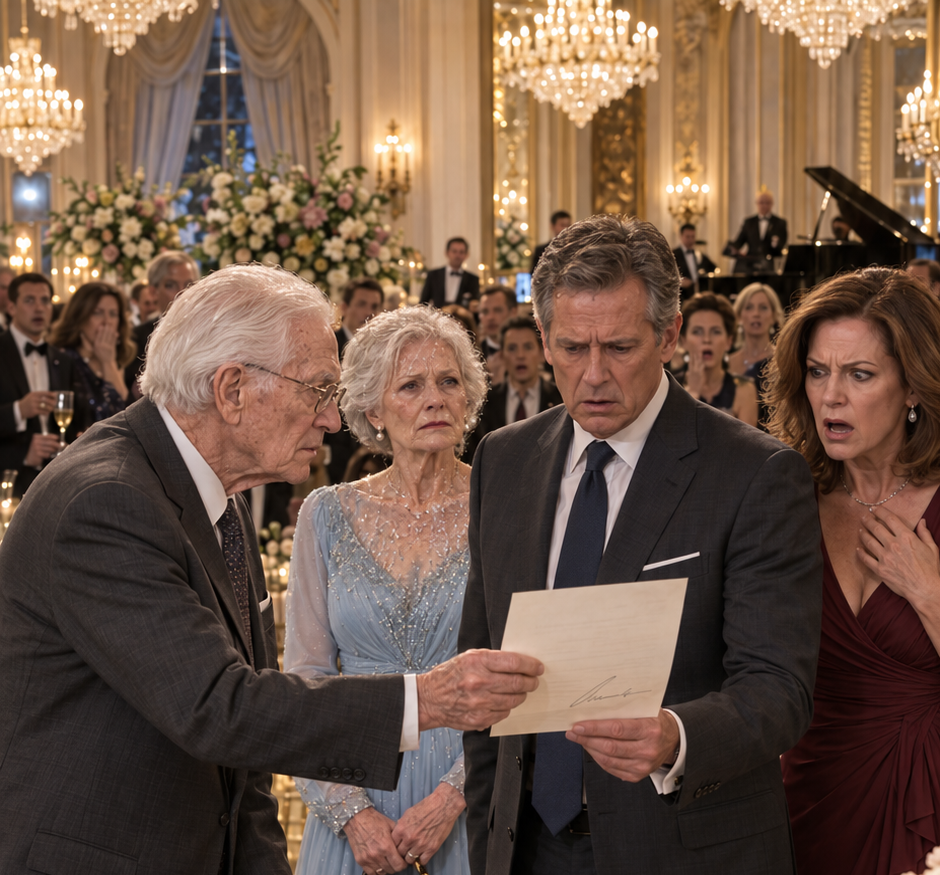
MY CHILDREN THREW ME OUT OF MY OWN EIGHTIETH BIRTHDAY PARTY.
THEN OUR ACCOUNTANT OPENED A BRIEFCASE AND TOLD THEM WHO HAD REALLY BEEN PAYING FOR THEIR LIVES.
PART 1 — THE GLASS ON THE FLOOR
At eighty years old, I had imagined many ways my children might eventually break my heart.
I had never imagined my daughter would do it with a glass of champagne in front of seventy people.
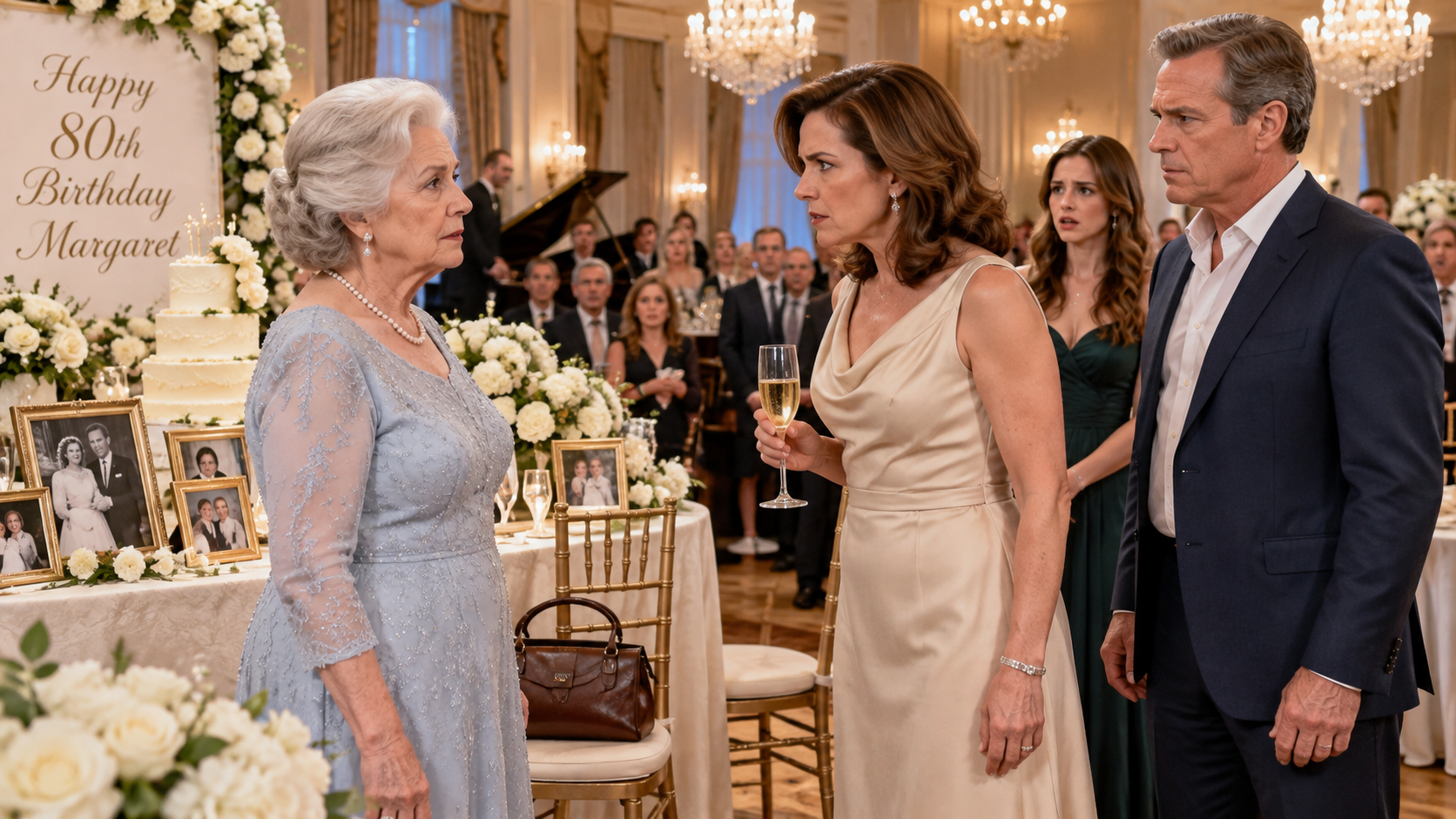
The champagne struck me across the face before I had time to turn away.
It was cold, sharp, almost absurdly sweet as it ran through my silver hair, over my cheeks, and down the neckline of the pale blue dress Sophie had helped me choose.
Somewhere behind Claire, a woman gasped.
For one second, the entire Richmond ballroom seemed to stop breathing.
The pianist stopped playing in the middle of “The Way You Look Tonight.”
A waiter carrying a tray of glasses froze beside the wall.
Beneath the chandeliers, relatives, neighbors, church friends, former business associates, and people I had known for forty years stared at me.
Claire stood three feet away holding the empty champagne flute.
She looked angry.
But what frightened me was that she also looked relieved.
“Tell them,” she said.
I wiped champagne from the corner of my eye.
“Claire.”
“No.
Not tonight.”
Her voice rose.
“Tell everyone the truth, Mom.
Daniel and I have been paying for your life for twenty years.”
A murmur moved through the room.
I looked at my daughter and saw, for just a moment, the six-year-old girl who used to climb into my bed during thunderstorms.
Then she disappeared.
7
In her place stood a fifty-two-year-old woman convinced she had been wronged.
My granddaughter Sophie pushed back her chair.
“Mom, stop.”
“Stay out of this.”
“Grandma didn’t do anything.”

Claire laughed once.
It was a hard little sound.
“That’s exactly the problem.
Everybody thinks Margaret Holloway is this brave, independent widow who has managed beautifully since Grandpa died.”
She looked around the ballroom.
“Ask her who paid the property taxes last year.”
Daniel stepped forward.
My son had always been quieter than Claire.
Even as a child, he preferred the authority of silence.
At fifty-five, with gray at his temples and a successful commercial printing company bearing his name, he had perfected the appearance of reasonableness.
“Claire,” he said.
“This isn’t helping.”
She turned on him.
“You wanted her to understand too.”
“Not like this.”
“Then when?”
Daniel looked at me.
That hurt more than Claire’s anger.
“Mom,” he said quietly, “we have been helping you for a long time.”
There it was.
Helping.
Such an innocent word.
Such a dangerous word when people begin keeping score.
“Yes,” I said.
“You have paid certain bills.”
Claire threw up both hands.
“Certain bills?”
She started counting on her fingers.
“Roof repairs.
Insurance.
Taxes.
Medical expenses.
Plumbing.
The new furnace.”
“Claire.”
“And every time we tried to talk about selling that ridiculous house, you refused.”
“It is my home.”
“You’re eighty!”
The words cracked across the room.
From somewhere near the cake table, somebody whispered her name.
Claire ignored them.
Three weeks earlier, she and Daniel had arrived at my house with coffee, lemon pastries, and a folder thick enough to frighten any elderly widow.
They called it a family financial plan.
I called it what it was.
A transfer of control.
They wanted me to sell the Richmond house Robert and I had lived in for forty-three years.
The house where our children learned to ride bicycles.
The house where Robert planted three dogwoods because Claire had once said three trees looked more like a family than two.
The house where I had cared for him through the last months of his life.
Daniel said the stairs were dangerous.
Claire said the yard was too large.
Both statements were true.
Then Daniel opened the folder.
The documents contained provisions that would eventually place substantial control over the proceeds of the house sale and portions of my financial affairs in his hands.
I read every page.
When I finished, I closed the folder.
“No.”
Claire stared at me.
“What do you mean, no?”
“I mean I am not signing this.”
“Mom, this isn’t about taking anything from you.”
“Then you won’t mind if I keep it.”
Daniel sighed.
“You are making this emotional.”
“It is my house, Daniel.
I am allowed to feel emotional about it.”
“We’ve been supporting that house for years.”
That sentence changed something.
I looked at both of them.
“I have always thanked you for anything you chose to pay.”
“Chose?”
Claire said.
“Do you hear yourself?”
“I never asked you.”
“Oh, come on.”
“I did not.”
Daniel had pushed his chair away from my kitchen table.
“Fine.
Don’t sign it today.”
“I will not sign it tomorrow either.”
He stared at me for several seconds.
Then he gathered the documents.
Claire stood.
“You are unbelievably stubborn.”
“No,” I said.
“I am still legally competent.”
She flinched.
I had chosen the words deliberately.
They left angry.
I believed time would cool things.
Instead, Claire organized my eightieth birthday party.
For weeks, she told everyone how much she and Daniel were spending.
The ballroom was beautiful.
White roses and hydrangeas covered the tables.
Photographs from my life stood in silver frames beside the cake.
Robert smiled from twenty different corners of the room.
Robert holding Daniel as a newborn.
Robert dancing with Claire at her wedding.
Robert beside me on our thirtieth anniversary.
Robert smiling as though our marriage had never contained a secret large enough to ruin us.
Now Claire pointed toward those photographs.
“Do you know what makes me angry?”
she asked.
“You let everybody believe you did it alone.”
I looked at her.
“I never said that.”
“You didn’t have to.”
Daniel stepped closer.
“Mom, just tell us what you meant earlier.”
“What?”
“When you said you appreciated everything we believe we’ve done for you.”
Claire went still.
“Yes.”
She folded her arms.
“What does believe mean?”
“This is not the place.”
“Of course it isn’t.”
Claire reached toward the chair beside me.
My old brown leather purse was sitting there.
Robert had bought it for me in Charleston nearly thirty years earlier because the clasp on my old one had broken during a weekend trip.
It had worn corners now, and Sophie had offered more than once to buy me a new one.
I always refused.
There are objects you keep not because they are valuable, but because someone who is gone once touched them.
Claire grabbed the purse.
“If you can’t show a little gratitude tonight, then maybe you should just go home.”
“Give me that.”
Daniel took it from her.
For one ridiculous second, relief rose inside me.
My son would stop this.
My son would remember himself.
Instead, Daniel lowered the purse carefully to the floor beside my shoes.
“Mom,” he said, “maybe it would be better if you left.”
Silence.
Absolute silence.
I looked at him.
There is a peculiar grief in realizing your child has become someone you would never have chosen to know.
I remembered sitting beside Daniel’s bed when he was nine and had pneumonia.
I remembered the night his first business nearly collapsed and he called our house after midnight because he was too ashamed to tell his wife.
I remembered Robert taking the telephone first.
Then I remembered what happened after that telephone call.
Daniel had never known.
Neither had Claire.
I bent slowly and picked up my purse.
My knees were not as cooperative as they had once been, but I refused Sophie’s hand when she rushed toward me.
“Grandma, please don’t leave.”
“I’m all right.”
“No, you’re not.”
Her eyes filled.
I touched her cheek.
“I will be.”
Claire’s voice came from behind her.
“Just once, Mom.
Admit it.”
I turned.
“Admit what?”
“That we supported you.”
I studied my daughter.
Then I said something I had not planned to say.
“You should be very careful asking for the truth in a room this crowded.”
Daniel’s expression changed.
“What does that mean?”
It meant eighteen years earlier, your father sat across from me at our kitchen table with shaking hands.
It meant he could barely lift his coffee cup.
It meant he confessed that he had made a financial decision without telling me.
A decision that could have cost us the house, our retirement, and nearly everything we owned.
It meant I spent almost two decades protecting my children from knowing why he did it.
But I said none of those things.
I turned toward the ballroom doors.
Then a chair scraped loudly across the floor behind me.
Everyone turned.
Arthur Bell stood near the rear wall.
Arthur was eighty-four, four years older than I was, and had handled our family finances for more than forty years.
He wore the same dark suits he had worn since the Reagan administration and carried a polished wooden cane.
His wife, Martha, caught his sleeve.
He covered her hand briefly.
Then he shook his head.
Arthur picked up a black leather briefcase from beside his chair and began walking toward us.
Tap.
Step.
Tap.
Step.
Nobody spoke.
When he reached the cake table, he placed the briefcase beside the white roses.
Claire frowned.
“Arthur, what are you doing?”
He ignored her.
He opened one brass latch.
Click.
Then the second.
Click.
I felt something inside me tighten.
“Arthur.”
He looked at me.
For more than twenty years, that man had respected every silence I asked him to keep.
He looked tired now.
And strangely sad.
“Margaret,” he said, “I promised to protect Robert’s financial history until you decided otherwise.”
Daniel glanced at Claire.
Arthur continued.
“But I believe your children have mistaken your silence for dependence long enough.”
He opened the briefcase.
Inside were thick folders, bank records, property documents, tax statements, and envelopes browned slightly at the edges.
Arthur removed the first folder.
Then he turned toward my son.
“Daniel,” he said, “I think you should see what your father signed eighteen years ago.”
He pulled out a document.
At the bottom was Robert’s signature.
Daniel stared at it.
Then his face lost its color.
PART 2 — THE DEBT ROBERT NEVER TOLD ME ABOUT
“What is that?”
Daniel reached for the paper.
Arthur did not give it to him.
“Do you remember March of 2008?”
Daniel swallowed.
“Of course.”
“Your company was six weeks from insolvency.”
The ballroom had become so quiet that I could hear the faint hum of the air-conditioning.
Daniel glanced around.
“This has nothing to do with Mom.”
“It has everything to do with your mother.”
I closed my eyes.
For eighteen years I had carried that spring inside me.
Daniel had been thirty-seven.
His commercial printing company had expanded too quickly.
He had leased new equipment, purchased a second warehouse, and taken on contracts that looked profitable until two clients failed within months of each other.
Then came the tightening credit markets.
The bank refused another extension.
Daniel called Robert at 12:17 one morning.
I remembered the exact time because I had been reading in bed.
Robert listened for fifteen minutes.
He said almost nothing.
Then he dressed.
“Where are you going?”
“Daniel needs help.”
“What happened?”
“Business problem.”
“I’m coming.”
“No.”
That should have frightened me.
It did not.
I trusted my husband.
That may be the most expensive luxury in any marriage—the belief that trust makes questions unnecessary.
Three months later, Robert sat at our kitchen table.
His hands were shaking.
“Margaret, I need to tell you something.”
I poured coffee.
“What?”
He pushed a folder toward me.
I opened it.
At first I did not understand.
Loan documents.
Personal guarantees.
A line of credit secured against investment accounts.
Then one page referring to our home.
I looked at Robert.
“What did you do?”
He stared at the table.
“I guaranteed Daniel’s restructuring loan.”
“How much?”
His voice was almost inaudible.
“Eight hundred and forty thousand.”
I sat very still.
“You pledged our assets?”
“Yes.”
“Without telling me?”
“Yes.”
“Robert.”
“I thought the business would recover.”
“You thought?”
“He was terrified, Margaret.”
“So you risked our house?”
“I was his father.”
“And I was your wife.”
He covered his face.
That was when I knew there was more.
“How much?”
He looked at me.
“What?”
“You would not look like that over eight hundred and forty thousand dollars.
What else did you do?”
His eyes filled.
“Claire.”
I stopped breathing.
Claire’s divorce had been finalized the previous year.
She had two children, a house she could barely afford, and an ex-husband whose business collapse had made child-support payments unreliable.
“What about Claire?”
“She was going to lose the house.”
I closed the folder.
“How much?”
“Three hundred and ten thousand.”
I stared at him.
“You gave her three hundred and ten thousand dollars?”
“No.”
“What did you do?”
“I bought the note.”
I almost laughed.
The sentence sounded too strange.
“Explain.”
“The bank was preparing foreclosure.
Arthur helped me acquire the mortgage through an entity.”
“And Claire?”
“She thinks the bank modified the loan.”
I stood so quickly my chair struck the wall.
“You used borrowed money to save both of them?”
Robert’s face folded.
“I couldn’t choose.”
“Nobody asked you to choose.”
“They were our children.”
“They are adults.”
“Margaret—”
“You risked everything without telling me!”
He shouted then.
The only time in forty-six years I remember Robert shouting at me.
“What was I supposed to do?
Let Daniel lose his company?
Let Claire take two children into an apartment because her husband destroyed their finances?”
I stared at him.
“Yes,” I said.
His mouth opened.
I lowered my voice.
“If the alternative was risking our home without telling me, then yes.
You were supposed to let our adult children face the consequences of adult life.”
He looked as though I had slapped him.
For two days, we barely spoke.
On the third morning, Arthur Bell came to the house.
He carried numbers.
Arthur always carried numbers when other people carried fear.
“If the restructuring fails,” he said, “the combined exposure could exceed one-point-two million.”
Robert looked sick.
I asked Arthur a simple question.
“What can be sold without forcing the sale of this house?”
He looked at me.
“Robert’s retirement assets would not cover it.”
“I did not ask about Robert’s assets.”
Both men stared.
I walked upstairs.
From the cedar chest in our bedroom, I removed a file Robert had not seen in years.
My father had been a pharmacist in Norfolk.
Before he died, he gave each of his three daughters shares in a regional pharmaceutical distribution company owned by one of his oldest friends.
My sisters sold theirs decades earlier.
I had not.
The company had grown quietly.
Then merged.
Then merged again.
Robert knew I owned shares.
He had no idea what they were worth.
In those days, husbands often managed family finances even when wives quietly owned more than anyone realized.
Arthur opened the folder.
For the first time in my life, I saw Arthur Bell lose his composure.
“Margaret.”
Robert looked from him to me.
“What?”
Arthur adjusted his glasses.
“How long have you held these?”
“Since 1974.”
“And you never sold?”
“No.”
He looked at me for a long moment.
“These are worth considerably more than the exposure.”
Robert whispered, “How much?”
Arthur gave him the figure.
Three million, eight hundred thousand dollars.
Robert sat down.
He did not speak for almost a minute.
Then he laughed once.
Not because anything was funny.
Because sometimes shock and shame wear the same face.
“You could have told me.”
I looked at him.
“So could you.”
Arthur’s voice pulled me back into the ballroom.
“The total amount Robert placed at risk was one million, one hundred and fifty thousand dollars.”
Claire sat down.
Daniel stared at the document.
“No.”
Arthur finally handed it to him.
Daniel read.
Then read again.
“My father guaranteed this?”
“Yes.”
“I thought the bank approved the restructuring.”
“The bank did,” Arthur said.
“Because your father secured the exposure.”
Daniel looked at me.
“Mom?”
I said nothing.
Claire stood.
“What does this have to do with my house?”
Arthur removed another document.
“You nearly lost it after the divorce.”
Claire’s expression hardened.
“I worked that out.”
“No,” Arthur said gently.
“Your father worked it out.”
“What?”
“He acquired your mortgage through a private entity and adjusted the terms.”
Claire laughed.
“That’s ridiculous.”
Arthur placed the paper on the table.
She read the name.
Bell-Robert Holdings.
Her mouth opened.
“What is this?”
“The entity that held your mortgage for eleven years.”
Claire looked at Arthur.
Then at me.
“You knew?”
“Not at first.”
“When?”
“After your father confessed.”
Her voice cracked.
“You let me believe I saved my own house.”
“You did save it.”
“How?”
“You kept working.
You raised your children.
You made every payment you could.”
“But Dad—”
“Yes.”
She looked toward Robert’s photographs.
For the first time that night, the anger left her face.
Daniel was still studying his loan guarantee.
“So Dad saved both of us.”
Arthur looked at me.
I knew what came next.
“Not exactly.”
Daniel raised his head.
Arthur reached into the briefcase again.
“Robert created the obligations.”
Then he placed a brokerage statement on the table.
“Margaret eliminated them.”
Daniel blinked.
“What?”
Arthur pointed to the statement.
“Your mother liquidated a portion of assets she had owned separately since the 1970s.”
Claire turned toward me.
“You had that kind of money?”
“Yes.”
“How much?”
“That was my private business.”
“You let us pay your bills!”
There it was again.
The old accusation searching desperately for somewhere to stand.
Arthur removed another folder.
“I was hoping we might reach this portion later.”
Claire glared at him.
“What portion?”
“The bills.”
PART 3 — THE LEDGER OF LOVE
Arthur Bell had kept a ledger on my family for twenty years.
Not because I wanted to count what my children gave me.
Because I wanted to make certain I gave it back.
The first entry was dated February 14, 2006.
Daniel had paid $1,842 for storm damage to our roof while Robert was recovering from minor surgery.
I remembered arguing with him.
“Daniel, I can pay this.”
“I know you can.”
“Then why are you doing it?”
“Because I’m your son.”
He smiled.
“Let me do something.”
So I did.
The following morning, I called Arthur.
“Put the same amount into the grandchildren’s accounts.”
“All of them?”
“Divide it equally.”
That became a habit.
Claire paid a tax bill.
I transferred the same amount into trusts for her children.
Daniel paid an insurance premium.
I matched it into accounts for his.
After Robert died, they became more insistent.
Perhaps helping me made them feel less helpless.
Perhaps it became part of how they understood themselves.
The responsible children.
The aging mother.
I could have stopped it.
I should have.
But each time I tried, Claire said, “Mom, please.”
Daniel said, “You took care of us.”
And I mistook accepting their generosity for preserving their dignity.
Arthur opened the ledger.
“Over approximately twenty years, Daniel and Claire paid one hundred forty-seven thousand, six hundred and twenty-three dollars in expenses on Margaret’s behalf.”
Claire crossed her arms.
“Thank you.”
Arthur continued.
“Margaret directed an equal amount to investment accounts established for your children.”
Nobody spoke.
Sophie looked at me.
“What accounts?”
Arthur turned a page.
“With appreciation and growth, the combined value is currently just over four hundred and eighty thousand dollars.”
Sophie covered her mouth.
Claire stared at me.
“You gave the money to our children?”
“Not your money,” I said.
“Mine.”
“But every time we helped you—”
“I matched it.”
“Why?”
“Because you would not let me refuse you.”
Daniel shook his head.
“So all those payments…”
“Were still generous.”
“No.”
His voice softened.
“You didn’t need them.”
“I never said I did.”
“But you let us believe…”
He stopped.
I waited.
“That you needed us?”
I asked.
He looked ashamed.
I smiled sadly.
“Daniel, there is a difference between needing your children and needing their money.”
Something moved through his face.
For the first time that evening, my son looked less like a businessman and more like a boy who had misunderstood an important lesson.
Claire was not ready.
“So what?
You secretly matched everything and now we’re villains because we didn’t know?”
“No.”
“Then what is this?”
“You asked for the truth.”
“You could have told us years ago.”
“Yes.”
“Why didn’t you?”
That was the question I had asked myself many times.
Because Robert had begged me.
Because I wanted my children to remember their father as a generous man, not a frightened man who nearly destroyed our retirement by trying to rescue adults who needed to learn how to fall.
Because after Robert died, the secret became less about protecting him and more about preserving the architecture of our family.
And eventually, because silence became easier than explanation.
“I was protecting your father,” I said.
Claire laughed bitterly.
“From us?”
“From himself.”
Arthur closed the ledger.
“Margaret never wanted Robert’s children to remember him primarily through his worst financial decision.”
Daniel looked toward the photograph of Robert holding him as a baby.
“Why would Dad hide it from me?”
“Because he knew you would feel guilty.”
“I should feel guilty.”
“No,” I said.
“You were frightened.
You called your father.”
“And he put everything at risk.”
“Yes.”
“Because of me.”
“Because of a decision he made.”
Daniel’s eyes filled.
I had not seen my son cry since Robert’s funeral.
“Why didn’t you tell me?”
“Because guilt is not the same as responsibility.”
He looked at me.
“You paid off the loan.”
“Yes.”
“How much?”
“Enough.”
Arthur answered anyway.
“Margaret ultimately spent nine hundred and twelve thousand dollars unwinding the guarantees and restructuring the obligations related to your company.”
Daniel sat down.
His knees seemed to fail him.
Claire whispered, “Nine hundred thousand?”
Arthur nodded.
Daniel stared at his hands.
“My whole company…”
“Survived because you rebuilt it,” I said.
“No.”
He looked up.
“It survived because you gave me the chance.”
“Yes.”
“That matters.”
I had no answer.
Sophie came to stand beside me.
She slipped her hand into mine.
Claire watched us.
“What about me?”
I knew what she meant.
Arthur removed a third file.
“Margaret eventually acquired full control of the entity holding your mortgage.”
Claire stared.
“When?”
“After Robert’s death.”
“And then?”
Arthur looked at me.
I answered.
“You refinanced twelve years ago.”
“Yes.”
“The bank told you the outstanding second obligation had been satisfied.”
Claire’s lips parted.
“That was you?”
“Yes.”
“How much?”
“One hundred eighty-six thousand.”
She sat down too.
For several seconds, neither of my children looked at me.
Around us stood an audience that had become irrelevant.
The humiliation had become something else.
An excavation.
Claire whispered, “Why?”
“Because you had two children.”
“That’s not an answer.”
“It was enough for me.”
Her face tightened.
“You let me think I did it alone.”
I almost smiled at the irony.
“Claire, ten minutes ago you were angry because you thought I let people believe I did things alone.”
She flinched.
“Maybe neither of us understood the other very well.”
Sophie squeezed my hand.
Daniel suddenly stood.
“This party should end.”
Claire looked at him.
“What?”
“This should be private.”
I stared at my son.
“When I asked for privacy, you put my purse on the floor.”
He closed his eyes.
“Mom.”
“No.”
My voice was quiet.
“I am not going to scream at you.
I am not going to throw anything.
I am not going to embarrass you the way you embarrassed me.”
His face crumpled slightly.
“But you will stay in this room long enough to understand why what happened tonight was not about money.”
Claire looked defensive again.
“Then what was it about?”
“Control.”
Nobody moved.
I nodded toward Daniel’s folder.
“The documents you brought to my house.”
Daniel’s jaw tightened.
“They were protective.”
“They placed you in a position to control substantial assets.”
“If your health declined.”
“That was not how every provision was written.”
“I was trying to help.”
“You were trying to decide what help looked like before I asked for it.”
Claire interrupted.
“Because you don’t ask.”
“No.”
I looked at her.
“I don’t.”
“And that’s healthy?”
“No.”
The answer surprised her.
“I have made mistakes too.”
The room seemed to soften.
“I should have told you more.
I should have spoken sooner.
I should have taught both of you that generosity without boundaries can become resentment.”
I looked toward Robert’s photographs.
“Your father and I were very good at rescue.
We were not always good at honesty.”
Daniel rubbed his forehead.
“The plan wasn’t about stealing your money.”
“I know.”
“Then why are you making it sound sinister?”
Before I answered, Sophie stepped forward.
“Because you asked me to sign something.”
Daniel froze.
Claire turned.
“What?”
Sophie looked terrified.
I felt her hand tremble.
“Sophie?”
She swallowed.
“Dad called me two weeks ago.”
Daniel spoke quickly.
“That has nothing to do with this.”
“What did he ask you to sign?”
I said.
Sophie looked at him.
“A statement.”
My heart slowed.
“What statement?”
“That Grandma had been forgetting things.”
Claire stared at Daniel.
“You did what?”
“It wasn’t like that.”
Sophie’s voice rose.
“You told me it was just in case!”
Daniel glanced around the ballroom.
“We are not discussing this here.”
I almost laughed.
Now he wanted privacy.
Arthur Bell’s face had changed.
“Daniel,” he said, “what statement?”
Daniel said nothing.
Sophie continued.
“He said there might be problems getting Grandma to accept help.
He asked me to write down anything I’d noticed.”
I turned toward my son.
“Have you been building a competency file on me?”
“No.”
“Daniel.”
“No!”
He lowered his voice.
“I spoke to an elder-care attorney about options.
That is not a crime.”
Claire stared at him.
“You told me we were just going to get her to sell the house.”
“We were.”
“Then why involve Sophie?”
“Because Mom refuses everything.”
I felt remarkably calm.
“Did you believe I had dementia?”
“No.”
“Did you believe I was incapable of understanding my finances?”
“No.”
“Then why document forgetfulness?”
He did not answer.
Sophie began to cry.
“I’m sorry, Grandma.”
I touched her arm.
“You have nothing to apologize for.”
“I didn’t sign it.”
“I know.”
Daniel looked at me.
“I was afraid.”
That answer stopped me.
Not because I believed it excused him.
Because I recognized it.
Robert had used the same words eighteen years earlier.
I was afraid.
Fear had nearly cost us everything once.
Now it had returned in our son wearing a better suit.
“Afraid of what?”
I asked.
Daniel looked at the floor.
“Of losing control.”
The honesty was so unexpected that Claire turned toward him.
He laughed bitterly.
“You want the truth?
Fine.”
He looked at me.
“When Dad died, you were fine.”
“Yes.”
“You handled the funeral.
The lawyers.
The accounts.
The house.
Everything.”
“Yes.”
“And I realized you didn’t need me.”
I stared at him.
He continued.
“I spent my whole adult life believing that one day I would be the one who took care of you.
Then every year you got older, and somehow you kept handling everything.”
“Daniel…”
“I know how it sounds.”
His voice cracked.
“Then I started paying bills because at least that was something.”
I felt tears in my eyes.
He looked toward the floor where he had placed my purse.
“Tonight, when you wouldn’t admit you needed us, I felt…”
He stopped.
“Angry?”
I asked.
“Useless.”
The word landed softly.
Claire looked away.
For the first time, I understood that the ugliness of the evening had not grown from greed alone.
It had grown from fear.
From aging.
From children watching a parent approach the end of life and confusing control with usefulness.
I stepped toward my son.
“I have always needed you.”
He looked up.
“But not as my banker.”
He cried then.
Quietly.
And if Arthur Bell had closed his briefcase at that moment, perhaps our family might have begun repairing itself immediately.
But Arthur did not close it.
He looked at Daniel with an expression I could not read.
Then he said, “There is still one document you have not seen.”
PART 4 — WHAT ROBERT LEFT BEHIND
Arthur removed a sealed envelope.
My name was written across the front in Robert’s handwriting.
I had seen it once before.
Ten years earlier.
Three weeks before Robert died.
He had asked Arthur to come to the house.
Cancer had hollowed him by then.
He sat in his study wrapped in a gray cardigan, though it was May.
Arthur brought two documents.
Robert signed both.
Afterward, he handed me the envelope.
“Not yet,” he said.
“What is it?”
“A confession.”
“You’ve already confessed.”
“Not all of it.”
I stared at him.
He smiled weakly.
“Don’t look so frightened.”
“You have a terrible record with that sentence.”
He laughed.
Then coughed until I had to hold a glass of water to his mouth.
When he recovered, he touched my wrist.
“Margaret, there are things children should know about their parents.”
“And things they shouldn’t.”
“Yes.”
His eyes softened.
“But we protected them too much.”
I knew he was right.
Arthur had held that envelope ever since.
Now, in the ballroom, he handed it to me.
“I believe the circumstances Robert described have occurred.”
Daniel looked at me.
“What circumstances?”
I did not answer.
I broke the seal.
Inside were six handwritten pages.
Robert’s handwriting had deteriorated near the end, but I could still read every word.
Margaret,
If you are reading this because Arthur decided the time has come, then I assume our children have confused your kindness with weakness.
I stopped.
Claire whispered, “What?”
I continued silently for several lines.
Then I looked at Arthur.
“Did you know all of this?”
“Yes.”
“Even the last part?”
“Yes.”
My hands began to shake.
Daniel stepped toward me.
“Mom?”
I handed Arthur the letter.
“Read it.”
Arthur adjusted his glasses.
He began.
“Margaret saved this family twice.”
Daniel looked at me.
Arthur continued.
“The first time was financial.”
“The second was moral.”
I felt the room recede.
Robert described the spring of 2008.
His panic.
His guarantees.
My anger.
My stock.
The debt.
Then the letter changed.
I had forgotten how brutal honesty could sound in the voice of someone dead.
“I allowed Daniel and Claire to believe I had rescued them,” Arthur read, “because I was ashamed to admit that Margaret rescued all three of us.”
Daniel covered his mouth.
Claire’s eyes filled.
Arthur continued.
“I was raised to believe a husband protected his family.
When I discovered that my wife possessed the means, judgment, and courage I lacked in the moment that mattered most, I was grateful to her and ashamed of myself in equal measure.”
I closed my eyes.
Robert had never said those words to me.
Not exactly.
“I asked her to keep the details private.
She agreed because she loved me.”
Arthur’s voice softened.
“That was selfish of me.”
The room blurred.
Sophie put an arm around my shoulders.
Arthur continued.
“Daniel, if you are hearing this, your mother never blamed you for calling me.
Claire, she never blamed you for needing help after your divorce.”
“But both of you should understand something I learned too late.”
“Love that rescues without telling the truth can make everyone weaker.”
Daniel began to cry again.
Arthur turned the page.
Then he hesitated.
“What?”
Claire asked.
Arthur looked at me.
I nodded.
He continued.
“After I became ill, Margaret and I changed our estate plan.”
Claire’s expression shifted.
There it was.
The thing people always pretend they are not thinking about when an elderly parent discusses money.
Inheritance.
Daniel looked uncomfortable.
“Dad didn’t need to explain that.”
Arthur continued reading.
“We calculated the support each child had already received.”
Claire stiffened.
“What does that mean?”
Arthur lowered the letter.
“Robert and Margaret decided that the financial rescues provided during your adult lives would be treated as advances against your eventual inheritance.”
Claire’s mouth fell open.
Daniel stared.
Arthur returned to the letter.
“Not as punishment.”
“Not because we love either of you less.”
“But because fairness does not always mean giving everyone the same check at the same moment.”
Claire whispered, “How much?”
Arthur opened another folder.
“To Daniel: approximately nine hundred and twelve thousand dollars associated with the business rescue, plus later gifts.”
Daniel looked sick.
“To Claire: approximately four hundred ninety thousand dollars related to housing support, debt resolution, and subsequent assistance.”
Claire stood.
“That is not fair.”
I stared at her.
The irony was almost too painful to acknowledge.
“What is not fair?”
“I didn’t ask for all of that.”
“Neither did I ask you to pay my property taxes.”
She stopped.
I continued.
“This is what happens when families help one another without speaking clearly about what the help means.”
Daniel sat back down.
“So what happens to the estate?”
Arthur closed the folder.
“Much of it is already settled.”
Claire looked at me.
“Settled how?”
“The grandchildren.”
Sophie stiffened.
Arthur nodded.
“Margaret and Robert established trusts for all five grandchildren.”
Claire stared.
“All five?”
“Yes.”
“Equal?”
“Substantially.”
“How much?”
“Enough that none of them should make major life decisions based solely on fear of money.”
Sophie shook her head.
“I don’t want Grandma’s money.”
I turned toward her.
“That is precisely why I trust you to receive it responsibly.”
She began crying.
Claire looked at me.
“So you’ve disinherited us.”
“No.”
“Then what do you call this?”
“Accounting.”
Her face changed.
I immediately regretted the word.
Not because it was false.
Because it sounded cruel.
“Claire.”
She stood very straight.
“Don’t.”
“Your father and I loved you.”
“Loved?”
“I love you.”
“You have a strange way of showing it.”
I almost laughed from exhaustion.
“You threw champagne in my face.”
Her eyes closed.
For the first time all evening, shame finally arrived.
“I know.”
Daniel looked toward Arthur.
“Is that everything?”
Arthur’s fingers rested on the black briefcase.
“No.”
I looked sharply at him.
“Arthur.”
He met my eyes.
“There is one financial matter Robert never told you.”
The room seemed to tilt.
“What?”
Arthur looked genuinely uncomfortable.
For more than forty years, I had trusted that man.
Now he would not look directly at me.
“Robert asked me to keep one transaction confidential until after certain conditions were met.”
My voice became cold.
“What transaction?”
“Arthur,” Daniel said, “maybe this isn’t the time.”
“No,” I said.
Everyone looked at me.
“If tonight is the night for truth, then we finish.”
Arthur sighed.
“Very well.”
He removed a thin red folder from the bottom of the briefcase.
Unlike the others, I had never seen it.
I felt fear for the first time that evening.
Arthur placed it on the cake table.
“Six months after Margaret used her assets to resolve the family’s financial crisis, Robert came to my office alone.”
I stared at him.
“He did what?”
“He wanted to repay you.”
My throat tightened.
“With what?”
Arthur looked toward Daniel.
Then Claire.
“Something neither of you knew he owned.”
PART 5 — THE LAST ACCOUNT
Robert had inherited nothing from his parents except a watch, a Bible, and a talent for convincing people that tomorrow would be better than today.
At least that was what I had always believed.
Arthur opened the red folder.
“In 1981, Robert invested twenty-five thousand dollars in a small technology company founded by a college friend.”
I blinked.
“What technology company?”
Arthur told me the name.
I had heard it before, though only vaguely.
The company had begun manufacturing specialized components used in industrial imaging systems.
By the 1990s, it had grown.
In the early 2000s, it was acquired by a much larger corporation.
I stared at Arthur.
“Robert never told me.”
“No.”
“How much was his position worth?”
Arthur looked apologetic.
“At the time of acquisition, approximately two-point-six million dollars.”
A murmur moved through the ballroom.
I felt anger rise.
Not because of the money.
Because once again, Robert had kept a financial secret from me.
“He had two-point-six million dollars while I sold my assets to clean up his disaster?”
“No.”
“What do you mean, no?”
“He had already transferred the shares.”
“To whom?”
Arthur turned the red folder toward me.
There were two names.
Daniel Holloway.
Claire Holloway.
My children stared.
I did not understand.
Arthur continued.
“In 1997, Robert placed the shares into two irrevocable trusts, one for each child.”
Claire whispered, “What?”
Daniel stood.
“I never had a trust.”
“You did.”
Arthur removed statements.
“The trust distributions were structured indirectly.”
Daniel looked confused.
“What does indirectly mean?”
Arthur pointed at him.
“Your original business capital.”
Daniel went pale.
He looked at me.
Then at Arthur.
“My first loan?”
“Was not a loan.”
Daniel sat down.
Arthur looked at Claire.
“Your college loans.”
Claire covered her mouth.
“Paid from the trust.”
“Your wedding contribution.
The down payment on your first house.
Several other transfers.”
She shook her head.
“Dad told me those were from savings.”
“They were distributions from assets he had already legally placed in your name.”
I looked at Robert’s photograph on the cake table.
The man had been dead ten years.
He was still capable of surprising me.
Arthur continued.
“By 2008, most of Daniel’s trust had been used to capitalize or support his business.”
Daniel whispered, “I spent it?”
“You used it.”
He stared at nothing.
Arthur turned to Claire.
“A substantial portion of yours had been distributed as well.”
Claire sank into her chair.
I understood before anyone said it.
When Robert risked our house to save Daniel’s business and Claire’s home, he was not merely rescuing his children.
He was trying to protect the lives they had built with money he had secretly given them years earlier.
Arthur looked at me.
“That was the source of Robert’s panic.”
I swallowed.
“He thought if their businesses and homes failed, he had failed them twice.”
“Yes.”
I closed my eyes.
The anger I had carried toward Robert for eighteen years shifted shape.
It did not disappear.
Secrets do not become noble simply because their motives were loving.
But I saw something I had not seen before.
He had not been gambling with our future because he believed our children were helpless.
He had been desperately trying to preserve gifts they never knew he had given.
Daniel whispered, “Why didn’t he tell us?”
Arthur looked at him.
“Because your father had a peculiar theory about money.”
Despite myself, I smiled.
“That sounds like Robert.”
“He believed inherited wealth damaged ambition if children knew it existed.”
Claire gave a stunned laugh.
“So he gave us money and made us think we earned it?”
“Not exactly.”
Arthur looked stern.
“You both worked very hard.”
He pointed toward Daniel.
“You built your company.”
Then toward Claire.
“You rebuilt your life after your divorce.”
“The money gave you opportunities.
It did not live your lives for you.”
I looked down at the papers.
“Why was this hidden from me?”
Arthur sighed.
“Because Robert was ashamed.”
I laughed softly.
“Robert spent half our marriage ashamed of the wrong things.”
That earned a few nervous smiles.
Arthur reached into the red folder again.
“There is one final transaction.”
I looked at him.
“Of course there is.”
Even Arthur smiled.
“After Margaret resolved the 2008 crisis, Robert still controlled one asset personally.”
“What?”
“His remaining interest in a commercial property partnership.”
I vaguely remembered it.
A warehouse complex outside Richmond.
“Worth?”
“At the time, about six hundred thousand.”
Daniel leaned forward.
“What did he do with it?”
Arthur handed me a document.
I read the first line.
Then stopped.
The property interest had been transferred into a trust.
Beneficiary:
Margaret Holloway.
I looked at Arthur.
“He gave it to me?”
“Yes.”
“When?”
“Nine months after your confrontation.”
“Why didn’t you tell me?”
“Robert instructed me not to.”
My anger returned.
“Why?”
Arthur reached into the folder.
“Because he wrote you a letter.”
Another envelope.
This one was smaller.
My name appeared across the front.
Arthur handed it to me.
I opened it.
Margaret,
If Arthur gives you this, I am gone, and our children have finally learned how foolish their father could be.
I laughed.
Then cried.
People politely looked away.
I continued.
You saved me when I had no right to ask you to.
You saved Daniel.
You saved Claire.
And because I know you, you probably told no one.
I wiped my eyes.
He knew me too well.
The next lines blurred.
I hope one day you understand that the worst thing I ever did with money came from loving our children badly.
I tried to protect them from every fall.
You were right.
A parent’s job is not to prevent every fall.
It is to make sure the child knows where home is afterward.
My throat closed.
I continued.
The property is yours.
Not repayment.
There is no repayment between us.
Call it an apology from a stubborn man who finally understood that his wife was the strongest person in the family.
I folded the letter.
The ballroom had disappeared behind tears.
Sophie wrapped her arms around me.
For several minutes, nobody spoke.
Then Claire walked toward me.
Slowly.
She stopped where she had stood before throwing the champagne.
Her hands trembled.
“Mom.”
I looked at her.
She began to cry.
“I don’t know how to apologize for tonight.”
“No.”
“You don’t have to forgive me.”
“No.”
She winced.
“But I want you to understand something.”
She nodded.
“I am not going to pretend it did not happen.”
Her eyes dropped.
“But I also refuse to let the worst ten minutes of your life with me become the whole story of us.”
She looked up.
I saw my little girl again.
This time she stayed.
Claire whispered, “I was angry because I thought you were using us.”
“I know.”
“And underneath that, I think I was terrified.”
“Of what?”
“You getting older.”
Her mouth trembled.
“And me becoming the mother.”
I reached for her hand.
“You will never become my mother.”
She laughed through tears.
“Thank God.”
A few people laughed softly.
Daniel came toward us.
He looked at my purse.
It was still in my hand.
His face collapsed.
“I put that on the floor.”
“Yes.”
“I don’t know why that feels worse than everything else.”
“Because you wanted me to feel small.”
He looked away.
I did not soften the truth.
After a moment, he nodded.
“Yes.”
Then he looked at me again.
“I am sorry.”
I believed him.
That did not erase it.
But forgiveness is not an eraser.
It is permission to begin writing the next page.
“I love you,” I said.
He cried harder.
“I love you too.”
Arthur began gathering documents.
I looked at him.
“Wait.”
He stopped.
“There is still a question.”
“What question?”
“The property Robert left me.”
Arthur nodded.
“What happened to it?”
He smiled.
Finally.
A real smile.
“Margaret, I have been waiting fifteen years for you to ask.”
Daniel frowned.
“What does that mean?”
Arthur removed one final statement.
“The warehouse partnership was sold seven years ago.”
I stared.
“And the proceeds?”
“Reinvested.”
“How much is the account worth?”
Arthur looked around the ballroom.
For the first time that night, the old accountant seemed to enjoy himself.
“Approximately eight-point-four million dollars.”
Claire sat down so abruptly Sophie laughed in spite of herself.
Daniel stared at me.
“You have eight million dollars?”
“I apparently do.”
Arthur corrected him.
“Closer to eleven million total once Margaret’s remaining separate investments are included.”
Silence.
Then Sophie started laughing.
Not cruelly.
Helplessly.
Soon I did too.
After champagne, accusations, secret trusts, hidden investments, and eighteen years of family mythology, laughter felt almost indecent.
It also felt wonderful.
Claire wiped her face.
“So all this time…”
I raised an eyebrow.
“Yes?”
“We thought we were keeping you afloat.”
“I know.”
Daniel gave a broken little laugh.
“And you’re worth eleven million dollars.”
“Apparently.”
Claire looked horrified.
“Mom, people are going to think this whole family is insane.”
I looked around at seventy people who had witnessed nearly every terrible detail.
“My dear, I believe that ship has sailed.”
Even Arthur laughed.
But then he cleared his throat.
“There is one more thing.”
Everyone groaned.
“Arthur,” I said, “if you pull another envelope from that briefcase, I may throw you into the cake.”
He smiled.
“No envelope.”
“Good.”
“Just a clarification.”
I waited.
“The eleven million dollars is not the surprise.”
Daniel stared at him.
“What could possibly be more surprising than that?”
Arthur looked at Sophie.
Then at me.
I felt my smile disappear.
“Arthur?”
He spoke carefully.
“Margaret amended the grandchildren’s trust six months ago.”
Claire looked at me.
“You did?”
“Yes.”
Arthur continued.
“The trust is not scheduled to distribute the principal upon Margaret’s death.”
Daniel frowned.
“Then when?”
“It already began.”
Sophie stared.
“What?”
Arthur looked at her.
“Your grandmother has been using the trust to purchase distressed medical debt anonymously throughout Virginia.”
I felt every face turn toward me.
Sophie whispered, “Medical debt?”
I nodded.
“When Robert was ill, I met families in waiting rooms who were choosing between treatment and keeping their homes.”
Claire stared.
“What did you do?”
“Bought some of the debt.”
“And?”
“Forgave it.”
Daniel’s mouth opened.
Arthur supplied the figure.
“To date, approximately three-point-one million dollars of medical debt has been retired for several hundred Virginia families.”
The ballroom fell silent again.
But it was a different silence.
Claire whispered, “Why didn’t you tell anyone?”
I looked at my children.
After everything that had happened, the answer seemed obvious.
“Because help stops being a gift when you need applause for giving it.”
Claire began crying again.
I squeezed her hand.
Arthur closed his briefcase.
For the first time that night, it stayed closed.
The party did not resume in the ordinary way.
No one asked the pianist to start again.
No one returned to casual conversation.
But Sophie cut the birthday cake.
Daniel carried plates.
Claire found a towel and gently dried champagne from my hair like she had when she was a child helping me after rain.
People stayed.
Some hugged me.
Some pretended they had not heard things they would certainly discuss for years.
At ten o’clock, only family remained.
The chandeliers had been dimmed.
Sophie sat barefoot in a chair beside me.
Daniel was stacking photograph frames.
Claire approached holding the old leather purse.
She had cleaned the champagne from one corner.
“I’m going to buy you a new one.”
“No.”
“Mom.”
“This one is fine.”
“It belongs in a museum.”
“It has sentimental value.”
She smiled.
“Dad bought it?”
“Yes.”
She touched the worn leather.
“Did he know what was in it?”
“What do you mean?”
She pointed.
“There’s something under the lining.”
I frowned.
Claire reached inside.
The inner seam had torn slightly.
She pulled out a small folded piece of paper.
My breath stopped.
It was old.
Very old.
Robert’s handwriting.
Of course.
Claire looked terrified.
“Should I call Arthur back?”
I laughed so hard I had to sit down.
“No.”
“What does it say?”
I unfolded the paper.
Three lines.
Margaret,
If you are carrying this ridiculous purse at eighty, you have officially proven that you are more stubborn than I am.
Buy yourself a new one.
For several seconds I could not speak.
Then I laughed until tears ran down my face.
Claire leaned against me.
Daniel came over.
Sophie read the note and laughed too.
Robert had hidden fortunes, debts, trusts, mistakes, apologies, and entire pieces of our family history.
But somehow the last secret he left me was not worth millions.
It was a joke inside an old purse.
And that, more than anything Arthur had pulled from the briefcase, felt like my husband.
I turned eighty believing my children had forgotten who I was.
By midnight, I understood something more uncomfortable and more hopeful.
We had all forgotten who one another were.
Claire had mistaken my silence for helplessness.
Daniel had mistaken control for love.
Robert had mistaken rescue for fatherhood.
And I had mistaken secrecy for protection.
Money had not caused our wounds.
It had merely given them numbers.
The real healing began when we stopped counting.
Six months later, I was still living in my Richmond house.
I installed a second handrail on the stairs.
That was my concession.
Daniel never mentioned selling it again.
Claire began visiting every Sunday, usually carrying groceries I did not need.
I stopped arguing.
Instead, I let her bring them.
Then I sent her home with twice as much food from my freezer.
Old habits are difficult to break.
Sophie joined the advisory committee for the medical-debt trust.
She insisted we rename it.
Not after me.
Not after Robert.
She called it The Open Door Fund.
When I asked why, she said, “Because you said a parent’s job is to make sure their children know where home is.”
“That was your grandfather.”
She smiled.
“You were the one who lived it.”
Daniel eventually framed Robert’s old loan guarantee.
Not in his office where clients could see it.
In the private hallway outside his study.
Underneath, he placed a small plaque.
Not with a dollar amount.
Just four words:
SOMEONE GAVE ME TIME.
Claire did something similar.
She began volunteering twice a month with a housing nonprofit helping divorced and widowed women remain in their homes.
She never told anyone why.
That pleased me most.
And the old leather purse?
I kept carrying it.
Naturally.
On my eighty-first birthday, Claire gave me a beautiful new purse.
Italian leather.
Far too expensive.
I thanked her.
Then I placed it carefully in my closet.
Sophie saw me arrive at dinner carrying Robert’s old brown one.
She laughed.
“Grandma, seriously?”
I opened it.
Inside was Robert’s note.
“I am eighty-one,” I said.
“At this point, stubbornness is no longer a flaw.”
“What is it?”
“A family tradition.”