My daughter-in-law announced that twenty-five of her relatives were coming to my house for Christmas.
She smiled as though she were giving me a gift.
“It’s only twenty-five people.”
Only.
Twenty-five people.
In my house.
Without asking.
I smiled back.
“Wonderful,” I said. “I’ll be on vacation.”
Her smile faltered.
“You can handle the cooking and cleaning yourself… because I’m not your maid.”
The color drained from her face so quickly that, for a brief moment, I almost felt sorry for her.
Almost.
Because she still had no idea the biggest surprise was waiting.
The silence that followed settled over the room like a heavy winter fog.
Emily stood frozen, caught somewhere between disbelief and panic.
Across the room, Daniel rubbed a hand across his forehead, already looking exhausted before the argument had even truly started.
He clearly had not expected Christmas to become a battlefield before Thanksgiving was even over.
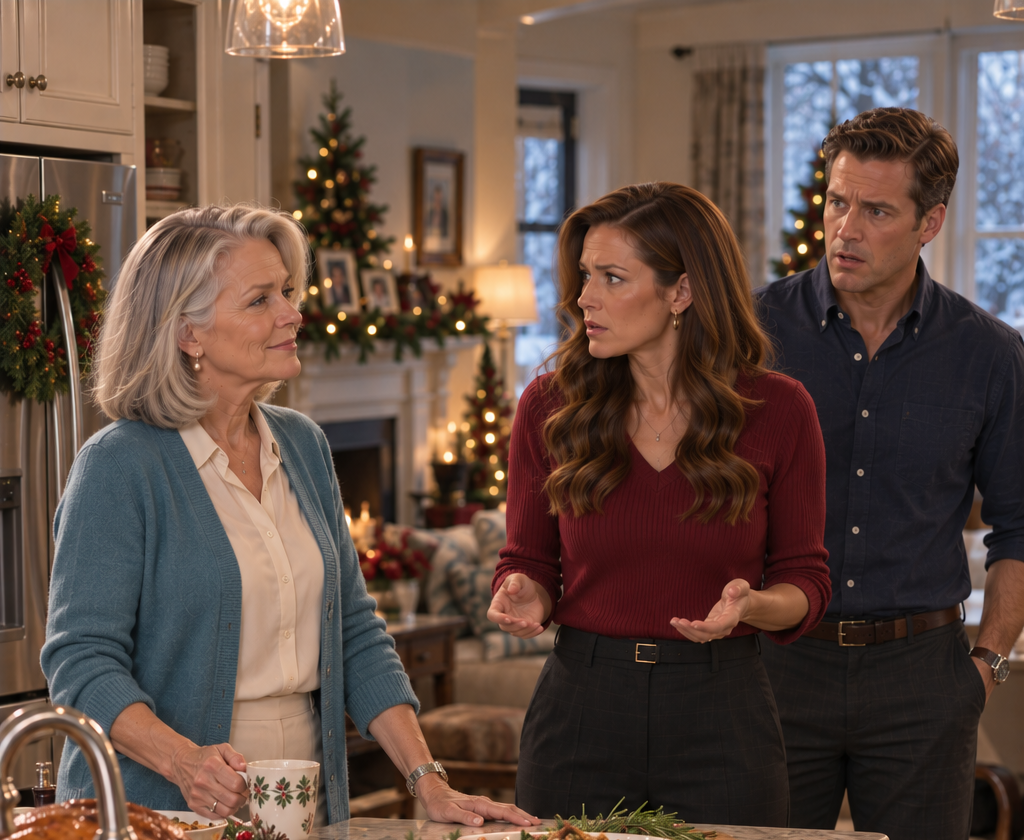
“Emily invited her entire family here for Christmas dinner,” I said calmly, keeping my eyes on him.
“Twenty-five people.”
“Here.”
“In my house.”
“Without asking me first.”
Daniel’s eyes widened.
“Twenty-five?” he repeated.
Then he turned toward his wife.
“Honey… did you really—”
“She’s making it sound much worse than it is,” Emily interrupted quickly.
But the nervous movement at the corner of her mouth revealed what her words tried to hide.
“It’s just my parents, my brothers and sisters, their children…”
She paused.
Then forced another smile.
“They’re family. Isn’t Christmas supposed to be about family?”
I looked at her.
“Yes.”
My voice remained gentle.
“But Christmas is not about treating someone else’s home like it belongs to you.”
The room went quiet again.
I turned toward Daniel.
“You see, I’ve already made other plans.”
His expression changed.
“What kind of plans?”
I folded my hands in front of me.
“A few weeks ago, I booked myself a Christmas cruise.”
Emily blinked.
Daniel stared.
“A cruise?”
I nodded.
“The Caribbean.”
“I leave on December twenty-second.”
For the first time since she walked into my kitchen, Emily had no immediate answer.
“What?”
Her voice rose slightly.
“You planned a vacation… and you never told us?”
I looked at her.
And for the first time in years, I stopped trying to make everyone else comfortable.
When I spoke again, my voice trembled.
Not because I was afraid.
Because years of disappointment were finally finding their way out.
“For five years, Emily, I have hosted every holiday.”
“I cooked.”
“I cleaned.”
“I bought the groceries.”
“I decorated the house.”
“I made sure everyone had a place to sit, something warm to eat, and a reason to smile.”
I paused.
“And every year, I told myself that was what family did.”
Emily looked away.
I continued.
“I smiled while you sat at my table with a glass of wine telling everyone how exhausted you were.”
“I washed dishes after everyone left.”
“I cleaned the kitchen while the rest of you relaxed.”
“And I never complained.”
“Not once.”
The room became completely still.
“But this year…”
I took a breath.
“The moment you announced that twenty-five people would be taking over my home—as though I were simply your personal cook and housekeeper—I realized something.”
I looked around the kitchen.
The room where I had spent countless Christmas mornings.
The room where I had prepared meals for people who rarely asked what I needed.
“I deserve a Christmas too.”
“One where I’m not standing over a hot stove all day.”
“One where I’m not washing dishes until midnight.”
“One where I don’t fall into bed exhausted while everyone else talks about what a wonderful holiday they had.”
Daniel opened his mouth.
I gently raised one hand.
Not to silence him.
Not to punish him.
But because, for the first time in years, it was finally my turn to be heard.
And the truth was…
I wasn’t leaving because I hated my family.
I was leaving because I had finally remembered that I mattered too.
I wasn’t leaving because I hated my family.
I was leaving because I had finally remembered that I mattered too.
Emily stared at me as though I had begun speaking another language.
Daniel looked from her to me.
Then back again.
“You’re really going?”
“Yes.”
“For Christmas?”
“Yes.”
“But everyone is coming here.”
I looked at him.
“I know.”
Emily recovered first.
She always did.
“Well, obviously we can still use the house.”
It was not a question.
That mattered.
I folded my arms.
“Obviously?”
Her expression tightened.
“I mean, everyone has already made plans.”
“I’m sure they have.”
“Some people are driving four hours.”
“Then I hope traffic is light.”
Daniel sighed.
“Mom.”
“What?”
“We can’t cancel Christmas now.”
“I didn’t ask you to.”
Emily blinked.
“Then what exactly are you saying?”
I smiled.
“I’m saying you are welcome to host the Christmas dinner you invited everyone to.”
Her shoulders relaxed.
For exactly two seconds.
Then I continued.
“You’ll buy the groceries.”
Her smile vanished.
“You’ll prepare the food.”
“You’ll make up the guest rooms.”
“You’ll arrange extra seating.”
“You’ll handle the dishes.”
“You’ll clean the floors.”
“You’ll wash the towels.”
“You’ll take down whatever decorations your relatives disturb.”
“And before I leave, we’ll write down which rooms are available and which ones are not.”
Emily stared at me.
“You’re serious.”
“Very.”
“But you always cook.”
“Yes.”
“You know all the recipes.”
“Yes.”
“Your kitchen is set up for this.”
“My kitchen will still be here.”
Her voice sharpened.
“You’re being petty.”
“No.”
“I’m going on vacation.”
The difference was almost beautiful.
For years, every refusal I imagined sounded hostile inside my head.
Then I finally said one aloud—
and discovered that no could be an ordinary word.
Daniel rubbed his forehead.
“Can we all calm down?”
“I am calm.”
He looked at Emily.
She was not.
“What are we supposed to feed twenty-five people?”
I glanced at the refrigerator.
“Food, probably.”
Daniel coughed.
It took me a second to realize he was hiding a laugh.
Emily saw it too.
“That’s funny to you?”
“No.”
He immediately straightened.
“It’s just—”
She glared.
He stopped.
I almost felt sorry for him.
Almost.
Then Emily asked:
“What about the turkey?”
“I haven’t ordered one.”
“What?”
“I wasn’t going to be here.”
“You always order it in November.”
“Not this year.”
“The pies?”
“No.”
“Your stuffing?”
“No.”
“Christmas breakfast?”
“No.”
Every answer made the reality larger.
Emily had not invited twenty-five people to a Christmas dinner.
She had invited twenty-five people to my labor.
She simply had not understood those were different things.
Finally she said:
“We’ll cater.”
“Excellent.”
Daniel looked at her.
“For twenty-five?”
“Probably closer to thirty if your mother’s side comes too.”
He stared.
“My side?”
She froze.
I raised an eyebrow.
Apparently the guest list had grown.
Daniel turned slowly.
“How many people did you invite?”
Emily shifted her weight.
“Twenty-five from my family.”
“And your side?”
She looked at me.
I smiled.
“Don’t look at me.”
Daniel closed his eyes.
“How many total?”
“Maybe thirty-two.”
His head snapped up.
“Thirty-two?”
“That includes children.”
“As though children eat air?”
She crossed her arms.
“You’re making it sound impossible.”
“No.”
Daniel pointed toward the kitchen.
“I’m making it sound expensive.”
There it was.
The first crack in the fantasy.
Christmas had always arrived beautifully in my house because I absorbed the cost before anyone saw it.
The groceries.
Wine.
Extra linens.
Paper goods.
Replacement glasses.
Decorations.
Heat.
Water.
Food people forgot they requested.
No one noticed because I never handed them an invoice.
That evening, Emily began making calls.
I heard pieces from upstairs.
“How much for thirty?”
“No, I mean a full Christmas dinner.”
“Yes, turkey.”
“Two hams?”
“Wait, that’s before dessert?”
Then silence.
Then:
“Okay, thank you.”
Ten minutes later—
another restaurant.
Then another.
By nine o’clock, she was sitting at the kitchen island with a calculator.
Daniel stood beside her.
I walked in for tea.
Neither spoke.
I filled the kettle.
Emily finally said:
“Do you know catering is almost two thousand dollars?”
“Yes.”
Her head turned.
“You knew?”
“I have hosted holidays for thirty years.”
Daniel looked at me.
“How much do you normally spend?”
“On Christmas?”
“Yes.”
“It depends.”
“Mom.”
I thought.
“Food, wine, flowers, extra household supplies, gifts for the children, breakfast the next morning…”
I shrugged.
“Usually fifteen hundred to two thousand.”
Emily stared.
“Every year?”
“Yes.”
Daniel looked genuinely sick.
I continued.
“That does not include my time.”
Neither answered.
The kettle clicked.
I poured my tea.
Then went upstairs.
The next three weeks were fascinating.
Emily became a project manager.
Spreadsheet.
Guest list.
Meal plan.
Sleeping arrangements.
A color-coded schedule taped to the refrigerator.
For the first time in five years—
I watched Christmas happen without being responsible for it.
And slowly—
Emily discovered all the invisible work she had mistaken for atmosphere.
Her sister wanted vegan options.
Her father could not eat salt.
Her brother wanted to bring his dog.
One niece had a nut allergy.
Two children needed booster seats.
Her mother asked whether the guest room had blackout curtains.
Someone wanted to arrive December twenty-third.
Someone else wanted to stay until December twenty-seventh.
Then Emily discovered we owned only twenty dining chairs.
I heard her say:
“Why don’t we have more chairs?”
I looked up from my book.
“Because I’ve never invited thirty-two people.”
She did not appreciate that answer.
A week before I left, Daniel came into the den.
“Mom?”
“Yes?”
“Can I ask you something?”
“Of course.”
He sat across from me.
“How long have you been planning this cruise?”
“Since September.”
His eyes widened.
“Why didn’t you tell us?”
“I intended to.”
“When?”
“When I knew what I wanted.”
He looked hurt.
“We’re your family.”
“Yes.”
“You could’ve mentioned Christmas.”
I closed my book.
“Daniel, when was the last time you asked what I wanted to do for Christmas?”
He opened his mouth.
Then stopped.
I waited.
He looked down.
“I don’t know.”
“Neither do I.”
That hurt him.
It was supposed to.
Not cruelly.
Accurately.
He rubbed his palms together.
“Did we really make it that bad?”
“You didn’t make anything one dramatic thing.”
“You simply grew accustomed to me handling everything.”
“And I grew accustomed to allowing it.”
He nodded.
“Emily shouldn’t have invited everyone.”
“No.”
“She thinks because we live here…”
He stopped.
I looked at him.
“Because you live here what?”
His eyes lifted.
For the past three years, Daniel and Emily had occupied the upstairs suite after selling their condominium during a difficult financial period.
At first, it was supposed to be six months.
Then Emily’s new job required travel.
Then housing prices rose.
Then interest rates changed.
Then there was always another reason.
They contributed toward utilities.
Not rent.
I had never minded.
Until I began noticing the language.
Our kitchen.
Our backyard.
Our guest room.
And finally—
Our Christmas.
Daniel said quietly:
“I think she sees this as our house too.”
I smiled sadly.
“I know.”
“She’s not trying to take it.”
“I didn’t say she was.”
“But?”
“But people don’t have to intend theft to become entitled.”
He leaned back.
“What does that mean?”
“It means when someone receives access long enough, they can begin confusing access with rights.”
He was quiet.
Then:
“Do I do that too?”
I looked at my son.
“Yes.”
That one hurt more.
“I do?”
“Yes.”
“How?”
“You’ve been discussing replacing my downstairs bathroom.”
“That’s because the tile is old.”
“It is.”
“And the roof.”
“It needs work.”
“And whether we should open the wall between the kitchen and dining room.”
“That would look amazing.”
I smiled.
“There.”
He stopped.
“What?”
“You said we.”
His face changed.
“Oh.”
“Exactly.”
He looked around the den.
“Mom, I don’t want your house.”
“I know.”
That was true.
Daniel was not waiting for me to die.
He was not scheming.
He simply had not noticed how often my ownership disappeared from ordinary conversation.
Sometimes entitlement is not evil.
Sometimes it is lazy grammar.
But lazy grammar can become expensive.
Two days before my cruise, I met with my attorney.
Daniel and Emily knew nothing about that appointment.
His name was Arthur Green.
He had handled my estate since my husband died.
I told him everything.
Not because I wanted anyone evicted.
Not yet.
I wanted clarity.
“What do you want?” he asked.
That question almost made me laugh.
It seemed everybody was suddenly asking.
“I want the house to remain mine.”
“It is.”
“I mean socially too.”
He understood.
We reviewed the deed.
My name alone.
Mortgage paid off nine years earlier.
Current estimated value:
$742,000.
Then Arthur showed me something I had asked him to prepare in October.
A revised estate plan.
Until then, Daniel had been scheduled to inherit the house directly.
I changed it.
Not because of Emily’s Christmas invitation.
That came later.
I changed it because months earlier, I overheard her talking to her mother.
She said:
“Once the house comes to us, I’m opening the kitchen wall.”
Her mother replied:
“You’ll probably need to redo the whole first floor.”
Emily laughed.
“Absolutely.”
No malice.
That almost made it worse.
My death had become a renovation timeline.
The revised plan placed the house into trust.
I retained complete control during my lifetime.
After my death, Daniel would have the option to purchase it at independently appraised market value.
If he declined—
the house would be sold.
Part of the proceeds would go to Daniel.
Part to my grandchildren.
Part to a local food-security nonprofit my husband had supported for years.
No automatic house.
No assumed renovation.
No certainty.
That was the biggest Christmas surprise.
I did not intend to reveal it before leaving.
Then Emily gave me a reason.
December twenty-second arrived.
My suitcase stood by the front door at six in the morning.
Emily came downstairs wearing a robe.
“You’re actually going.”
I smiled.
“I admire your optimism.”
She ignored that.
“What time do you get back?”
“December twenty-ninth.”
Her eyes widened.
“What?”
“I told you.”
“I thought you said the twenty-seventh.”
“No.”
“What are we supposed to do with everyone?”
“Enjoy them.”
“Some people are staying until the twenty-eighth.”
“Then you’ll have company.”
She stared at me.
I put on my coat.
Then handed Daniel an envelope.
His face changed.
“What’s this?”
“House instructions.”
Emily rolled her eyes.
“Seriously?”
“Yes.”
“No guests in my bedroom.”
“No one uses my office.”
“No smoking.”
“No pets upstairs.”
“No furniture moved between rooms.”
“No borrowing my car.”
“And if anything is damaged, you replace it.”
Emily laughed.
“You wrote rules?”
“For my house.”
She muttered something.
I ignored it.
Then I handed Daniel a second envelope.
“This one you open after Christmas.”
He frowned.
“Why?”
“Because I would like one holiday where I am not managing everyone else’s reaction.”
He stared at it.
Emily looked suddenly interested.
“What is it?”
I smiled.
“My Christmas gift to myself.”
Then I left.
The cruise was wonderful.
That is not something women in stories like mine are usually allowed to say.
We are supposed to spend the entire vacation thinking about our children.
Feeling guilty.
Checking the phone.
Wondering whether everyone ate.
I did not.
The first night, I sat alone on the deck with a glass of white wine and watched Florida disappear behind us.
A woman beside me asked:
“Traveling with family?”
“No.”
“Lucky.”
I laughed.
Her name was Susan.
She was sixty-eight.
Widowed.
From Atlanta.
By the second day, we were having breakfast together.
By the third—
four other women had joined us.
One divorced.
One widowed.
One married to a husband who hated cruises and happily stayed home.
We ate food none of us cooked.
Used towels none of us washed.
Walked away from plates without stacking them.
It felt scandalous.
On Christmas morning, my phone showed seventeen missed calls.
I ignored sixteen.
Then I listened to Daniel’s voicemail.
“Mom.”
Noise roared in the background.
Children.
People talking.
Something crashing.
He sounded exhausted.
“I just wanted to say Merry Christmas.”
A pause.
“And…”
He laughed weakly.
“I understand now.”
That was all.
I smiled.
Then went swimming.
I learned the details later.
The turkey finished ninety minutes late.
One ham dried out.
A child spilled fruit punch on the rug.
Emily’s brother brought the dog despite being told no.
The dog vomited beneath the piano.
Her mother criticized the potatoes.
One cousin complained about sleeping on an air mattress.
Someone broke a wineglass.
Someone else used my bedroom bathroom because the upstairs one was occupied.
Daniel stopped them before they entered the bedroom itself.
That mattered.
At eleven thirty Christmas night, after the last local guest left—
Emily cried in the kitchen.
Not because dinner was terrible.
Apparently it was fine.
She cried because she had spent fourteen hours standing.
Cooking.
Serving.
Finding towels.
Emptying trash.
Loading dishes.
Answering questions.
Cleaning spills.
Helping children.
Replacing toilet paper.
Checking food temperatures.
Looking for serving spoons.
And while she did it—
other people sat in the living room telling her what a lovely Christmas she had hosted.
Daniel told me this later.
He said she looked at him and whispered:
“Is this what your mother does every year?”
He answered:
“Yes.”
Emily cried harder.
Sometimes empathy needs comfortable shoes and a sink full of dishes.
I returned December twenty-ninth.
The house was clean.
Not my version of clean.
But clean.
A faint stain remained on the rug.
A lamp had been moved.
The refrigerator was overflowing.
Emily looked exhausted.
Daniel picked me up from the airport.
He hugged me longer than usual.
“How was the cruise?”
“Wonderful.”
“Really?”
“Very.”
He smiled.
“Good.”
Then:
“Mom?”
“Yes?”
“I’m sorry.”
I knew what he meant.
But I made him say it.
“For what?”
He stared at the road.
“For thinking Christmas just happened.”
That was a better apology than I expected.
When we reached the house, Emily stood in the kitchen.
For a second—
neither of us spoke.
Then she said:
“I owe you an apology too.”
I removed my coat.
“Okay.”
She looked around.
“I didn’t realize.”
“No.”
“I thought you liked doing all of it.”
“I did.”
That surprised her.
“I love cooking.”
“I love hosting.”
“I love decorating.”
I paused.
“I stopped loving being expected to do it.”
Her eyes filled.
“I’m sorry.”
“Thank you.”
Then Daniel remembered the second envelope.
He had obeyed.
He had not opened it.
He brought it from his desk.
Emily sat beside him.
I made tea.
Then I joined them.
“Open it.”
Daniel tore the seal.
First page.
The trust certificate.
He read slowly.
His expression changed.
Emily leaned closer.
“What is it?”
He looked at me.
“You changed the house.”
“Yes.”
“What does that mean?”
“It means you no longer inherit it automatically.”
Emily went still.
Daniel read the next page.
Then the next.
Finally:
“When did you do this?”
“October.”
“Before Christmas?”
“Yes.”
Emily’s face tightened.
“Because of me?”
“Partly.”
She looked hurt.
I did not soften it.
“I heard you talking about remodeling after the house came to you.”
Her cheeks reddened.
“You heard that?”
“Yes.”
“It was hypothetical.”
“To you.”
I folded my hands.
“To me, it was listening to someone plan the walls of my home around my absence.”
Nobody spoke.
Daniel looked down.
“I talked about it too.”
“Yes.”
He nodded.
“I’m sorry.”
Emily stared at the paperwork.
“So what happens after…”
She stopped.
Good.
Even the sentence felt different now.
“After I die?”
She looked embarrassed.
“Yes.”
“Daniel has the first option to purchase the house at fair market value.”
Daniel blinked.
“Purchase?”
“Yes.”
“Not inherit.”
“Correct.”
He leaned back.
That was a significant difference.
A seven-hundred-thousand-dollar difference.
Emily asked:
“And if we can’t?”
“Then it is sold.”
“What happens to the money?”
I told them.
Daniel.
The grandchildren.
The nonprofit.
Emily looked stunned.
“You’re giving some of it away?”
“Yes.”
“How much?”
Daniel turned toward her.
“Emily.”
She stopped.
That was new.
He looked at me.
“You don’t have to tell us.”
I smiled.
“No.”
“I don’t.”
That was another gift.
The next six months changed our household.
Not dramatically.
Practically.
Daniel and Emily began paying rent.
They offered.
I accepted.
Not market rate.
Enough to restore the relationship between adult occupants and homeowner.
We wrote it down.
A real agreement.
Rent.
Utilities.
Guest rules.
Privacy.
Notice before parties.
No renovations without written permission.
Emily laughed when Arthur reviewed it.
“You made us sign a lease?”
I smiled.
“Apparently family benefits from clarity.”
She signed.
So did Daniel.
Then something surprising happened.
They moved out nine months later.
Not angrily.
Intentionally.
They found a townhouse fifteen minutes away.
Daniel said:
“We need something that’s ours.”
I almost cried.
Exactly.
Something theirs.
Not mine transformed by repetition.
On moving day, Emily handed me her key.
“I think I finally understand why this matters.”
I looked at it.
“Why?”
“Because when you don’t own something, gratitude should last longer than the first month.”
That was pretty good.
I hugged her.
My house became quiet.
I missed them.
That surprised nobody more than me.
I missed Daniel making coffee too strong.
Emily leaving shoes near the back door.
The grandchildren raiding the pantry.
But missing people does not mean a boundary was wrong.
Sometimes distance allows affection to return without resentment sitting beside it.
Christmas changed after that.
We rotated.
One year Daniel hosted.
One year Emily’s sister.
One year my niece.
One year we rented a cabin and everybody paid equally.
I hosted again at seventy-five.
By choice.
Sixteen people.
Not twenty-five.
Emily arrived at nine in the morning wearing jeans and an apron.
“What can I do?”
I smiled.
“Potatoes.”
She groaned.
“I was hoping for wine.”
“Potatoes first.”
Daniel handled the turkey.
The grandchildren set the table.
After dinner, I sat beside the fireplace.
Nobody allowed me into the kitchen.
I could hear dishes.
Arguments about where things belonged.
Laughter.
Emily shouted:
“Why do you own eleven different serving spoons?”
I shouted back:
“Because people keep inviting twenty-five relatives!”
Everyone laughed.
That Christmas felt like family again.
Not because I worked harder.
Because I was no longer working alone.
At seventy-eight, I took another Christmas cruise.
Nobody panicked.
Daniel texted:
Have fun. We’ve got Christmas.
Three words mattered most.
We’ve got Christmas.
Not:
When will you be back?
Not:
Where’s the turkey recipe?
Not:
Can we use your house?
They had it.
Without me.
And because they could manage without me—
being included started feeling like love again instead of dependency.
At eighty-one, I sold the house.
My decision.
The property had appreciated significantly.
The stairs bothered me.
The yard had become work.
And I wanted something smaller.
Daniel never asked whether he could have it.
Not once.
When I told him I had accepted an offer, he hugged me.
“You okay?”
“Yes.”
“Sad?”
“A little.”
“Excited?”
“Very.”
“What do you want to do next?”
That sentence.
Again.
What do you want?
I bought a two-bedroom condominium.
Elevator.
Balcony.
A kitchen exactly large enough to cook dinner for eight.
That feature was intentional.
The trust changed because the house no longer existed.
I revised my estate plan.
Daniel still received a share.
The grandchildren received theirs.
The nonprofit remained.
Emily knew none of the amounts.
She never asked again.
At eighty-four, she gave me one of my favorite Christmas gifts.
A small framed photograph.
Christmas from years earlier.
The year after the cruise.
I was sitting beside the fireplace.
No apron.
Glass of wine in my hand.
Behind me—
Daniel and Emily were washing dishes.
On the back she had written:
Proof that Mom sat down.
I laughed until I cried.
At eighty-seven, Daniel asked whether I regretted leaving that first Christmas.
“No.”
“Not even a little?”
“No.”
He smiled.
“Emily still talks about the dog throwing up.”
“Good.”
“Trauma builds character.”
I laughed.
Then he became serious.
“I think that Christmas saved our marriage.”
That surprised me.
“How?”
“We were fighting all the time before.”
“I didn’t know.”
“We blamed money.”
“Work.”
“The kids.”
“You.”
I raised an eyebrow.
“Me?”
“Not fairly.”
He looked embarrassed.
“We had built our whole adult life around someone else absorbing part of the load.”
“When you stopped, we had to learn how to function together.”
I thought about that.
“And?”
“We almost didn’t.”
“But we did.”
He smiled.
“Yes.”
Emily and Daniel celebrated their thirty-fifth anniversary when I was ninety-two.
She toasted me at dinner.
That made me suspicious immediately.
“Don’t make this sentimental.”
She laughed.
“Too late.”
Then she raised her glass.
“To the woman who taught me that hosting is not the same as serving.”
I smiled.
“And that inviting twenty-five people to somebody else’s house is apparently frowned upon.”
Everyone laughed.
She continued.
“I thought Christmas magic was decorations, food, gifts, and a beautiful table.”
She looked at me.
“It turns out Christmas magic is usually one exhausted woman doing forty invisible jobs.”
Several women at the table raised their glasses.
The men looked uncomfortable.
Good.
Emily smiled.
“So now we rotate.”
“Because magic needs a schedule.”
I laughed harder than anyone.
Years later, one of my granddaughters asked me why the cruise had mattered so much.
“You could have just told them no.”
“Yes.”
“Why didn’t you?”
I thought for a moment.
“Because sometimes you can say you are tired a hundred times and people hear a complaint.”
“But when you stop doing the work—”
“They see the work.”
She nodded.
“Did you want Christmas to fail?”
“No.”
And I meant it.
“I wanted them to succeed.”
“Without using me as the infrastructure.”
She laughed.
“That sounds like something from Grandpa’s engineering books.”
“He would approve.”
The truth was—
Christmas did not fail.
The turkey was late.
The rug was stained.
The kitchen was chaos.
Emily cried.
Daniel discovered catering prices.
But everybody ate.
Nobody died.
The house survived.
So did the family.
That was important.
For years, I had convinced myself that if I stopped carrying everything—
everything would collapse.
It didn’t.
Other people simply had to lift.
That realization was almost embarrassing.
I had not been indispensable.
I had been overextended.
Those are not the same thing.
And there is freedom in knowing the difference.
When I was ninety-four, I spent Christmas on another cruise.
This time, I was not alone.
Emily came with me.
Daniel hated cruises.
He stayed home.
On Christmas morning, Emily and I sat on a deck beneath a Caribbean sun.
A waiter placed breakfast in front of us.
Neither of us cooked it.
Neither of us knew where the dishes would go afterward.
Emily took one sip of coffee.
Then looked at me.
“You know…”
“What?”
“I finally understand why you left.”
I smiled.
“Took you long enough.”
She laughed.
Then her expression softened.
“I’m glad you did.”
“So am I.”
“What do you think would’ve happened if you stayed?”
I looked toward the water.
“I probably would have cooked for thirty-two people.”
“And cleaned until midnight.”
“Yes.”
“And been angry.”
“Very.”
“But you wouldn’t have said anything.”
Probably not.
That was the old version of me.
The woman who believed love was measured by how much inconvenience she could absorb without showing it.
I spent decades being proud of that woman.
Now I felt compassion for her.
She meant well.
She simply did not understand that generosity without boundaries eventually stops feeling generous to everyone involved.
To the giver—
it becomes exhaustion.
To the receiver—
it becomes normal.
And once generosity becomes normal—
gratitude quietly disappears.
That Thanksgiving afternoon long ago, Emily smiled and announced twenty-five relatives were coming to my house.
She believed she was planning Christmas.
What she was actually planning was my labor.
My money.
My time.
My kitchen.
My home.
Then I said:
“Wonderful.”
“I’ll be on vacation.”
Those may have been the most important words I spoke in my seventies.
Not because I abandoned Christmas.
Because I finally stopped abandoning myself for it.
The cruise ended.
The family remained.
The house eventually sold.
The inheritance changed.
Daniel grew up in ways adulthood had somehow postponed.
Emily learned to ask before inviting.
And I discovered something wonderfully ordinary.
Christmas did not need me standing at the stove for fourteen hours to exist.
It only needed people willing to make room for one another.
Including the woman who had spent years making room for everybody else.